
How African Gods Inspired the World of Black Panther
When Black Panther burst onto cinema screens in 2018, it changed the way audiences viewed superhero films. Ryan Coogler’s masterpiece wasn’t simply another Marvel blockbuster filled with dazzling action sequences and cutting-edge visual effects. It became a cultural phenomenon that celebrated African identity, history, languages, fashion, architecture, and spirituality in ways rarely seen in mainstream Hollywood. Wakanda felt alive not because of its futuristic technology, but because its traditions carried the weight of centuries of history and belief.
One of the film’s greatest achievements was its portrayal of mythology. Rather than inventing an entirely fictional religion, Marvel drew inspiration from diverse African cultures, weaving together deities, ancestral beliefs, and traditional symbolism into a spiritual framework that felt both authentic and original. While Wakanda itself is fictional, many of the ideas that define its society have deep roots in real African mythologies that have been passed down for generations.
From the Panther Goddess Bast to the legendary storyteller Anansi, several African deities echo throughout the world of Black Panther. Some appear directly in Marvel’s comics, while others subtly influence Wakandan philosophy, leadership, and cultural identity. Understanding these mythological inspirations not only enriches the films but also reveals the remarkable diversity of African mythology that has too often been overlooked in global popular culture.
Bast: The Divine Protector Behind the Black Panther
Among all the mythological figures connected to Black Panther, none is more important than Bast. Within Marvel lore, Bast is the Panther Goddess who chooses Wakanda’s protector, watches over the kingdom, and grants the powers of the Black Panther through the sacred Heart-Shaped Herb. Every Wakandan king or queen who assumes the mantle of Black Panther enters the Ancestral Plane under her divine guidance, reinforcing the idea that rulership is not simply inherited—it is spiritually earned.
Marvel’s Bast is directly inspired by the Egyptian goddess Bastet, one of the most beloved deities of ancient Egypt. Originally worshipped as a fierce lioness before gradually evolving into a cat-headed goddess, Bastet embodied protection, motherhood, fertility, music, joy, and the defense of the home. While she possessed a gentle, nurturing side, ancient Egyptians also believed she could unleash terrifying fury against those who threatened her followers. This duality made her one of Egypt’s most complex and respected deities.
Marvel adapts these characteristics beautifully. Wakanda is not an aggressive empire seeking conquest; instead, it is a nation devoted to protecting its people, preserving its traditions, and safeguarding vibranium from those who would exploit it. Bast becomes the perfect divine guardian for such a civilization. Rather than merely serving as a source of supernatural powers, she symbolizes the moral responsibility that accompanies leadership. Every Black Panther is expected to protect rather than dominate—a principle that mirrors Bastet’s ancient role as both guardian and defender.
The Power of Ancestors in Wakandan Belief
Although Bast occupies the highest place within Wakandan spirituality, one of the most authentic elements of Black Panther is its emphasis on ancestor worship. Across much of Africa, the relationship between the living and the dead has traditionally been viewed not as a permanent separation but as an ongoing conversation. Ancestors continue to guide, protect, and influence their descendants long after death, serving as guardians of both families and entire communities.
This belief is beautifully represented through the Ancestral Plane, one of the most memorable locations in the Marvel Cinematic Universe. Whenever T’Challa consumes the Heart-Shaped Herb, he journeys to a serene landscape where he meets previous kings of Wakanda beneath a majestic tree. These encounters are not merely visions or dreams. They represent the idea that wisdom is inherited through generations and that leadership requires listening to those who came before.
Many African cultures share similar concepts, though the practices vary widely between regions. Ancestors are often consulted before major decisions, honored through rituals, and regarded as active participants in community life. By making ancestral guidance central to Wakandan society, Marvel rooted its fictional kingdom in one of Africa’s oldest and most enduring spiritual traditions. The result is a mythology that feels emotionally authentic, even when surrounded by futuristic technology and superhero spectacle.
Anansi: The Storyteller Behind Wakanda’s Wisdom
Not every influence on Black Panther comes from kings and warriors. One of Africa’s most celebrated mythological figures is Anansi, the clever spider who appears throughout the folklore of the Akan people of Ghana and whose stories later spread across the Caribbean through the African diaspora. Unlike traditional warrior gods, Anansi triumphs through intelligence, wit, and creativity, often outsmarting far stronger opponents.
According to legend, Anansi once completed a series of impossible challenges set by the sky god Nyame to earn ownership of all the world’s stories. Since then, he has become synonymous with storytelling, wisdom, and the preservation of knowledge. His tales are more than entertainment; they teach moral lessons, celebrate cleverness, and preserve cultural identity across generations.
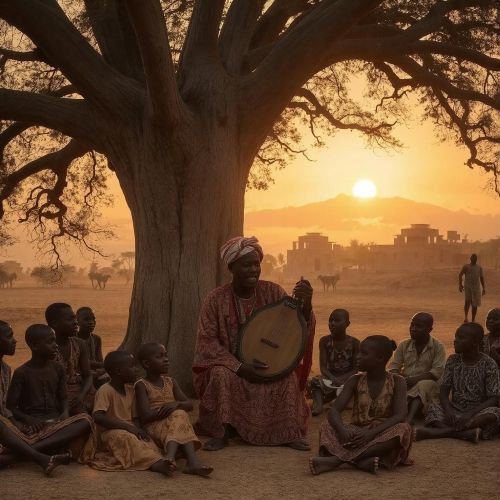
Although Anansi never appears in the Black Panther films, his influence can be felt in Wakanda’s deep respect for oral tradition and collective memory. Throughout the films, stories shape identity just as much as history. The legends of Bashenga, the first Black Panther, inspire future rulers, while the memories of ancestors influence present-day decisions. Wakanda understands that civilizations are sustained not merely by technology but by the stories they choose to preserve. This idea reflects Anansi’s enduring legacy as Africa’s greatest storyteller.
Ogun and the Marriage of Tradition and Technology
Perhaps no African deity better represents Wakanda’s technological achievements than Ogun, the Yoruba god of iron, metalworking, craftsmanship, and invention. Revered across Nigeria and neighboring regions, Ogun is considered the patron of blacksmiths, engineers, warriors, and anyone who transforms raw materials into tools that advance civilization. Iron, under Ogun’s guidance, became the foundation of agriculture, warfare, and industry.
The parallels between Ogun and Wakanda are immediately apparent. Vibranium may be fictional, but it occupies the same cultural importance within Wakanda that iron once held in many African societies. Rather than exploiting their natural resources recklessly, Wakandans treat vibranium with reverence, using it to improve medicine, transportation, communication, and defense while maintaining harmony with their environment.
Shuri embodies this philosophy perfectly. Although she creates some of the Marvel Universe’s most advanced technologies, she never abandons her nation’s traditions. Her laboratory exists alongside ancient rituals, royal ceremonies, and spiritual customs. This harmonious relationship between innovation and heritage reflects Ogun’s enduring message that technological progress should strengthen culture rather than replace it. In Wakanda, science and spirituality are partners rather than rivals.
Oya and the Cost of Transformation
One of the central themes running through Black Panther is transformation. T’Challa evolves from a cautious prince into a visionary king. Wakanda itself moves from centuries of isolation toward greater engagement with the outside world. Even its traditions are questioned, challenged, and ultimately redefined. These themes closely resemble the domain of Oya, the Yoruba goddess of storms, wind, change, and transformation.
Oya governs moments when old systems must give way to new beginnings. Storms, though destructive, clear away what no longer serves a purpose, creating opportunities for renewal. She represents the difficult truth that meaningful progress often requires upheaval, sacrifice, and uncomfortable self-reflection.
Killmonger’s challenge forces Wakanda into exactly such a moment. His methods are undeniably violent, yet his criticism exposes the kingdom’s long-standing refusal to aid oppressed people of African descent across the world. T’Challa ultimately rejects Killmonger’s extremism while accepting that Wakanda cannot remain isolated forever. This willingness to embrace change without abandoning core values mirrors Oya’s role as a goddess who transforms societies through necessary disruption rather than senseless destruction.
The Warrior Spirit of Sekhmet
While Bast symbolizes protection, another Egyptian goddess echoes throughout Wakanda’s military traditions. Sekhmet, the lion-headed goddess of war, justice, and healing, was one of ancient Egypt’s most formidable deities. She represented overwhelming strength, righteous vengeance, and the power to defend cosmic order against chaos. Yet despite her fearsome reputation, Sekhmet was also associated with healing, illustrating that true strength lies in knowing when to fight and when to restore peace.
This philosophy resonates strongly with the Dora Milaje, Wakanda’s elite royal guard. They are among the most skilled warriors in the Marvel Universe, yet their loyalty is directed not toward conquest but toward protecting the kingdom and its people. Their discipline, restraint, and unwavering sense of duty reflect the ideals embodied by Sekhmet far more than simple martial prowess.
Wakanda itself follows a similar path. For centuries it possessed technology capable of dominating the world, yet it chose secrecy over imperialism. Violence is never portrayed as a means of expansion but as a last resort to preserve peace and justice. This moral approach to warfare aligns remarkably well with Sekhmet’s dual identity as both destroyer and protector.
Why Black Panther Resonates Beyond the MCU
The enduring appeal of Black Panther lies in its ability to blend fantasy with cultural authenticity. Marvel did not attempt to recreate any single African religion or civilization. Instead, it respectfully drew inspiration from numerous traditions, including Egyptian, Yoruba, Akan, and other belief systems, creating a fictional world that celebrates the richness and diversity of African mythology rather than reducing it to a single narrative.
For many viewers, the film served as an introduction to African mythologies they had never encountered before. Interest in Bastet, Anansi, Ogun, and other deities surged following the film’s release, inspiring readers to explore the real legends that influenced Wakanda. In this sense, Black Panther accomplished something few superhero films achieve—it became a gateway to genuine historical and mythological discovery.
Its legacy extends far beyond comic books and cinema. By placing African mythology at the heart of one of Marvel’s most celebrated franchises, Black Panther demonstrated that ancient legends remain as relevant today as ever. Whether through divine protectors, ancestral wisdom, or stories passed from one generation to the next, the myths that inspired Wakanda continue to remind us that every great civilization is built not only on power, but also on the stories it chooses to remember.

No posts were found.