


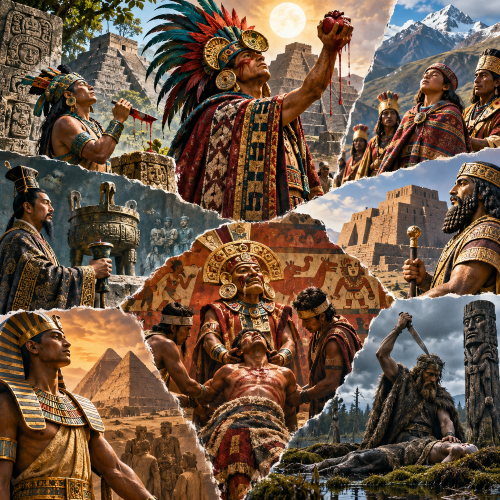
8 Ancient Cultures That Practised Ritual Human Sacrifice
Human sacrifice is among the most disturbing aspects of ancient religious history. Across different continents and civilisations, societies believed that offering a human life could communicate with supernatural powers, secure divine protection, restore cosmic balance or influence events beyond human control. While the practice may seem incomprehensible today, it occupied an important place in the religious and political imagination of several ancient cultures.
For these societies, human sacrifice was not always understood as an act of senseless violence. It could represent an exchange between humans and gods, a demonstration of devotion, an offering during a crisis or even a way of accompanying powerful rulers into the afterlife. Archaeological discoveries, ancient inscriptions and historical accounts reveal that the practice took different forms depending on the civilisation and its beliefs.
However, it is important to recognise that not every society practised human sacrifice regularly, and the available evidence varies considerably. Some traditions are supported by extensive archaeological findings, while others remain debated among historians.
Here are eight ancient cultures associated with human sacrifice and the beliefs that influenced these practices.
1. Aztec Civilisation: Human Sacrifice to Sustain the Universe
The Aztec civilisation of central Mexico is perhaps the most widely recognised culture associated with human sacrifice. For the Aztecs, the universe was maintained through a continuous relationship between humans and supernatural forces. Their gods had made sacrifices to bring the world into existence, and humanity was expected to repay this divine debt through offerings, including blood.
One of the most important deities associated with these rituals was Huitzilopochtli, the god of the sun and warfare. According to Aztec religious beliefs, the sun required nourishment to continue its journey across the sky. Human blood and hearts were considered powerful offerings that could help maintain cosmic order.
Sacrificial ceremonies took place at major religious centres, particularly the Templo Mayor in Tenochtitlan, the Aztec capital. Captives taken during warfare frequently became sacrificial victims, although other individuals could also be selected for particular ceremonies. Different festivals were dedicated to different deities, and the rituals varied accordingly. Some involved the symbolic representation of gods through selected individuals who were treated as divine impersonators before their deaths.
Human sacrifice also served political purposes. Public ceremonies reinforced the authority of rulers, demonstrated military dominance and brought communities together through shared religious observances. Although Spanish accounts often described enormous numbers of victims, historians continue to examine these figures critically, distinguishing archaeological evidence from colonial exaggeration.
2. Maya Civilisation: Blood Offerings and Communication with the Gods
The ancient Maya civilisation of Mesoamerica had a complex religious system in which blood represented a powerful connection between humans, ancestors and supernatural beings. Unlike the Aztecs, whose large-scale sacrificial ceremonies became particularly prominent during the later centuries of their civilisation, Maya religious practices included several forms of blood offering. These ranged from personal bloodletting by rulers to the ritual killing of captives and selected individuals.
Maya rulers sometimes pierced their tongues or other parts of their bodies to produce blood, which was offered during ceremonies intended to communicate with ancestors and divine forces. These rituals were closely associated with royal authority and the legitimacy of political leadership. Human sacrifice also occurred, particularly during important religious and political events. Archaeological discoveries reveal evidence of decapitation, ritual killing and the sacrifice of children at certain Maya sites.
At Chichén Itzá, the Sacred Cenote became associated with offerings to supernatural powers connected with water and fertility. Archaeological investigations have recovered human remains and valuable objects from its depths, although the exact circumstances surrounding individual offerings remain subjects of research. For the Maya, sacrifice was connected to a wider understanding of obligation. Humans owed something to the gods and ancestors who had made existence possible. Blood offerings were one way of fulfilling this spiritual responsibility.
3. Inca Civilisation: Capacocha and the Sacred Children
The Inca civilisation of South America developed one of the most distinctive forms of ritual human sacrifice through a ceremony known as Capacocha, also written as Qhapaq Hucha. These ceremonies were conducted during significant political, religious and environmental events. They could accompany the death of an emperor, the birth of a royal heir, military victories, natural disasters or periods of agricultural uncertainty.
Children were frequently selected for Capacocha ceremonies. They were often considered physically and spiritually suitable for becoming offerings to important deities, particularly Inti, the sun god, and mountain spirits known as apus. The selected children could travel considerable distances to reach important religious centres or high-altitude mountains. Some were eventually sacrificed and buried in carefully prepared mountain tombs.
One of the most remarkable archaeological discoveries associated with this practice is the group of naturally preserved Inca children found on Mount Llullaillaco in Argentina in 1999. Their remains, preserved by the extreme cold and dry conditions, provided extraordinary insight into Inca religious ceremonies.
The discovery demonstrated how carefully these rituals were organised. Clothing, food, ceremonial objects and other offerings accompanied the children, suggesting that their deaths were understood within a larger religious journey. Capacocha reflected the Inca belief that the natural and supernatural worlds were closely connected, with mountains, celestial bodies and ancestors playing important roles in maintaining the wellbeing of the empire.
4. Shang Dynasty China: Sacrifices for Ancestors and Royal Power
The Shang Dynasty of ancient China, which flourished approximately between 1600 and 1046 BCE, provides some of the earliest extensive archaeological evidence of organised human sacrifice. Shang religious beliefs placed enormous importance on ancestral spirits. The royal family believed that deceased ancestors could influence rainfall, agricultural productivity, military victories and the wellbeing of the living.
Kings and religious specialists communicated with these supernatural forces through divination, offerings and ceremonies. Oracle bone inscriptions, discovered primarily at the ancient capital of Yin near modern Anyang, provide valuable evidence of these practices. Archaeological excavations have uncovered numerous sacrificial pits containing human remains. Some individuals appear to have been war captives, while others may have been selected for particular religious ceremonies.
Human offerings were also associated with royal burials. Servants, attendants and other individuals were sometimes buried alongside members of the ruling elite, suggesting that their deaths were connected to the status and afterlife requirements of powerful individuals. These discoveries demonstrate that human sacrifice in Shang society was closely associated with political authority, ancestor worship and the relationship between the living and the dead. The practice was not simply about appeasing supernatural beings. It also reinforced the position of the king, who occupied the central role in communicating with the ancestral world.
5. Ancient Mesopotamia: Royal Death Pits and the Afterlife
Ancient Mesopotamia was home to several civilisations, including the Sumerians, Akkadians, Babylonians and Assyrians. Although human sacrifice was not a universal or continuous feature of Mesopotamian religious life, archaeological discoveries reveal that it occurred in particular historical contexts. One of the most significant discoveries comes from the Royal Cemetery of Ur in present-day Iraq.
Dating primarily to the Early Dynastic Period, approximately 2600–2450 BCE, the cemetery contained elaborate royal burials accompanied by numerous human remains. Some tombs included groups of attendants, musicians and other individuals who appeared to have died alongside the deceased ruler. The famous tomb of Queen Puabi contained an extraordinary collection of jewellery and ceremonial objects, alongside evidence of attendants buried within the funerary complex.
Archaeologists have debated the precise circumstances surrounding these deaths, but the findings are generally regarded as important evidence for ritual human sacrifice associated with royal funerals. The underlying belief may have involved the continuation of royal authority beyond death. Attendants were potentially expected to accompany their rulers into the afterlife, preserving aspects of the social hierarchy that existed during their earthly lives.
Mesopotamian evidence also includes references to substitute king rituals, in which a temporary ruler could be appointed to absorb an anticipated divine punishment intended for the actual monarch. These practices reveal how deeply political authority, supernatural protection and the afterlife were interconnected in ancient Mesopotamian society.
6. Moche Civilisation: Sacrifice and the Power of the Gods
The Moche civilisation flourished along the northern coast of present-day Peru between approximately 100 and 800 CE. Its religious traditions included elaborate ceremonies involving warfare, ritual violence and human sacrifice. Unlike many other ancient cultures, the Moche left behind an extensive visual record of their beliefs through pottery, murals and monumental architecture.
Their artwork frequently depicts ritual combat, captive warriors and ceremonial figures associated with sacrificial practices. These representations have helped archaeologists understand the relationship between warfare, political authority and religious ceremonies. Excavations at sites such as Huaca de la Luna have uncovered human remains displaying evidence of violent deaths. Research suggests that some individuals were sacrificed following ritualised combat or other ceremonial activities.
The Moche also appear to have associated human sacrifice with the maintenance of relationships between the human and supernatural worlds. One particularly important discovery is the evidence of large-scale sacrificial events at several northern Peruvian archaeological sites. These findings demonstrate that human sacrifice was not merely a symbolic element in Moche artwork but an actual component of certain religious practices.
The Moche example is especially significant because it illustrates how archaeology can connect artistic representations with physical evidence, allowing historians to reconstruct aspects of ancient religious behaviour.
7. Ancient Egypt: Human Sacrifice During the Early Dynastic Period
Ancient Egypt is generally remembered for its elaborate funerary traditions, monumental pyramids and elaborate beliefs about the afterlife. However, archaeological evidence suggests that human sacrifice may have occurred during its earliest dynastic period. The strongest evidence comes from the First Dynasty, when Egypt was undergoing political unification and the development of centralised royal authority.
Excavations around royal tombs at Abydos have revealed subsidiary burials containing individuals arranged around the tombs of kings. Some researchers interpret these burials as evidence that servants or attendants were sacrificed to accompany rulers into the afterlife. The presence of these individuals alongside royal tombs suggests that the practice may have been connected to the belief that the king would continue exercising authority after death.
However, the interpretation remains debated. Not every subsidiary burial necessarily represents a sacrificial victim, and the archaeological evidence does not establish that all the individuals were killed specifically for funerary purposes. Interestingly, the practice appears to have declined during the subsequent development of Egyptian royal burial traditions.
Later Egyptian funerary culture increasingly relied on figurines known as ushabti, which were intended to perform labour for the deceased in the afterlife. This development provides an interesting example of how religious beliefs and funerary practices evolved over time.
8. Iron Age Northern Europe: Human Offerings in Sacred Landscapes
Several Iron Age communities in Northern Europe have been associated with ritual human sacrifice, particularly through discoveries of preserved bodies in peat bogs. These remains, commonly known as bog bodies, have been recovered from parts of modern-day Denmark, Germany, Ireland, the Netherlands and Britain. Some of the most famous examples include Tollund Man and Grauballe Man from Denmark. Their remarkably preserved remains have allowed researchers to investigate the circumstances surrounding their deaths.
Certain bog bodies display evidence of violent deaths, including strangulation and other forms of physical trauma. In some cases, the circumstances have led researchers to consider ritual sacrifice as a possible explanation. Ancient Roman writers also described some northern European communities as practising ritual killings, although their accounts must be interpreted carefully because they were outsiders describing unfamiliar cultures.
Peat bogs may have held special religious significance for certain communities, making them possible locations for offerings to supernatural forces associated with the landscape. However, not every bog body represents a sacrificial victim. Some may have been executed as criminals or killed under other circumstances. The evidence nevertheless suggests that ritual killing and offerings of human lives formed part of the religious landscape of certain Iron Age European societies.
Why Did Ancient Cultures Practise Human Sacrifice?
Despite their geographical and cultural differences, many societies associated human sacrifice with similar underlying ideas. Maintaining cosmic order: Some cultures believed that the universe required regular offerings to continue functioning. The Aztecs, for example, connected sacrifice with the movement of the sun and the maintenance of cosmic balance.
Communicating with supernatural forces: Blood and human life were sometimes considered powerful offerings through which people could communicate with gods, ancestors and spirits. Protecting political authority: Rulers used religious ceremonies to reinforce their legitimacy, demonstrate their power and establish their position as intermediaries between humans and the supernatural world.
Preparing for the afterlife: Some ancient societies believed that attendants and servants should accompany important individuals after death, preserving their earthly status in the next world. Responding to crises: Droughts, military defeats, natural disasters and political instability could encourage communities to conduct extraordinary ceremonies intended to restore divine favour.
Conclusion
Human sacrifice reveals a disturbing but important dimension of ancient religious history. From the monumental temples of the Aztecs to the mountain shrines of the Incas and the royal burial grounds of Mesopotamia, different civilisations developed their own explanations for offering human lives to supernatural powers. These practices were shaped by religious beliefs, political structures, social hierarchies and ideas about the relationship between life, death and the afterlife. They also demonstrate how ancient societies attempted to understand forces that appeared beyond human control.
However, human sacrifice should never be treated as a defining characteristic of an entire civilisation. Its frequency, purpose and acceptance varied across different periods and communities. Archaeological discoveries continue to challenge earlier assumptions and provide a more nuanced understanding of these ancient practices. Studying human sacrifice is ultimately about understanding how people in the past interpreted their place in the universe, what they believed their gods demanded and how far religious conviction could shape human behaviour.

No posts were found.


