


Huitzilopochtli : The Aztec God of War and the Sun
At a glance
| Description | |
|---|---|
| Origin | Aztec Mythology |
| Classification | Gods |
| Family Members | Omecίhuatl (Father), Ometecuhtli (Mother), Coatlique (Mother), Quetzalcoatl, Tezcatlipoca, Xipe Totec (Brothers) |
| Region | Mexico |
| Associated With | Human Sacrifice, War, Winter Solstice |
Huitzilopochtli
Introduction
Huitzilopochtli was a god of the Aztecs and was considered the supreme god of the Méxica. He was named Ce Técpatl and was associated with gold, warriors, and rulers. The Aztecs believed that the battle between him and Coyolxauhqui was a recurring theme that explained the daily exchange of sky control and the concept of night and day.
The Méxica revered Huitzilopochtli for what they believed was his long journey from the Aztln cave. During this time, priests had carried a massive idol of the god and promised the Méxica great wealth and success if they were suitably worshipped. The migration was marked by a rebellion incited by Copil, son of his sister Malinalxochitl who was ultimately killed and his heart tossed into Lake Texcoco. The Méxica settled at various locations during the migration but finally settled at Tenochtitlan where an eagle sat on a cactus marking the auspicious spot.
Physical Traits
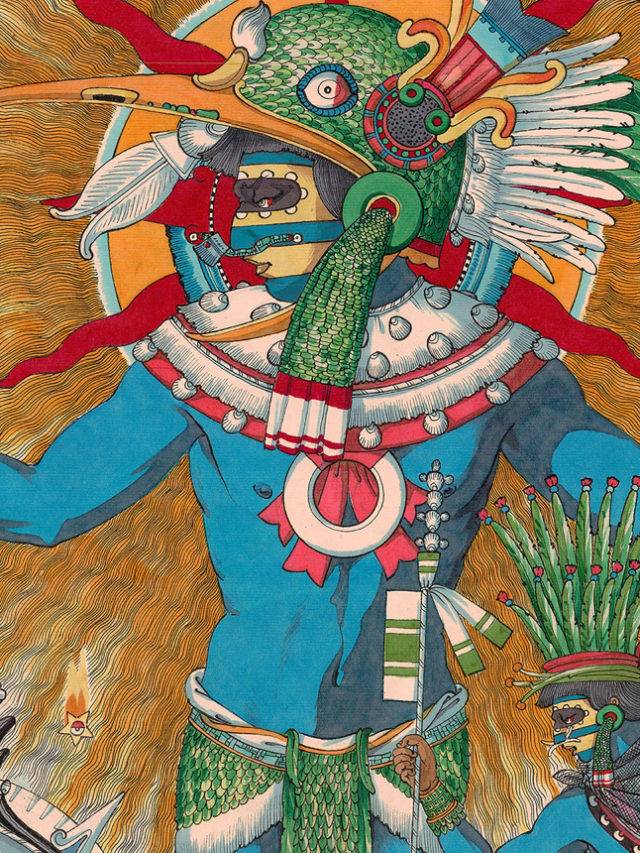
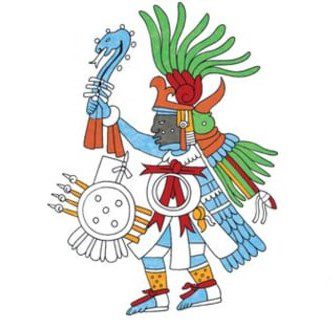
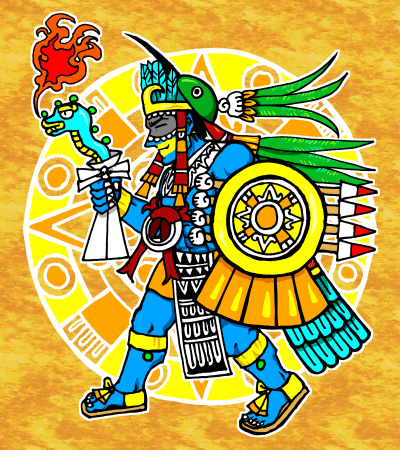
Huitzilopochtli is commonly depicted as a powerful young warrior, embodying both martial strength and divine authority. His face is often painted with brilliant blue stripes, symbolizing the clear daytime sky and his connection to the sun. He wears an elaborate hummingbird-feather headdress, a direct reference to his name and the belief that fallen warriors were reborn as hummingbirds accompanying the sun across the heavens.
His attire includes finely crafted turquoise jewelry, gold ornaments, and richly decorated warrior garments befitting the protector of the Aztec Empire. One of his most recognizable attributes is the Xiuhcoatl, the legendary “Fire Serpent,” which serves as his divine weapon. He also carries a shield adorned with eagle feathers and colorful banners, representing military victory and celestial power.
Aztec codices frequently portray Huitzilopochtli with an imposing yet dynamic posture, ready for battle rather than standing motionless. His presence radiates determination and authority, while the surrounding imagery often includes sunlight, flames, hummingbirds, and eagle symbolism that reinforce his identity as both a solar deity and an unrivaled warrior.
Family
Unlike the other Aztec deities, Huitzilopochtli had no clear equivalent to the earlier versions of Ometeotl. Also, unlike the other great Aztec gods, he was not considered the brother of one of the great Mesoamerican goddesses. He was the son of Omecίhuatl and Ometecuhtli. Additionally, the god is the offspring of Coatlίcue, the supreme earth goddess. He was also considered the brother of the other great Mesoamerican gods Quetzalcoatl, Tezcatlipoca and Xipe Totec.
It is believed that Huitzilopochtli killed his mother, Coatlcue, by beating her with her three siblings on Mt. Coatepec. He also gave birth to a child with feathers under his mother’s breast. Her children attacked her but when they decapitated Huitzilopochtli, she sprang from her corpse and lopped off her sister’s head. There have been varying theories about how she was supposed to act. Huitzilopochtli also dismembered his sister’s corpse so that its torso fell to the ground, which became the moon. He then dealt with his other siblings and separated them into the heavens.
Other Names
Although Huitzilopochtli is his best-known name, he was known by several titles that reflected different aspects of his divine role. He was often called Xiuhpilli, meaning “Turquoise Prince,” highlighting his association with fire, precious stones, and royal authority. As the patron god of Tenochtitlan, he was revered as the supreme protector of the Mexica people and the divine guardian of their empire.
In religious ceremonies, priests also referred to him through honorific titles emphasizing his role as the victorious warrior, solar protector, and defender of cosmic balance. These names reinforced his importance not only as a military deity but also as the sustaining force that ensured the rising of the sun each day.
Powers and Abilities
As the Aztec god of the sun and war, Huitzilopochtli possessed immense divine power. He governed the movement of the sun across the sky, ensuring that daylight triumphed over the forces of darkness. Every sunrise symbolized his victory over Coyolxauhqui and the stars, repeating the cosmic battle that occurred at his birth.
His mastery over warfare made him the patron of Aztec warriors, who prayed for his protection before entering battle. Victorious soldiers believed they fought under his guidance, while those who died in combat were rewarded with a place beside the sun before eventually returning to Earth as hummingbirds.
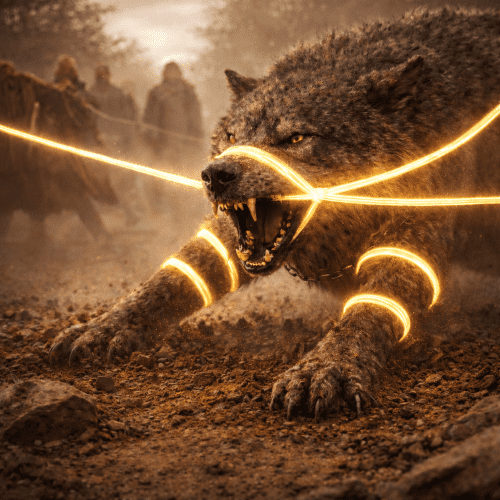
Huitzilopochtli also wielded the Xiuhcoatl, a supernatural Fire Serpent capable of overwhelming even divine enemies. The Aztecs believed that human sacrifices provided the sacred energy necessary to sustain his strength, ensuring the continued movement of the sun and the survival of the world itself.
Beyond warfare, Huitzilopochtli represented leadership, courage, determination, and the willingness to overcome impossible odds. His myths reinforced the belief that sacrifice and perseverance were essential for preserving both civilization and cosmic harmony.
Modern Day Influence
Although the worship of Huitzilopochtli ended following the Spanish conquest, his legacy remains deeply embedded in Mexican history and culture. Archaeological discoveries at the Templo Mayor in Mexico City continue to reveal new insights into his worship, including temples, sculptures, ceremonial offerings, and the famous Coyolxauhqui Stone that depicts his victory over his sister.
His story remains central to studies of Aztec civilization and frequently appears in books, documentaries, museums, and academic research. Artists continue to portray Huitzilopochtli in paintings, sculptures, graphic novels, films, and digital media, emphasizing his role as both a fierce warrior and a symbol of indigenous resilience.
Modern discussions surrounding Huitzilopochtli also explore the broader cultural significance of Aztec religion, leadership, sacrifice, and identity. As one of the most recognizable figures in Mesoamerican mythology, he continues to inspire historians, artists, and mythology enthusiasts around the world, serving as a powerful reminder of one of the greatest civilizations in the Americas.
Related Images




Source
Wikipedia. (n.d.). Huitzilopochtli. In Wikipedia: The Free Encyclopedia. Retrieved November 7, 2025, from https://en.wikipedia.org/wiki/Huitzilopochtli
Encyclopaedia Britannica. (n.d.). Huitzilopochtli: Aztec god. In Britannica. Retrieved November 7, 2025, from https://www.britannica.com/topic/Huitzilopochtli
León-Portilla, M. (1990). Aztec thought and culture: A study of the ancient Nahuatl mind. Norman, OK: University of Oklahoma Press.
Bierhorst, J. (1990). The mythology of Mexico and Central America. New York, NY: William Morrow Paperbacks.
ResearchGate. (n.d.). Huitzilopochtli: The Aztec god of war. Retrieved November 7, 2025, from https://www.researchgate.net/
Google Books. (n.d.). Aztec mythology study material. Retrieved November 7, 2025, from https://books.google.com/
Journal of Latin American Studies. (n.d.). Articles on Huitzilopochtli. Cambridge University Press. Retrieved November 7, 2025, from https://www.cambridge.org/core/journals/journal-of-latin-american-studies
Frequently Asked Questions
What was Huitzilopochtli Aztec god of?
Who is the most powerful Aztec god?
The most powerful Aztec god is often considered to be Tezcatlipoca, the god of the night sky, hurricanes, and sorcery. He was a central figure in the Aztec pantheon and represented a duality of creation and destruction.
What are two facts about Huitzilopochtli?
Huitzilopochtli was the principal deity of the Mexica people, later known as the Aztecs, guiding them during their migration to the Valley of Mexico. He was revered as the god of war and the sun, symbolizing strength and military prowess. His worship involved elaborate human sacrifice rituals, believed to nourish him and ensure the sun’s daily rise. Huitzilopochtli represented the importance of warfare in Aztec culture and the need for offerings to maintain cosmic order. His influence was central to the identity and religious practices of the Aztec civilization.
Is Huitzilopochtli a girl or boy?
How powerful is Huitzilopochtli?
Huitzilopochtli is considered one of the most powerful deities in Aztec mythology, embodying the dual aspects of war and the sun. As the god of war, he provided strength and victory to warriors, making him essential for military success.

Pingback: Huitzilopochtli Aztec God – Mythlok | Bookmarking Page