


Tik Tik : The Night Hunter of Philippine Folklore
At a glance
| Description | |
|---|---|
| Origin | Philippine Mythology |
| Classification | Hybrids |
| Family Members | N/A |
| Region | Philippines |
| Associated With | Nocturnal hunting, Deception, Shapeshifting, Predation on unborn life |
The Mythlok Perspective
In Mythlok’s Perspective, the Tik Tik represents a universal fear tied to vulnerability and the unknown. It is less about a literal creature and more about the anxiety surrounding childbirth and unseen dangers. Similar entities exist across cultures, such as the Slavic night spirits that prey on infants or the Mesopotamian Lamashtu. These parallels show how societies externalize fear into predatory beings. The Tik Tik stands as a distinctly Philippine expression of this shared human concern.
Tik Tik
Introduction
The Tik Tik is a mysterious supernatural bird associated with the Aswang traditions of the Philippines. Known for its distinctive nocturnal call, this creature occupies an unusual place in Philippine folklore, where the sounds of birds are sometimes interpreted as warnings of approaching supernatural danger. Rather than representing one named individual, Tik Tik refers to a type of folkloric being whose identity and behaviour vary across regional traditions.
In several accounts from the Eastern Visayas and Bicol, the Tik Tik is described as an avian companion or scout of the Aswang. Its calls announce the presence of its master or help the creature locate vulnerable households, particularly those where women are about to give birth. This association has made the Tik Tik particularly feared in communities where stories of supernatural attacks on children and pregnant women remain part of oral tradition.
The name comes from the characteristic ticking or clicking sound attributed to the bird. Some traditions also associate its call with the presence of danger nearby. Its legend demonstrates how ordinary sounds in the natural environment can acquire supernatural significance within traditional belief systems.
Physical Description
Descriptions of the Tik Tik differ between Philippine regions. In its older folkloric representation, it is primarily identified as a bird rather than a humanoid monster. Its appearance is not consistently established, although some accounts associate it with nocturnal birds that produce distinctive calls. The bird’s most recognisable characteristic is its voice. The repeated ‘tik-tik’ sound is believed to signal the approach of an Aswang or another dangerous supernatural being. In certain regional interpretations, related birds are described as resembling crows or other dark-feathered birds that become active after sunset.
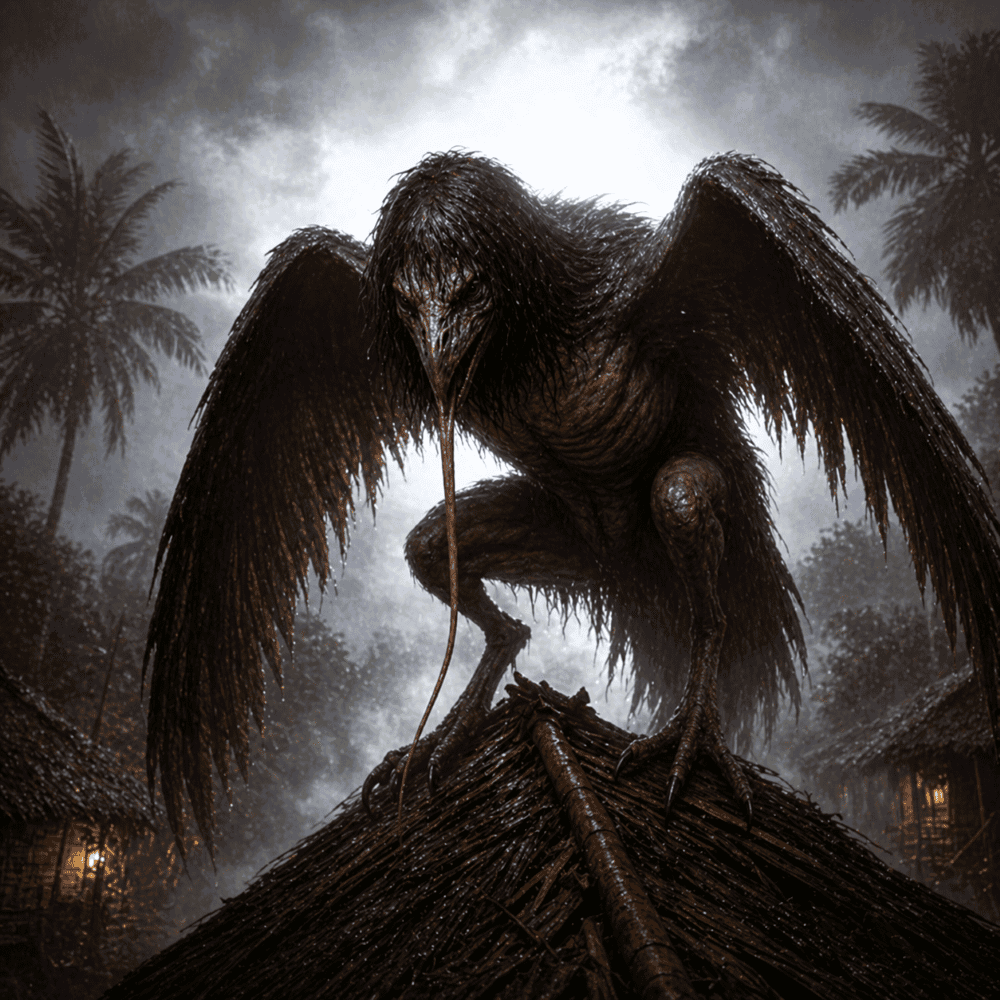
Contemporary horror representations have expanded this description considerably. The Tik Tik is sometimes depicted as a large winged humanoid with clawed limbs, dark feathers and an elongated tongue. These characteristics overlap with the physical descriptions of other Aswang variants, particularly viscera-sucking creatures. However, the distinction between the traditional bird and the modern monster is important. The long, thread-like tongue associated with attacks on unborn children is more commonly connected to the predatory Aswang tradition than to the original avian scout itself.
Mythological Context
The Tik Tik belongs to the wider supernatural landscape of Philippine folklore, where the Aswang represents a broad category of feared beings rather than one specific creature. Depending on the region, Aswang traditions include blood drinkers, viscera suckers, shape-shifters, witches and other supernatural predators. Within this landscape, the Tik Tik occupies a distinctive position because of its relationship with sound. Unlike creatures identified primarily through their appearance or physical abilities, it is often recognised through an auditory warning.
The bird is particularly associated with the activities of an Aswang that hunts newborn children or targets pregnant women. Its calls may announce the presence of the supernatural predator or help direct it towards vulnerable households. Filipino folklore researcher Maximo D. Ramos documented the relationship between the tiktik bird and the viscera-sucking Aswang in his work on Philippine lower mythology. His research describes the bird as an avian scout that flies ahead of the supernatural predator.
Origins
The Tik Tik originates in the oral traditions of the Philippines, particularly accounts associated with the Eastern Visayas and Bicol regions. Its precise beginnings are difficult to establish because these traditions developed through generations of storytelling rather than through a single written mythology. Early colonial accounts provide some historical context for the creature. Spanish chroniclers and missionaries recorded beliefs surrounding the Aswang and other supernatural beings encountered in Philippine communities. These accounts helped preserve descriptions of local traditions, although they must be understood within the cultural and religious perspectives of their authors.
An important modern study is Allan N. Derain’s May Tiktik sa Bubong, published in 2021 by the National Commission for Culture and the Arts. Derain examines historical accounts, ethnographic observations and the Panay-Bukidnon epic tradition to investigate the relationship between ominous bird calls and the Aswang. One particularly interesting aspect of this research is the possible identification of the folkloric tiktik with actual birds. The study traces associations involving the corocoro and alimokon, the latter identified with the white-eared brown fruit dove of Western Visayas. This suggests that traditional supernatural beliefs may have developed partly through interpretations of familiar sounds in the natural environment.
Notable Members
Unlike mythological pantheons populated by individually named gods, heroes and supernatural personalities, the Tik Tik tradition does not have a recognised collection of individually named members. The name identifies a category of folkloric beings or an avian figure associated with the Aswang. Different communities have their own descriptions and interpretations, but these do not establish separate individuals with independent biographies or genealogies.
The tiktik bird described in Eastern Visayan accounts and the related birds called kikik or wak-wak in Bicol traditions represent regional expressions of this broader folkloric motif. Their calls and relationships with supernatural predators differ according to local storytelling traditions. Consequently, the Tik Tik is best understood as a class of beings rather than an individual mythological character.
Relationship with Other Beings
The Tik Tik is most closely associated with the Aswang, particularly the viscera-sucking varieties found in Philippine folklore. Its relationship with these creatures is often described through the role of a scout or companion. In some traditions, the bird flies ahead of its master, searching for houses where pregnant women or newborn children may be found. Its calls can signal the presence of the approaching Aswang, creating an unsettling connection between the creature’s voice and impending danger.
The Tik Tik is also frequently associated with the Manananggal, another well-known Aswang variant. The Manananggal is particularly recognisable for its ability to separate its upper body from its lower half and fly through the night. Both creatures appear in stories involving supernatural attacks on pregnant women, although their traditional identities and physical characteristics are not interchangeable. These relationships demonstrate how Philippine folklore frequently connects different supernatural beings through shared hunting practices, habitats and predatory behaviour.
Similar Beings
Several Philippine supernatural beings share characteristics with the Tik Tik, particularly their association with nocturnal activity and the Aswang tradition. The Wakwak is among the closest comparisons. In different regional accounts, the name describes a bird-like supernatural creature or a being associated with distinctive wing sounds. The Kikik is another related name, particularly associated with Bicol traditions, where its call is believed to announce the presence of an Aswang.
The Ekek is also associated with bird-like supernatural predators in some modern regional classifications. However, these names are not necessarily interchangeable everywhere, and their meanings depend on local oral traditions. The Manananggal provides another point of comparison because of its association with nocturnal flight and attacks on pregnant women. Unlike the Tik Tik bird, however, the Manananggal is generally described as an independent supernatural predator rather than an avian scout.
Symbolism and Interpretations
The Tik Tik represents the fear of unseen danger in Philippine folklore. Its significance comes not only from its association with the Aswang but also from the idea that ordinary sounds can carry warnings about supernatural threats. The bird’s call creates a connection between the natural environment and the unseen world. A sound heard in the darkness becomes more than an ordinary animal noise; it becomes a possible indication that something dangerous is approaching.
Its association with childbirth and vulnerable households also reflects traditional anxieties surrounding pregnancy, infant mortality and the protection of families. The Aswang stories surrounding the Tik Tik gave these fears a recognisable supernatural identity. There is also an environmental dimension to the tradition. Derain’s research explores how bird calls associated with supernatural warnings may correspond to actual sounds in the local environment. Such interpretations suggest that folklore can preserve ways of understanding and responding to natural surroundings.
Modern Influence
The Tik Tik continues to influence contemporary Filipino horror, literature and popular culture. Its association with the Aswang makes it a natural subject for stories exploring supernatural predators, rural fears and the relationship between traditional beliefs and modern life. One of its most recognisable cinematic appearances is in the 2012 Filipino horror film Tiktik: The Aswang Chronicles. The film draws upon Aswang folklore and presents a contemporary interpretation of the supernatural creatures associated with the tradition.
The broader Aswang universe has also gained international recognition through works such as Trese, which adapts Philippine supernatural traditions into an urban fantasy setting. These modern adaptations introduce traditional creatures to new audiences while expanding their visual and narrative identities. Digital storytelling, independent films, graphic novels and online folklore communities have further contributed to the Tik Tik’s continued presence. Its distinctive call remains one of the most recognisable elements of the legend.
Ultimately, the Tik Tik demonstrates how Philippine folklore transforms familiar elements of the natural world into expressions of supernatural belief. Whether understood as an ominous bird, an Aswang’s companion or a creature in modern horror, it remains an important part of the Philippines’ rich tradition of supernatural storytelling.
Related Images




Source
Maximo, D. R. (1990). Creatures of Philippine lower mythology. [PDF document]. Retrieved from https://about.openlibhums.org/fetch.php/form-library/zjZvJu/Creatures_Of_Philippine_Lower_Mythology_By_Maximo_D_Ramos.pdf
Monie Maunay. (2008, December 20). Tik Tik, the Filipino supernatural folklore. HubPages. https://discover.hubpages.com/religion-philosophy/tiktik-the-filipino-supernatural-folklore
Nasayao. (2010). Bikol beliefs and folkways: A showcase of tradition. https://phspirits.com/tiktik/
Plasencia, J. de. (1589). Customs of the Tagalogs. https://en.wikipedia.org/wiki/Aswang
Ramos, M. D. (1971). Creatures of the lower mythology. University of Kansas.
Wikipedia contributors. (2025). Aswang. Wikipedia. https://en.wikipedia.org/wiki/Aswang
Jocano, F. L. (1969). Philippine Mythology. Quezon City: Capitol Publishing House.
Eugenio, D. L. (1993). Philippine Folk Literature: The Myths. University of the Philippines Press.
Cannell, F. (1999). Power and Intimacy in the Christian Philippines. Cambridge University Press.
Demetrio, F. (1992). The Soul Book: Introduction to Philippine Pagan Religion. GCF Books.
Frequently Asked Questions
What is a Tik Tik in Philippine folklore?
A Tik Tik is a nocturnal aswang that hunts pregnant women using stealth, shapeshifting, and a deceptive ticking sound.
Is Tik Tik the same as Aswang?
Tik Tik is a type of aswang, specifically a viscera-sucking variant with bird-like traits.
Why does the Tik Tik make a ticking sound?
The sound confuses victims, growing quieter as the creature gets closer to mislead them.
What does the Tik Tik eat?
It is believed to feed on fetuses or unborn life using its long, thread-like tongue.
How do people protect against Tik Tik?
Traditional beliefs mention garlic, salt, and light as protective elements against aswang creatures.


