


Rakshasa : The Powerful Shape Shifting Beings of Indian Lore
| Description | |
|---|---|
| Origin | Indian Mythology |
| Nature | Mostly evil |
| Notable Members | Ravana, Kumbhakarna, Indrajit, Shurpanakha, Tataka, Hidimba, Ghatotkacha |
| Symbolism | Chaos, Illusion, Disruption of dharma, Moral ambiguity |
| Epics | Ramayana, Mahabharata, Puranas |
Mythlok Perspective
From the Mythlok perspective, Rakshasas occupy a role that many mythologies reserve for monsters, yet Indian tradition rarely confines them to that identity. Unlike the Oni of Japanese folklore or the Ogres of European legend, Rakshasas are often rulers, scholars, devotees, and warriors with distinct moral agency. Their enduring significance lies in this complexity. Rather than representing evil itself, they reveal how power, knowledge, and ambition become destructive only when separated from dharma. In this way, Rakshasas are less symbols of darkness and more mirrors of humanity’s struggle to balance strength with wisdom.
Rakshasa
Introduction
The Rakshasa is one of the most recognizable supernatural beings in Indian mythology. Appearing throughout the Ramayana, Mahabharata, the Puranas, and several regional traditions, Rakshasas are often portrayed as powerful shape-shifting beings who challenge gods, sages, and heroic kings. Although many stories describe them as dangerous or destructive, Indian mythology rarely presents them as creatures of absolute evil. Instead, they are complex characters capable of wisdom, devotion, courage, loyalty, and even righteousness.
The Sanskrit word Rakshasa has often been translated as “demon,” but this translation oversimplifies their role. Unlike purely malevolent beings found in many mythologies, Rakshasas exist within the moral framework of dharma, where their choices—not merely their birth—determine their character. Figures such as Ravana, Vibhishana, Hidimbi, and Ghatotkacha demonstrate that Rakshasas occupy a wide spectrum of personalities, making them some of the most layered beings in Indian mythology.
Physical Description
Rakshasas rarely possess a single permanent appearance. One of their defining characteristics is the ability to change form at will, allowing them to become humans, animals, or even seemingly harmless objects to deceive their enemies. This mastery over illusion, known as maya, makes them far more dangerous than creatures that rely only on physical strength.
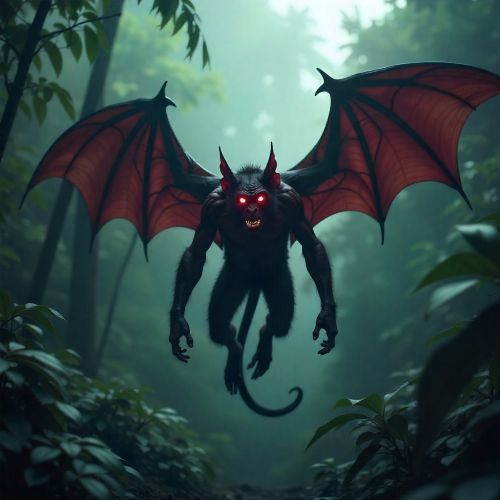
When they reveal their true forms, Rakshasas are generally described as imposing and terrifying. Ancient texts portray them with enormous bodies, muscular frames, blazing eyes, sharp claws, protruding fangs, wild hair, and booming voices. Some are depicted with multiple heads or additional arms, although such features are usually reserved for exceptionally powerful individuals like Ravana rather than being common to all Rakshasas.
Female Rakshasas, known as Rakshasis, are frequently portrayed as masters of disguise. Characters such as Surpanakha and Hidimbi can transform into extraordinarily beautiful women, using charm and deception before revealing their supernatural nature. This contrast between beauty and monstrosity reinforces the Rakshasas’ association with illusion, unpredictability, and psychological manipulation rather than brute force alone.
Mythological Context
Rakshasas play a central role in many of India’s greatest mythological narratives. In the Ramayana, they dominate the conflict between Rama and Ravana, with Lanka serving as the powerful kingdom ruled by the Rakshasa king. Numerous Rakshasas attempt to prevent Rama’s mission, creating many of the epic’s defining battles.
The Mahabharata presents a broader and more nuanced picture. Rather than existing solely as villains, Rakshasas sometimes become allies, family members, or respected warriors. Hidimbi marries Bhima, while their son Ghatotkacha becomes one of the Pandavas’ greatest champions during the Kurukshetra War.
Across Hindu literature, Rakshasas are commonly associated with forests, mountains, battlefields, and remote wilderness. Many stories describe them interrupting Vedic sacrifices, attacking ascetics, or threatening travelers. These actions symbolize challenges to social and cosmic order. Yet the same literature also depicts Rakshasas as rulers, scholars, military commanders, and accomplished practitioners of spiritual disciplines, showing that they belong to a sophisticated civilization rather than a race of mindless monsters.
Origins
The origins of the Rakshasa vary considerably across Hindu literature, reflecting the diversity of Indian mythological traditions. There is no universally accepted account of their creation. Some Puranic traditions state that Rakshasas originated during Brahma’s creation of living beings. According to one well-known account, some newly created beings cried “Rakshama” (“Let us protect”), while others cried “Yakshama.” Those associated with the former became Rakshasas, while the latter became Yakshas. Other traditions instead describe Rakshasas as descendants of the sage Pulastya through his grandson Vishrava, making Ravana, Kumbhakarna, Vibhishana, and Surpanakha members of this distinguished lineage.
Certain texts also associate Rakshasas with Nirriti, the goddess connected with decay, misfortune, and the southwest direction, further emphasizing their links with destructive or chaotic forces. Modern historians have occasionally suggested that some Rakshasa legends may preserve cultural memories of encounters between different ancient communities. However, this remains a scholarly interpretation rather than an accepted historical fact and is not presented as an explanation within the traditional mythological texts themselves.
Notable Members
No Rakshasa is more famous than Ravana, the ten-headed king of Lanka. While remembered primarily as the antagonist of the Ramayana, Ravana was also celebrated as a brilliant scholar, an accomplished musician, and a devoted worshipper of Shiva. His downfall resulted not from a lack of knowledge but from arrogance and his refusal to abandon adharma.
His brother Kumbhakarna is equally memorable. Although often remembered for his legendary sleep, Kumbhakarna was an unmatched warrior whose loyalty to his family remained unwavering even when he disagreed with Ravana’s decisions.
Vibhishana stands in sharp contrast to his brothers. Choosing righteousness over family loyalty, he joined Rama’s forces during the war and later became king of Lanka. His story illustrates one of Indian mythology’s recurring themes—that virtue depends on one’s actions rather than one’s birth.
Other notable Rakshasas include Surpanakha, whose encounter with Rama and Lakshmana sets the events of the Ramayana into motion, Maricha, whose transformation into the golden deer enables Sita’s abduction, and Tataka, the fearsome forest Rakshasi defeated by Rama early in his journey.
The Mahabharata introduces Hidimbi, who marries Bhima, and their son Ghatotkacha, whose extraordinary magical powers become crucial during the Kurukshetra War. Their stories demonstrate that Rakshasas could become respected members of heroic lineages rather than remaining permanent enemies of humanity.
Relationship with Other Beings
Rakshasas frequently come into conflict with the Devas, sages, and kings who uphold dharma. Their attempts to disrupt sacrifices, intimidate ascetics, and spread fear often symbolize forces that threaten religious and social order.
Their relationship with humans is far more varied than many retellings suggest. While numerous stories describe Rakshasas as man-eaters or predators, others depict friendships, marriages, and political alliances between Rakshasas and humans. The marriage of Bhima and Hidimbi remains one of the best-known examples, producing the heroic Ghatotkacha.
Rakshasas also interact with other supernatural races, including Yakshas, Nagas, Gandharvas, and Asuras. Although these groups occasionally cooperate or oppose one another, Hindu mythology generally treats them as distinct classes of beings with unique origins, responsibilities, and symbolic meanings.
Similar Beings
Rakshasas are often compared with Asuras, but the two are not identical. Asuras are generally portrayed as powerful rivals of the Devas who seek dominion over the cosmos, whereas Rakshasas are more closely associated with shape-shifting, illusion, wilderness, and direct interaction with humans.
They also differ from Pishachas, who are corpse-eating spirits linked with darkness and impurity, and from Vetalas, supernatural beings that inhabit dead bodies. Meanwhile, Yakshas serve almost as their symbolic counterparts, typically acting as guardians of natural wealth and sacred places.
Outside India, Rakshasas share certain similarities with ogres, demons, and shape-shifting monsters from other mythologies. However, few mythological traditions combine monstrous appearances with royal authority, scholarship, magical mastery, and moral complexity as consistently as Indian mythology does with Rakshasas.
Symbolism and Interpretations
Rakshasas represent far more than supernatural enemies. They often embody the forces that challenge dharma, including unchecked ambition, greed, violence, pride, and uncontrolled desire. Their repeated attacks on sacred rituals symbolize disruptions to both spiritual discipline and social harmony.
Yet Indian mythology deliberately avoids reducing them to simple embodiments of evil. Characters such as Vibhishana and Hidimbi demonstrate that virtue is not determined by race or lineage. Conversely, Ravana illustrates how extraordinary intelligence, devotion, and power can become destructive when separated from humility and moral responsibility.
Many modern scholars therefore view Rakshasas as symbols of moral complexity rather than absolute wickedness. Their stories explore how wisdom, strength, family loyalty, and ambition can either uphold or undermine the balance of the world depending on the choices individuals make.
Modern Influence
The Rakshasa continues to be one of the most enduring figures in Indian popular culture. Annual Dussehra celebrations feature the burning of Ravana’s effigies, symbolizing the triumph of righteousness over arrogance and injustice.
Rakshasas frequently appear in television adaptations of the Ramayana and Mahabharata, graphic novels, children’s literature, fantasy fiction, films, and video games. Contemporary storytellers increasingly portray them as multidimensional characters with personal motivations instead of one-dimensional villains.
Outside India, Rakshasas have also entered global fantasy through novels, comics, and tabletop role-playing games. These adaptations often reinterpret their appearance while preserving their defining qualities of intelligence, magical power, and shape-shifting abilities.
Their lasting popularity reflects the richness of Indian mythology itself. Rather than representing evil alone, Rakshasas continue to remind audiences that power without self-control can become destructive, while even those born into darkness retain the ability to choose the path of righteousness.
Sources
Encyclopaedia Britannica. (n.d.). Rakshasa. https://www.britannica.com/topic/rakshasa
Mythology.net. (n.d.). Rakshasa – Hindu mythological being. https://mythology.net/hindu/rakshasa/
Vyasa Mahabharata. (n.d.). Rakshasas. https://www.vyasaonline.com/encyclopedia/rakshasas/
Doniger, W. (2009). The Hindus: An alternative history. Penguin Press.
Doniger, W. (1993). Hindu myths: A sourcebook translated from the Sanskrit. Penguin Books.
Goldman, R. P., et al. (1984–2017). The Rāmāyaṇa of Vālmīki: An epic of ancient India (Vols. 1–7). Princeton University Press.
Smith, B. K. (1994). Classical Hindu mythology: A reader in the Sanskrit Purāṇas. Temple University Press.
Frequently Asked Questions
What is a Rakshasa in Indian mythology?
A Rakshasa is a powerful supernatural being in Indian mythology known for shape-shifting, immense strength, magical abilities, and its prominent role in epics such as the Ramayana and Mahabharata.
Are all Rakshasas evil?
No. While many Rakshasas oppose heroes and disrupt dharma, figures such as Vibhishana, Hidimbi, and Ghatotkacha demonstrate that Rakshasas can also be noble, compassionate, and righteous.
Who is the most famous Rakshasa?
Ravana, the king of Lanka in the Ramayana, is the most famous Rakshasa. He is remembered as both a brilliant scholar and the principal antagonist of Rama.
What powers do Rakshasas have?
Rakshasas are commonly described as possessing shape-shifting abilities, immense physical strength, magical powers, flight, illusion (maya), and exceptional combat skills.
What is the difference between a Rakshasa and an Asura?
Asuras are primarily powerful rivals of the gods in cosmic conflicts, whereas Rakshasas are more closely associated with shape-shifting, illusion, wilderness, and interactions with humans in Indian mythology.


