


Aghoy : The Whistling Forest Spirits of Philippine Folklore
At a glance
| Description | |
|---|---|
| Origin | Philippine Mythology |
| Classification | Spirits |
| Family Members | N/A |
| Region | Philippines |
| Associated With | Forests, Whistling, Gifts |
Mythlok Perspective
In Mythlok’s Perspective, the Aghoy represent a relationship with nature built on coexistence, trust and mutual respect rather than fear or dominance. Their friendships with humans and preference for peaceful households share an interesting parallel with the Kodama of Japanese folklore, spirits believed to inhabit trees and protect the forests they call home. However, while Kodama are primarily associated with the sacredness of trees and the consequences of disturbing nature, the Aghoy are more closely connected with human relationships, hospitality and everyday interactions.
Aghoy
Introduction
Among the supernatural beings of Philippine mythology, the Aghoy occupy a distinctive place in the traditional beliefs of the Waray-speaking communities of Eastern Visayas. These mysterious, dwarf-like spirits are associated with forests, farms and trees, where they are believed to live away from busy human settlements. Unlike many supernatural creatures that threaten or deceive people, the Aghoy are generally considered friendly and approachable. They are known for visiting human homes, communicating through whistles and helping people recover lost possessions.
The Aghoy are not described as a single individual but as a group of supernatural beings sharing similar characteristics and abilities. Their stories offer an interesting glimpse into the traditional relationship between humans and the unseen inhabitants of the natural world. Accounts collected from Leyte and Samar portray them as sociable spirits who appreciate peaceful households and avoid places where people argue. Their presence reflects a worldview in which forests and familiar landscapes are inhabited by beings that possess their own personalities, preferences and supernatural abilities.
Physical Description
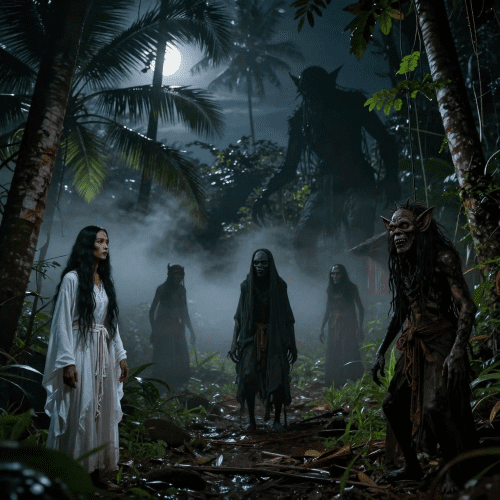
The Aghoy are generally described as small, human-like beings with an appearance that resembles miniature versions of ordinary people. Some traditional descriptions portray them as attractive, fair-skinned individuals with yellow or golden hair, deep-set eyes and prominent noses. Their appearance is sometimes compared to that of young adults, although their supernatural nature distinguishes them from humans. They are also described as barefoot and wearing simple clothing.
Their physical characteristics are not entirely consistent across regional accounts. In some traditions, the Aghoy are presented as dwarf-like forest inhabitants, while others emphasise their ability to conceal themselves from human observation. A 2026 narrative study conducted in Lawaan, Eastern Samar, documents local descriptions of the Aghoy as small human-like beings capable of shapeshifting, becoming invisible and teleporting. Their association with trees and forest environments is another recurring feature of these descriptions.
Mythological Context
Within Waray folklore, the Aghoy belong to a broader supernatural landscape populated by spirits believed to inhabit forests, fields, trees and other natural spaces. Traditional communities often regarded these environments as places shared by humans and unseen beings. The Aghoy fit into this belief system as supernatural neighbours rather than distant divine figures or inherently hostile entities.
Ethnographic accounts collected by Richard Arens in the 1950s provide particularly valuable information about their place in local beliefs. The Aghoy are described as friendly towards humans, visiting their houses and enjoying the food offered there. However, they reportedly do not sleep in human homes. Their behaviour also reflects a preference for peaceful surroundings, as they are believed to disappear when arguments break out within a household. Their ability to locate lost objects makes them particularly useful to the people who believe in them.
Origins
The precise origin of the Aghoy is not preserved in a clearly documented creation story. Instead, their identity emerges through regional oral traditions and beliefs passed between generations in Leyte and Samar. These accounts describe them as established inhabitants of forests and agricultural landscapes, suggesting that their existence was understood as part of the natural and supernatural order.
The connection between the Aghoy and their surroundings is particularly important. They are believed to occupy places where human activity meets the wilderness, including farms, wooded areas and large trees. The 2026 study Echoes of the Forest: A Narrative Study of the Aghoy documents these associations through interviews with ten older residents of Lawaan, Eastern Samar. Their accounts demonstrate how local communities continue to preserve and interpret stories about these mysterious beings. Rather than identifying a single creator or ancestral figure, Waray folklore presents the Aghoy as an established class of supernatural inhabitants.
Notable Members
Unlike mythological traditions built around powerful gods, legendary heroes or individual supernatural personalities, the Aghoy are primarily understood as a collective group. No widely documented individual Aghoy has emerged as a central character with a distinct name, genealogy or independent body of legends.
Their significance comes from the characteristics shared by the group rather than the achievements of particular members. Individual encounters generally involve unnamed Aghoy visiting human settlements, helping people locate missing belongings or communicating through whistles. Consequently, their collective identity is more important than individual personalities in the surviving folklore.
Relationship with Other Beings
The Aghoy exist within a wider network of supernatural beliefs found throughout the Philippine islands. Their descriptions sometimes overlap with those of other forest-dwelling spirits, particularly beings associated with enchanted landscapes and human settlements. However, these similarities do not necessarily indicate shared identities or common origins.
In Richard Arens’s ethnographic account, the Aghoy are mentioned alongside the Agta, a separate category of forest spirit described in Leyte and Samar traditions. The Agta are associated with dark appearances and are believed to inhabit forests and swamps. The Aghoy, by comparison, are described as dwarf-like and friendly towards humans. Arens also mentions the Encantados, supernatural beings believed to inhabit large trees and other selected places. These distinctions illustrate the diversity of supernatural beliefs within Eastern Visayan folklore.
Similar Beings
Several supernatural beings across Philippine mythology share characteristics with the Aghoy, particularly their association with forests, nature and human settlements. The Duwende are perhaps the closest comparison, as they are commonly described as dwarf-like supernatural inhabitants with magical abilities. The Engkanto are enchanted beings associated with beautiful appearances and supernatural environments, while the Visayan Tamawo are known as mysterious forest-dwelling entities.
The Diwata, often associated with natural landscapes and supernatural authority, provide another point of comparison. However, these beings represent distinct traditions and should not be treated as alternative names for the Aghoy. What makes the Aghoy particularly recognisable is their friendly relationship with humans, their ability to locate lost objects and their preference for peaceful households.
Symbolism and Interpretations
The Aghoy represent the traditional belief that forests and agricultural landscapes are inhabited by supernatural beings deserving of respect. Their presence reflects the close relationship between rural communities and the natural environments on which their livelihoods depend. Trees and wooded areas are not merely physical features of the landscape but spaces that may contain unseen inhabitants.
Their preference for peaceful households also gives them an interesting social dimension. The belief that Aghoy disappear when people argue suggests an association between harmony and the presence of benevolent supernatural forces. Their ability to find lost objects further connects them with ideas of assistance, cooperation and the mysterious relationship between humans and the unseen world.
In contemporary interpretations, the Aghoy can also be understood as expressions of environmental respect and traditional ecological beliefs. Their stories encourage people to approach forests and unfamiliar natural spaces with caution rather than treating them as empty or uninhabited places.
Modern Influence
Although the Aghoy are not as widely represented in contemporary popular culture as the Aswang or Tikbalang, they remain an important part of the cultural heritage of Eastern Visayas. Their continued presence in local storytelling demonstrates the importance of oral traditions in preserving regional identities and supernatural beliefs.
Recent academic research has also contributed to documenting these traditions. The 2026 study Echoes of the Forest: A Narrative Study of the Aghoy, conducted by researchers from Eastern Samar State University, records community accounts and develops a digital storytelling project titled The Whistle in the Forest. Such initiatives provide opportunities to preserve regional folklore through contemporary media and introduce lesser-known Philippine supernatural beings to younger audiences. The Aghoy therefore represent more than mysterious forest inhabitants. They are part of a living tradition that connects local communities with their landscapes, inherited beliefs and cultural memory.
Related Images

Source
Fandom. (2019, January 1). Aghoy – Myth and Folklore Wiki. https://myth-folklore.fandom.com/wiki/Aghoy
Fandom. (2008, January 1). Aghoy – Creatures of myth Wiki. https://creaturesofmyth.fandom.com/wiki/Aghoy
Gavereza, K. (2018, January 17). Aghoy – Philippine Spirits. https://www.philippinespirits.com/tag/aghoy/
Gavereza, K. (2018, June 17). The Elves of Philippine Folklore – The Aswang Project. https://www.aswangproject.com/elves-philippine-folklore/
Manilatown Archives. (2024, November 2). Philippine Mythology Exhibition Program. https://www.manilatown.org/wp-content/uploads/2024/02/MYTHOLOGY-EXHIBITION-PROGRAM-FINAL.pdf
Philstar. (2015, October 30). The creatures of Filipino myths and legends | The Freeman. https://www.philstar.com/the-freeman/cebu-lifestyle/2015/10/30/1516599/creatures-filipino-myths-and-legends
PressReader. (2015, October 31). PressReader. https://www.pressreader.com/philippines/the-freeman/20151031/282273844627117
Stoic Aswang. (2015, December 23). Monsters & other supernatural beings from Filipino folklore & myths. https://stoicaswang.wordpress.com/2015/12/23/monsters-other-supernatural-beings-from-filipino-folklore-myths/
Frequently Asked Questions
What are Aghoy in Philippine mythology?
Aghoy are supernatural, dwarf-like nature spirits from Waray folklore in the Eastern Visayas, Philippines, known for their friendly behaviour and ability to find lost objects.
Where do the Aghoy live?
Aghoy are believed to inhabit forests, trees and agricultural landscapes in Eastern Visayas, particularly in the traditional folklore of Leyte and Samar.
Are Aghoy good or evil spirits?
Aghoy are generally considered benevolent spirits. They are friendly towards humans, visit peaceful households and sometimes help people recover lost possessions.
What powers do the Aghoy possess?
Aghoy are associated with finding lost objects, communicating through whistles, invisibility, shapeshifting and teleportation in regional folklore.
Are Aghoy and Duwende the same?
No. Aghoy and Duwende are distinct supernatural beings in Philippine folklore, although both are commonly described as small, human-like spirits with magical abilities.


