


Bantugan : The Handsome Philippine Prince Who Defied Death
At a glance
| Description | |
|---|---|
| Origin | Philippine Mythology |
| Classification | Mortals |
| Family Members | Tominaman sa Rogong (Father), Lalawanen sa Solog (Mother) |
| Region | Philippines |
| Associated With | Good Looks, Bravery, War |
Mythlok Perspective
From the Mythlok perspective, Bantugan represents the fragile balance between personal glory and collective responsibility. While Greek heroes such as Hercules often prove their greatness through individual feats of strength, Bantugan’s story in the Maranao Darangen places equal importance on family, loyalty, and reconciliation. His legend suggests that true heroism extends beyond defeating enemies; it lies in restoring relationships and protecting the community. Through Bantugan, Maranao storytelling transforms the warrior’s triumph into a reflection on the responsibilities of power.
Bantugan
Introduction
Bantugan is a legendary warrior-prince from the Darangen, the epic tradition of the Maranao people of Mindanao in the southern Philippines. Associated with the Kingdom of Bumbaran, he is celebrated for his courage, royal status, and extraordinary adventures. His story explores the complexities of heroism, family relationships, jealousy, love, death, and resurrection, offering a glimpse into the cultural values and imagination of the Maranao people.
The Darangen is one of the most important works of traditional Philippine literature. It consists of 17 narrative cycles containing approximately 72,000 lines, recounting the adventures of mythical heroes alongside episodes reflecting Maranao history, customary law, and social values. Originally transmitted through oral performance, the epic was recognised by UNESCO as a Masterpiece of the Oral and Intangible Heritage of Humanity in 2005 and inscribed on its Representative List of the Intangible Cultural Heritage of Humanity in 2008. Bantugan’s story remains an important part of this literary heritage, connecting generations through storytelling, performance, and cultural memory.
Physical Traits
Bantugan is portrayed as a handsome and charismatic prince whose appearance and warrior reputation command admiration. His attractiveness is an important part of his legendary identity, contributing to his popularity and creating tension within the royal household. He represents the heroic ideal of a noble warrior whose physical presence is matched by courage, confidence, and skill.
His martial identity is closely associated with the kampilan, a traditional sword used in parts of the southern Philippines. The weapon provides a fitting cultural reference when discussing the fighting traditions represented in stories from Mindanao, although specific descriptions of Bantugan’s personal weapon should be checked against the version of the epic being used.
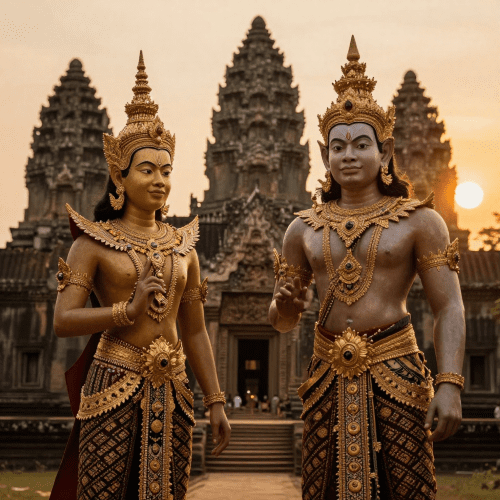
Modern artistic interpretations of Bantugan sometimes present him in elaborate royal clothing and warrior costumes. Such portrayals help communicate his status to contemporary audiences, particularly in theatrical productions, but they should not automatically be treated as definitive descriptions from the original oral tradition.
Bantugan’s physical appeal also serves a narrative purpose. His popularity attracts admiration, but it contributes to the jealousy and personal conflict that shape his relationship with other members of the royal family. His character therefore combines the outward qualities of a heroic prince with the human vulnerabilities that make his story compelling.
Family
Bantugan belongs to the royal household of Bumbaran, a legendary kingdom central to his adventures in the Darangen. His relationship with King Madali is particularly important to the narrative, as their interactions reveal how personal feelings can complicate royal responsibilities and family loyalty.
In commonly retold versions of Bantugan’s story, tension develops between the two brothers because of Bantugan’s popularity and his relationships with others. This conflict leads to a series of events involving separation, death, and eventual restoration. The episode presents a complicated picture of royal life, where personal pride and jealousy can have consequences extending beyond individual relationships.
Bantugan’s sister is also significant to the wider tradition. The National Museum of the Philippines describes a Darangen episode in which Datu Bantugan searches for his younger sister, Arcata Lawanen, after her abduction by Ayonan Dimasangkay of Sagorongan-a-Ragat. The resulting conflict leads to a battle and, ultimately, reconciliation between the kingdoms. This narrative forms the basis of the traditional Sagayan war dance.
These family relationships demonstrate that Bantugan’s adventures are not simply tales of individual strength. They explore loyalty, responsibility, conflict, and reconciliation within a royal and communal setting. Because the Darangen contains multiple cycles and has been transmitted through different performances and retellings, individual names and narrative details should be understood in the context of the particular version being discussed.
Other names
Bantugan is commonly identified as Datu Bantugan in Philippine cultural accounts. The title Datu is associated with traditional leadership and social authority in parts of the Philippines, making it appropriate to his portrayal as a royal figure within the epic.
The spelling Bantugen also appears in the title Darangen ni Bantugen, a ballet adaptation of the Maranao epic presented by the Philippine Ballet Theater in 2008. The production focused on Bantugan’s death and resurrection, translating elements of the oral tradition into a modern theatrical form. The variation in spelling illustrates how names may be rendered differently in publications and artistic adaptations.
Bantugan should primarily be understood within the Maranao cultural tradition from which his story originates. Although comparisons with heroes from other cultures can help readers explore similarities between epic narratives, claims that Bantugan belongs to unrelated regional legends require independent evidence. His established cultural significance rests on his role in the Darangen and the continuing performance and interpretation of that epic.
Powers and Abilities
Bantugan’s legendary reputation rests on his exceptional courage, fighting ability, and extraordinary adventures. Like many heroes in epic literature, he occupies a world in which human experience and supernatural events intersect. His story explores the limits of ordinary human strength and the possibility of overcoming seemingly insurmountable challenges.
One of the most remarkable elements associated with Bantugan is his death and resurrection. The episode forms the central focus of the ballet Darangen ni Bantugen, which follows the hero’s final struggle, the loss of his life, and his restoration. This narrative gives Bantugan a place within the wider tradition of legendary heroes whose stories confront mortality and the possibility of renewal. The precise details of his death and return, however, depend on the version of the epic being retold.
Bantugan’s martial prowess is another defining characteristic. His adventures involve dangerous journeys, confrontations with powerful opponents, and conflicts that test his courage and determination. These episodes establish him as a heroic figure whose abilities extend beyond ordinary expectations. Beyond physical combat, Bantugan’s story explores the consequences of pride, the importance of relationships, and the possibility of reconciliation after conflict. These themes help explain why his adventures remain meaningful beyond their legendary setting.
Modern Day Influence
Bantugan continues to reach contemporary audiences through the preservation and reinterpretation of the Darangen. His story provides an important connection to Maranao cultural heritage, demonstrating how traditional oral literature can survive through performance, scholarship, and the creative arts.
One of the best-documented modern adaptations is Darangen ni Bantugen, a ballet presented by the Philippine Ballet Theater in 2008. The production transformed elements of the epic into a stage performance, focusing particularly on Bantugan’s death and resurrection. Through choreography, music, costumes, and dramatic storytelling, the ballet introduced audiences to a major figure in Maranao literature while interpreting the epic through a contemporary artistic medium.
Bantugan’s story is also connected to Sagayan, a traditional war dance associated with the Maranao and Maguindanao communities. According to the National Museum of the Philippines, Sagayan depicts the adventures of Datu Bantugan, including the battle to rescue his abducted sister. The story concludes with reconciliation between the opposing kingdoms, giving the dance a meaning that extends beyond warfare to include community protection and peace.
The wider Darangen tradition also preserves knowledge of Maranao social values, customary law, aesthetics, and oral performance. UNESCO notes that specialised male and female performers traditionally chant the epic during wedding celebrations, sometimes over several nights. Its survival depends on the knowledge of performers, elders, scholars, and communities who continue to value this heritage.
For contemporary readers, Bantugan can also serve as a starting point for comparative mythology. His heroic adventures, family conflicts, and resurrection can be examined alongside stories from other cultures, including those of Hercules and Thor. Such comparisons highlight recurring themes in epic storytelling without suggesting that these traditions share the same origins.
Ultimately, Bantugan’s significance lies not only in his reputation as a warrior-prince but also in his place within a living cultural tradition. Through the Darangen, Sagayan, and modern artistic adaptations, his story continues to introduce audiences to the imagination, values, and literary heritage of the Maranao people.
Related Images



Source
National Commission for Culture and the Arts. (2008, May 27). Dancing Darangen: The way to the Maranao epic. https://ncca.gov.ph/about-culture-and-arts/in-focus/dancing-darangen-the-way-to-the-maranao-epic/
Riwarung, L. H. S. (2015). Darangen: The epic of the Meranao. The Journal of History, 61(1).
https://www.ejournals.ph/article.php?id=14648
UNESCO. (2008). Darangen epic of the Maranao people of Lake Lanao. Intangible Cultural Heritage.
https://ich.unesco.org/en/RL/darangen-epic-of-the-maranao-people-of-lake-lanao-00159
UNESCO. (2008). The Darangen epic of the Maranao people of Lake Lanao. UNESCO Multimedia Archives. https://www.unesco.org/archives/multimedia/document-1750
University Research Center, Mindanao State University. (1986). Darangen: In original Maranao verse, with English translation (Vol. 1). University Research Center, Mindanao State University. National Museum of the Philippines Library catalogue:
https://library.nationalmuseum.gov.ph/cgi-bin/koha/opac-detail.pl?biblionumber=648&query_desc=Provider%3AUniversity+Research+Center%2C+Mindanao+State+University
University Research Center, Mindanao State University. (1987). Darangen: In original Maranao verse, with English translation (Vol. 2). University Research Center, Mindanao State University. National Museum of the Philippines Library catalogue:
https://library.nationalmuseum.gov.ph/cgi-bin/koha/opac-detail.pl?biblionumber=529&shelfbrowse_itemnumber=812
UNESCO. (2008). Darangen Epic of the Maranao People of Lake Lanao. Representative List of the Intangible Cultural Heritage of Humanity.
Jocano, F. L. (1969). Outline of Philippine Mythology. Centro Escolar University Research and Development Center.
Samar, E. C. (2013). Mga Nilalang Na Kagila-gilalas. Adarna House.
Frequently Asked Questions
Who is Bantugan in Philippine mythology?
Bantugan is a legendary warrior-prince from the Darangen, the epic of the Maranao people of Mindanao, Philippines, known for his heroic adventures and royal heritage.
What are Bantugan's powers and abilities?
Bantugan is celebrated for his courage, martial prowess, and extraordinary adventures. Specific supernatural abilities vary across retellings and should be verified against the epic.
Who is Bantugan's brother?
Bantugan’s brother is King Madali, the ruler of Bumbaran. Their relationship is central to the epic’s themes of jealousy, family conflict, and reconciliation.
What is the Darangen, and why is Bantugan important to it?
The Darangen is a traditional Maranao epic recognised by UNESCO. Bantugan is one of its celebrated heroes, whose adventures preserve important elements of Maranao cultural heritage.
How is Bantugan remembered in modern Filipino culture?
Bantugan’s legend lives on through performances of the Darangen, the Sagayan war dance, and theatrical adaptations that celebrate Maranao storytelling and cultural traditions.


