
Banebdjedet : The Sacred Ram God of Ancient Egypt
At a glance
| Description | |
|---|---|
| Origin | Egyptian Mythology |
| Classification | Gods |
| Family Members | Hatmehyt (Wife), Horus the Child (Son) |
| Region | Egypt |
| Associated With | Fertility, Divine essence (ba), Rebirth, Kingship, |
The Mythlok Perspective
In Mythlok’s Perspective, Banebdjedet represents a rare kind of divinity that is not defined by dominance but by essence. He is not the storm or the sun, but the force that gives them meaning. His identity as the ba transforms him into a philosophical bridge between existence and spirit. When compared to figures like the Norse Ymir or the Chinese Pangu, who embody creation through physical form, Banebdjedet stands apart as a symbol of inner vitality. He reflects a worldview where power is not always visible, but always present.
Banebdjedet
Introduction
Banebdjedet stands as one of the most intriguing yet often overlooked deities of ancient Egyptian belief. Worshipped primarily in the Nile Delta city of Djedet, later known to the Greeks as Mendes, he represented far more than a local god. His name, meaning “Ba of the Lord of Djedet,” connects him directly to the concept of the ba, the vital spiritual essence in Egyptian thought, and aligns him closely with Osiris, the god of death and rebirth.
Rather than existing as a separate being, Banebdjedet functioned as a manifestation of divine essence itself. This made him a powerful theological bridge between physical life and spiritual continuity. His cult centered on sacred rams, believed to be living embodiments of the god, and these animals were treated with royal reverence, even mummified and buried in elaborate tombs.
Over time, Banebdjedet evolved beyond a regional deity into a symbol of cosmic balance, fertility, and kingship. His presence in major mythological narratives, including the dispute between Horus and Seth, reflects his role as a neutral force of wisdom and divine authority.
Physical Traits
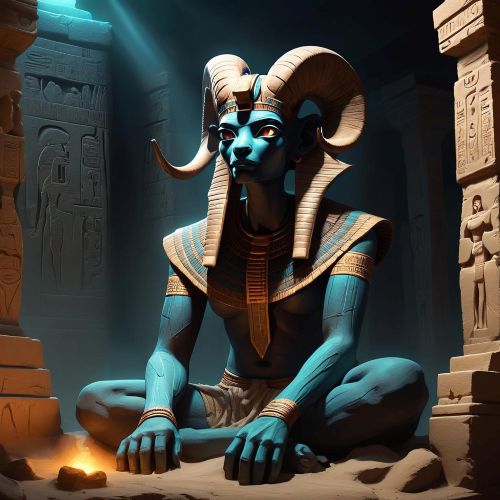
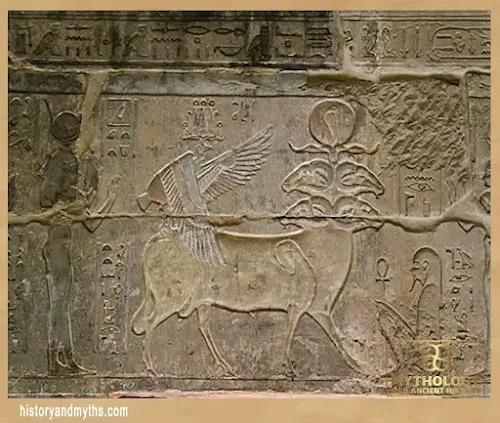
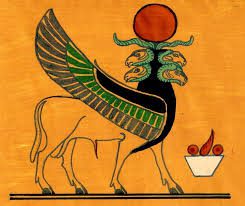
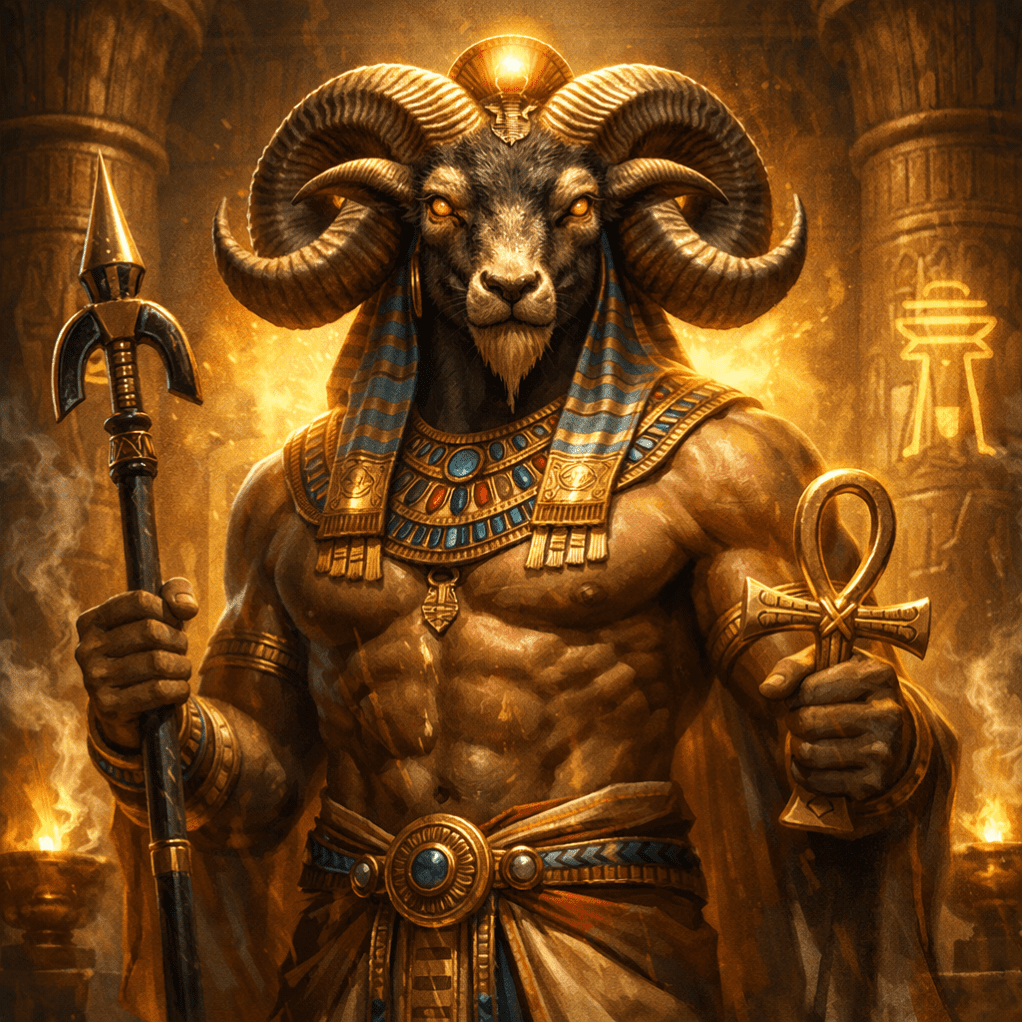
Banebdjedet is most commonly depicted as a ram or a human figure with a ram’s head, emphasizing strength, virility, and divine energy. His horns are typically long and curved, reinforcing his association with power and fertility. In temple reliefs and statues, he often carries sacred objects such as the was-scepter, the ankh, and the djed pillar, each symbolizing authority, life, and stability.
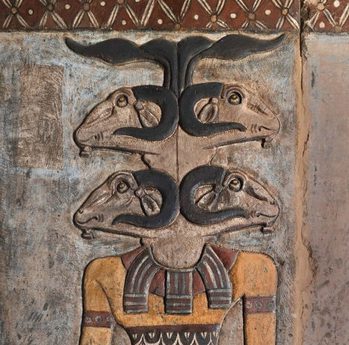
One of his most distinctive forms features four ram heads, facing different directions. This representation reflects his connection to multiple cosmic forces, linking him simultaneously to Re, Shu, Geb, and Osiris. Through this imagery, Banebdjedet becomes more than a single deity; he embodies a unified expression of creation, air, earth, and the afterlife.
There has been historical confusion regarding his sacred animal. Greek writers referred to him as the “goat of Mendes,” but Egyptian iconography clearly identifies the animal as a ram. This misunderstanding likely arose from cultural differences in animal classification rather than actual worship practices.
Family
Banebdjedet’s primary consort is Hatmehyt, a local fish goddess of Mendes who predates his prominence in the region. Their union represents the merging of older local traditions with broader Egyptian theology. Together, they form a triad with their child, Horus the Child, also known as Harpocrates.
This familial structure mirrors the well-known Osiris-Isis-Horus triad, reinforcing Banebdjedet’s identity as a manifestation of Osiris’s essence. Through this role, he symbolically participates in the cycle of death, rebirth, and kingship that defines Egyptian cosmology. He is also associated with Tatenen, a primordial earth deity linked to creation and emergence. This connection further strengthens his identity as a force that bridges life’s beginnings with its renewal.
Other names
Banebdjedet appears in ancient texts under several variations, including Banebdjed, Ba-neb-Djedet, and Banaded. These variations reflect differences in transliteration rather than distinct identities. His titles often emphasize his authority and divine nature, such as “Lord of Mendes,” “Ba Lord,” and “Lord of the Djed Pillar.”
Greek interpretations introduced the phrase “Goat of Mendes,” which later influenced Western misunderstandings of the deity. Despite this mislabeling, his core identity as a ram god remained consistent within Egyptian tradition. In some theological contexts, his four-headed form is referred to with specific titles that emphasize his multi-aspect nature, though these are less commonly preserved in modern sources.
Powers and Abilities
Banebdjedet’s powers are deeply tied to the concept of the ba, making him a living representation of spiritual force and continuity. He embodies fertility, vitality, and regeneration, qualities that were essential to both agricultural life and royal legitimacy in ancient Egypt.
His association with Osiris places him firmly within the cycle of death and rebirth. He is believed to aid the deceased in their journey through the afterlife, offering a form of spiritual renewal that echoes the flooding and retreat of the Nile. This connection makes him a quiet but significant presence in funerary traditions.
One of his most notable roles is that of a mediator. In the mythological conflict between Horus and Seth, Banebdjedet serves as a voice of balance and reason. Rather than taking sides, he represents the principle that divine order must prevail over personal conflict.
He is also linked to kingship and divine authority. Some pharaohs claimed a connection to him to reinforce their legitimacy, aligning themselves with his role as a source of life and power. His protective aspects extend into the spiritual realm, where his presence is believed to repel harmful forces and restore equilibrium.
Modern Day Influence
Although Banebdjedet is not as widely recognized today as figures like Osiris or Ra, his legacy continues to influence both academic study and popular imagination. Egyptologists frequently examine his cult to better understand how local traditions shaped broader religious systems in ancient Egypt.
One of the most persistent modern reinterpretations stems from the Greek misidentification of his sacred animal. This confusion contributed to later associations with goat imagery in Western esoteric traditions, eventually influencing figures like Baphomet. However, these interpretations diverge significantly from his original role as a life-affirming and balanced deity.
In contemporary media, Banebdjedet occasionally appears in fiction inspired by Egyptian themes, often reimagined in ways that emphasize his mysterious and ancient nature. Despite these adaptations, scholarly interest remains focused on his unique theological role as a manifestation of divine essence rather than a conventional god.
Related Images




Source
Ancient Egypt Online. (n.d.). Banebdjed. https://ancientegyptonline.co.uk/banebdjed/
Arab, W. S. A. (2016). The iconography of the god Banebdjedet. International Journal of Heritage, Tourism, and Hospitality, 7. https://www.semanticscholar.org/paper/The-Iconography-of-the-God-Banebdjedet-Arab/25b481b1d9c3eb0073e90fb2414983e712758f45
Bard, K. A. (2008). An introduction to the archaeology of ancient Egypt. Blackwell Publishing.
Henadology. (n.d.). Banebdjedet. https://henadology.wordpress.com/theology/netjeru/banebdjedet/
Pinch, G. (2002). Handbook of Egyptian mythology. ABC-CLIO.
Redford, D. B. (2002). The ancient gods speak. Oxford University Press.
Redford, D. B. (2010). City of the ram-man: The story of ancient Mendes. Princeton University Press.
Wilkinson, R. H. (2003). The complete gods and goddesses of ancient Egypt. Thames & Hudson.
Frequently Asked Questions
Who is Banebdjedet in Egyptian belief?
Banebdjedet is a ram-headed god associated with Mendes, representing the ba or spiritual essence of Osiris and embodying fertility, vitality, and divine power.
Why is Banebdjedet associated with a ram?
The ram symbolized strength, fertility, and life force in ancient Egypt, making it the perfect representation of Banebdjedet’s divine nature.
Is Banebdjedet the same as Osiris?
Not exactly. He is considered the ba or spiritual manifestation of Osiris rather than the god himself.
What role did Banebdjedet play in Egyptian myths?
He acted as a mediator in divine conflicts, particularly in the dispute between Horus and Seth, representing balance and wisdom.
Why is he called the “Goat of Mendes”?
This name comes from a Greek misunderstanding. The sacred animal of Banebdjedet was actually a ram, not a goat.