

Ashur : The Supreme God of the Assyrian Empire
At a glance
| Description | |
|---|---|
| Origin | Assyrian Mythology |
| Classification | Gods |
| Family Members | Mullissu (Wife), Ninurta and Zababa (sons, adopted) |
| Region | Iraq |
| Associated With | War, Kingship, Justice |
The Mythlok Perspective
In the Mythlok Perspective, Ashur is less a storyteller’s god and more an empire’s conviction made divine. His authority grows not through mythic narrative but through conquest, order, and political will. Like Roman Jupiter or Egyptian Amun-Ra, Ashur absorbs power as the state expands, yet he goes further by concentrating sovereignty into a single, almost monotheistic force. Ashur shows how belief can evolve from explanation into enforcement.
Ashur
Introduction
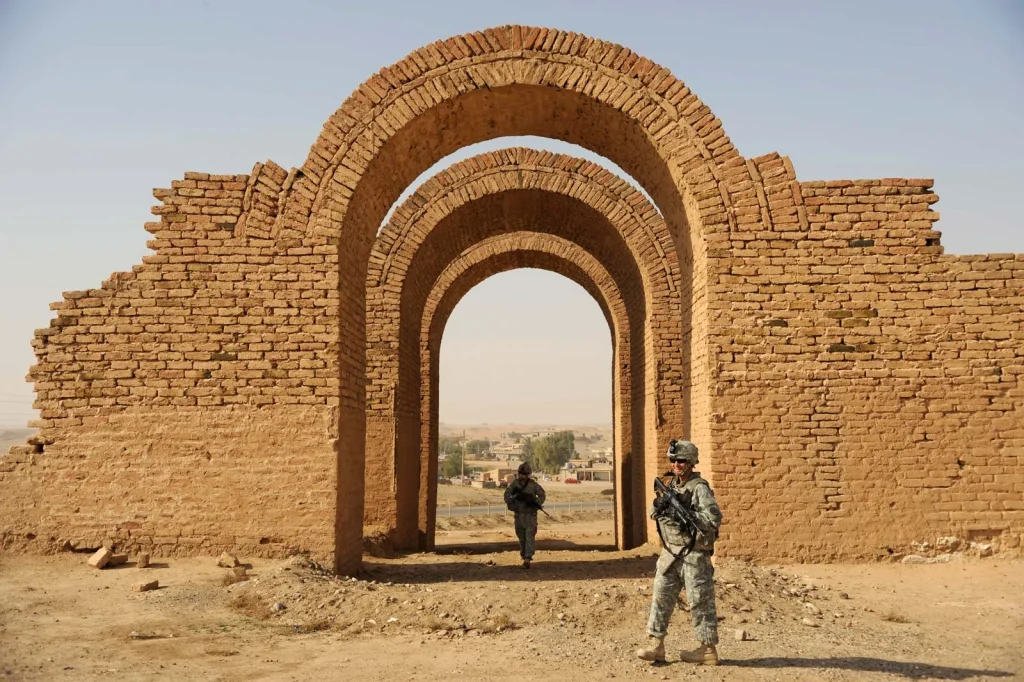
Ashur, also spelled Assur or Aššur, was the national god of the Assyrian civilisation and one of the most politically charged deities of the ancient Near East. His origins lie in the city of Ashur, located at modern Qalʿat Sharqat in northern Iraq along the western bank of the Tigris River. In the third millennium BCE, Ashur began as a local city god whose identity was inseparable from the land and people who bore his name. Over time, as Assyria expanded from a regional power into a territorial empire, Ashur was elevated from a guardian deity into the supreme god of the Assyrian pantheon.
Unlike many Mesopotamian gods who possessed elaborate myth cycles, Ashur’s authority emerged primarily through state ideology. Assyrian kings did not present themselves as divine but as earthly agents executing Ashur’s will. Royal inscriptions consistently declare that Ashur granted kingship, sanctioned wars, and defined the borders of the world through conquest. By the Neo-Assyrian period, Ashur was no longer merely a god of place but the embodiment of Assyria itself, representing sovereignty, cosmic order, justice, and legitimate power. His cult approached a quasi-monotheistic structure, where other gods were acknowledged but ultimately subordinated to his supremacy.
Physical Traits
Ashur’s visual identity was not fixed in a single anthropomorphic form but evolved through symbolic and borrowed imagery. Early representations show little distinction between Ashur and older Mesopotamian sky gods such as Anu or Enlil. Over time, however, Assyrian art developed a recognisable iconography that conveyed Ashur’s authority rather than his physical presence.
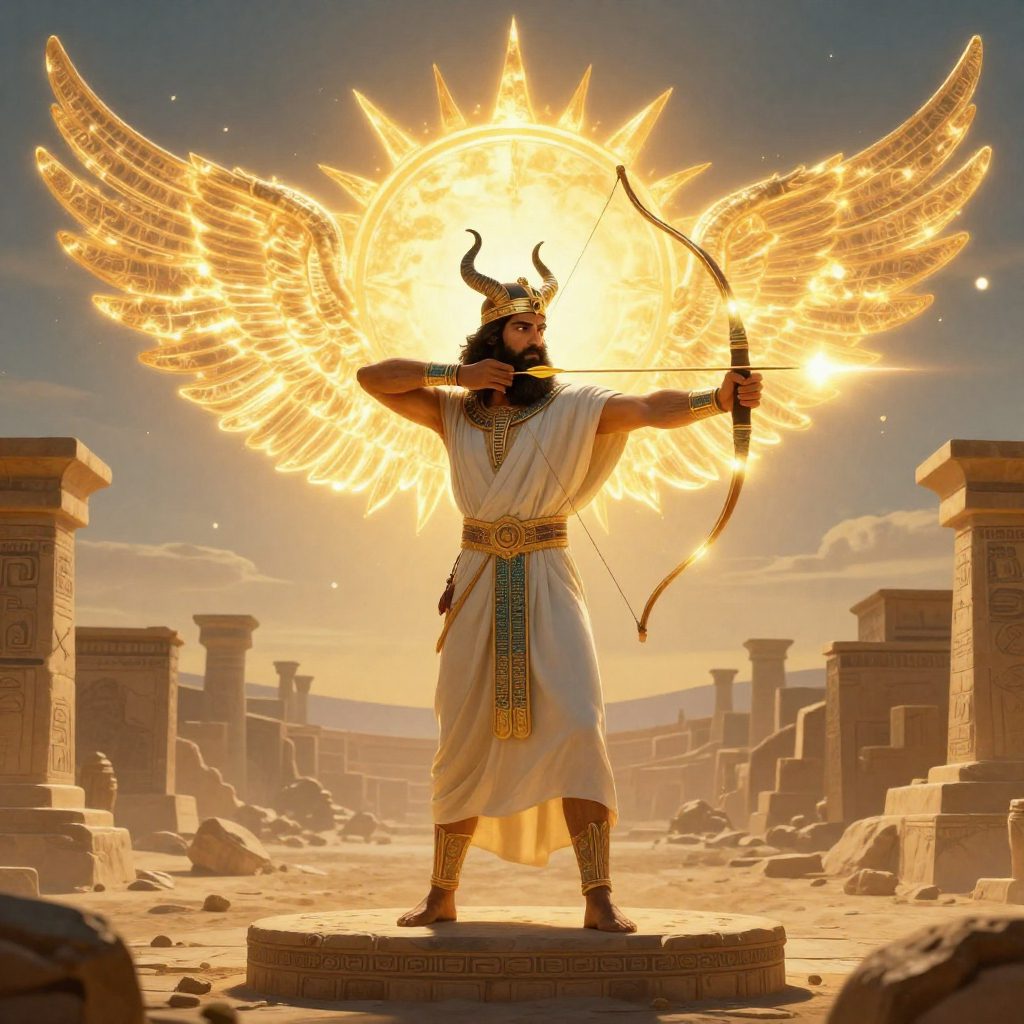
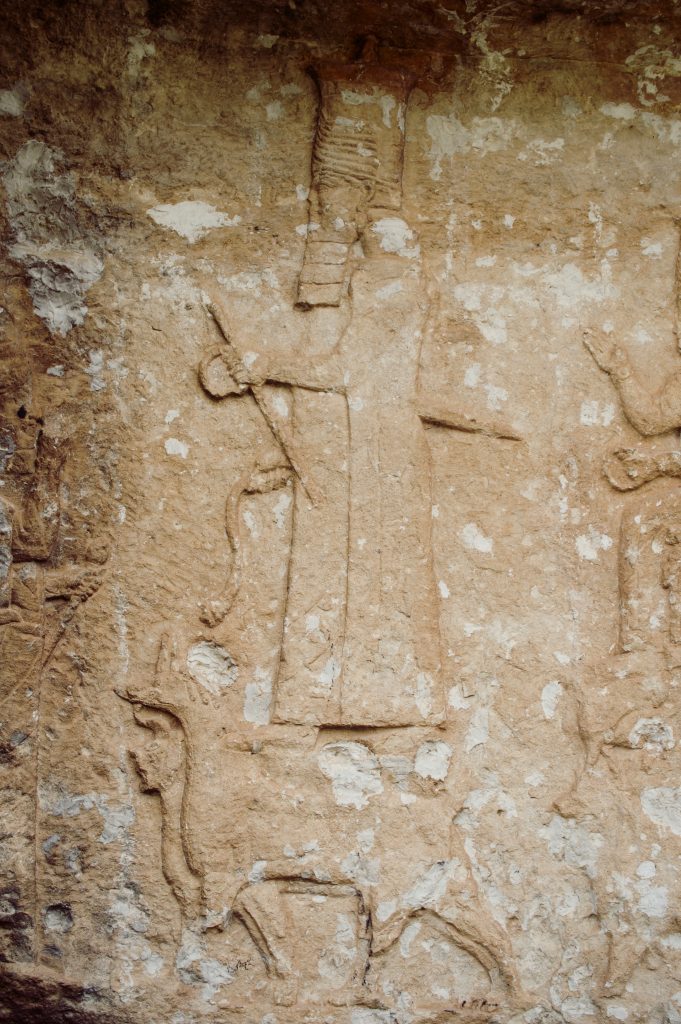
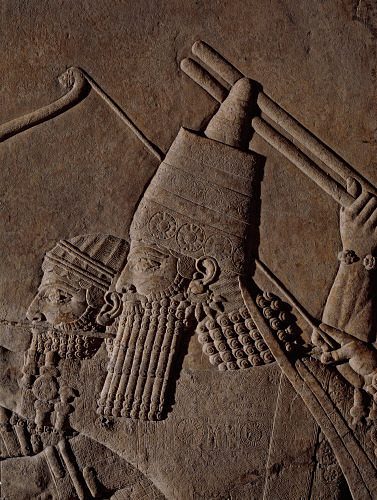
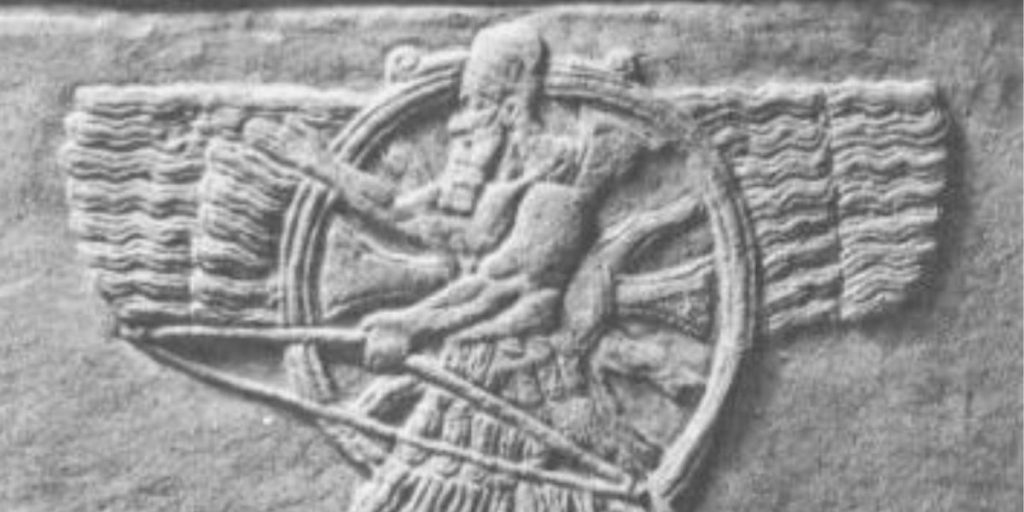
The most enduring symbol associated with Ashur is the winged disc. This emblem often appears hovering above kings in Assyrian reliefs, signifying divine sanction and protection. In some depictions, the disc encloses a bearded warrior drawing a bow, reinforcing Ashur’s role as a god of war and imperial expansion. He is frequently shown wearing a horned helmet, a traditional marker of divinity, and carrying a bow with a quiver of arrows, echoing the martial identity of the Assyrian state.
Other representations show Ashur standing upon a snake-dragon, an image adopted from Babylonian tradition and associated with cosmic dominance. While some scholars once interpreted the winged disc as a purely solar symbol, modern scholarship tends to view it as a composite emblem of divine authority, kingship, and omnipresence. The martial features appear to be later ideological additions, reflecting Assyria’s transformation into a military empire.
Family
Ashur originally possessed no defined family, as his earliest identity was that of a personified city rather than a mythological individual. As Assyria absorbed southern Mesopotamian religious frameworks, scholars and priests retroactively assigned Ashur a divine genealogy to align him with established cosmic structures.
In this reconstructed family model, Ashur inherited the wife of Enlil, Ninlil, who was renamed Mullissu in Assyrian tradition. Through this association, Ashur also adopted Ninurta and Zababa as sons, both deities linked to war and royal power. Some traditions additionally associate Ashur with Ishtar in her local manifestations, particularly Ishtar of Arbela or Nineveh, sometimes as consort and occasionally as daughter, depending on the source.
These familial connections were fluid and politically motivated rather than the result of long-standing myth. They reflect an effort to elevate Ashur into a universal supreme god without creating an entirely new cosmology. His divine household was therefore a theological construction designed to reinforce imperial ideology.
Other names
Ashur was known by several names and titles that reflected his evolving status. “Assur” was the Akkadian form most commonly used in royal inscriptions, while “Aššur” appears in earlier cuneiform sources. One of the most significant theological developments was his identification with Anshar, a primordial deity in Mesopotamian creation traditions.
During the reigns of Sargon II and Sennacherib, Assyrian scholars deliberately equated Ashur with Anshar, rewriting creation narratives so that Ashur replaced Marduk as the central cosmic hero. This reinterpretation positioned Ashur as a god present since the beginning of creation. He was also titled “King of the Gods,” “Lord of the Lands,” and “The Assyrian Enlil,” emphasising both universal authority and national identity.
Powers and Abilities
Ashur’s powers were inseparable from Assyrian statecraft. He was believed to grant kingship, legitimise rule, and command military success. Every major Assyrian campaign was framed as a sacred mission undertaken on Ashur’s behalf, and kings routinely submitted detailed battle accounts to his temple.
As a god of sovereignty, Ashur defined cosmic order through expansion. Conquest was not merely political but metaphysical, extending Ashur’s dominion over chaos. He was considered omnipresent, allowing him to be worshipped throughout the empire and enabling the absorption of local deities as aspects of his authority.
Ashur also acquired creative power through his identification with Anshar. In Assyrian versions of the creation epic, he assumes the role of the primordial force who establishes divine hierarchy. His immortality was symbolically tied to war and empire; as long as Assyria endured, Ashur remained supreme.
Modern Day Influence
Although the Assyrian Empire fell in the seventh century BCE, Ashur’s legacy persists in cultural memory. Modern Assyrian communities, many of whom are Christian, continue to regard Ashur as a symbol of ancestral identity rather than an object of worship. His winged disc appears on variations of the Assyrian flag, representing continuity and heritage.
Ashur’s theological structure also influenced early encounters with Christianity. The Assyrian familiarity with a supreme, omnipresent god eased the transition to monotheistic belief systems. Today, Ashur remains a central subject in Assyriology, archaeology, and discussions of how religion can function as state ideology.
Related Images


Source
Britannica. (2025). Ashur. Encyclopaedia Britannica. https://www.britannica.com/topic/Ashur-Mesopotamian-deity
Lambert, W. G. (1983). The god Aššur. Iraq, 45(2), 82-86. Cambridge University Press. https://www.cambridge.org/core/journals/iraq/article/god-assur/A603B74D475B587AD19173DE0462AF46
MacKenzie, D. A. (1915). Myths of Babylonia and Assyria. Sacred Texts. https://sacred-texts.com/ane/mba/mba20.htm
Tallqvist, K. (1932). Der assyrische Gott. Societas Orientalis Fennica.
Wikipedia contributors. (2025). Ashur (god). Wikipedia. https://en.wikipedia.org/wiki/Ashur_(god)[3]
World History Encyclopedia. (2017). Assur. https://www.worldhistory.org/assur/
Black, J., & Green, A. (1992). Gods, demons and symbols of ancient Mesopotamia: An illustrated dictionary. University of Texas Press.
Pongratz-Leisten, B. (2015). Religion and ideology in Assyria. De Gruyter.
Frequently Asked Questions
Who was Ashur in Assyrian religion?
Ashur was the national god of Assyria and the supreme deity of its pantheon, representing kingship, war, and imperial authority.
Was Ashur originally a city god?
Yes, Ashur began as the local god of the city of Ashur before being elevated as Assyria expanded.
Is Ashur connected to Anshar?
Assyrian scholars identified Ashur with Anshar to place him at the centre of creation myths.
What symbol is associated with Ashur?
The winged disc is the most common symbol associated with Ashur, representing divine authority.
Is Ashur still worshipped today?
Ashur is not actively worshipped but remains a cultural and historical symbol for Assyrian identity.