


Asag : The Sumerian Demon Who Challenged the Gods
At a glance
| Description | |
|---|---|
| Origin | Sumerian Mythology |
| Classification | Hybrids |
| Family Members | N/A |
| Region | Iraq |
| Associated With | Mountains, Stones, Destructive supernatural power, Disease |
The Mythlok Perspective
In Mythlok’s Perspective, Asag is more interesting as a force of disrupted landscape than as a conventional demon. Unlike monsters whose purpose is simply destruction, Asag challenges civilisation through the mountains, stones and waters that surround it. His confrontation with Ninurta resembles a wider mythic pattern in which divine order is established by mastering untamed nature. What makes Asag distinctive is that his defeat does not simply remove a threat; it transforms the same landscape into the source of fertility and abundance.
Asag
Introduction
Asag is one of the most formidable monstrous beings in Sumerian mythology, best known from the Sumerian poem Lugal-e, often translated as The Exploits of Ninurta. The story centres on a confrontation between Asag and Ninurta, the warrior god and son of Enlil. Rather than presenting Asag simply as a generic demon of evil, the poem places him within a wider mythic landscape of mountains, stones, hostile forces and disrupted water systems.
In Lugal-e, Asag emerges from the mountains as a powerful and rebellious figure. The text describes him as a warrior who knows no fear and portrays his influence as sufficiently dangerous that cities and even gods are threatened by his authority. His stone offspring raid settlements, while Asag establishes himself as a ruler capable of passing judgement over the land. The image is therefore not merely that of a monster attacking civilisation; Asag represents a rival power establishing its own order in opposition to Ninurta and the established divine hierarchy.
The myth culminates in Ninurta’s defeat of Asag. After overcoming him, Ninurta declares that Asag will henceforth be called “Stone.” The transformation becomes part of the poem’s larger explanation of how mountains and waters are brought under control. Ninurta gathers stones, manages the mountain waters and channels them towards the Tigris, allowing agricultural land to become fertile again. Asag’s defeat therefore connects warfare, landscape and agriculture in a distinctly Mesopotamian mythological framework.
Physical Traits
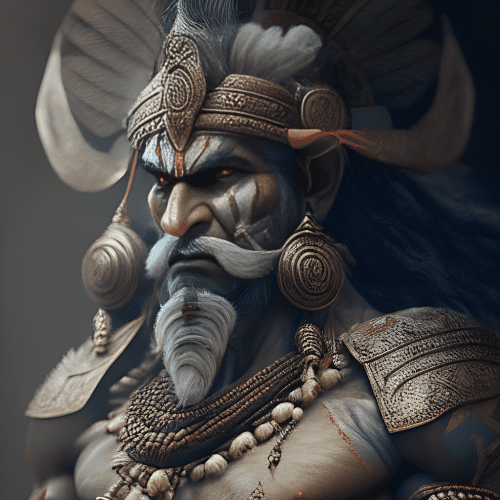
The ancient evidence does not provide a single, detailed anatomical portrait of Asag. Modern descriptions sometimes portray him with multiple arms and legs, numerous eyes, scales, horns, talons or a rock-like body, but these features should not be presented as though they form one securely attested description from Lugal-e. The surviving Sumerian text instead focuses much more strongly on Asag’s terrifying presence, strength, mountain association and supernatural effects.
One of the most famous descriptions associated with Asag is that his presence is so destructive that fish are said to boil alive in the rivers. This image captures the extreme environmental danger represented by the demon. Asag is not simply frightening to look at; his existence itself disturbs the natural world.
The poem also repeatedly associates him with the mountains. He is described as a powerful figure born from or emerging through the relationship between heaven and the green earth, and he becomes established in the mountainous regions. His connection with stones is particularly important because his offspring are identified through different types of stone, turning the mountain landscape itself into an army.
For this reason, the most reliable way to visualise Asag is as a monstrous, supernatural mountain being rather than as a creature with a fixed fantasy-style anatomy. His physical identity is inseparable from stone, mountains and the hostile landscape beyond the cultivated Mesopotamian plain.
Family
Asag’s family relationships require some caution because modern summaries frequently simplify the ancient text. Lugal-e describes heaven and the verdant earth as being involved in his birth, but the passage does not straightforwardly establish the familiar genealogy of “An and Ki as his father and mother” in the way modern encyclopedias sometimes imply. The text actually presents Asag as a warrior born through the interaction of heaven and the green earth and explicitly describes him as knowing no father.
His most important family relationship in the story is therefore with his stone offspring. Asag produces offspring in the mountains, and these beings are associated with named varieties of stone, including diorite, hematite and other stones. They function collectively as warriors who raid cities and support Asag’s authority.
This is significant because the offspring are more than a monstrous brood. They turn geological material into living political and military forces. The mountains become populated by beings that recognise Asag as their king, creating a rival kingdom that Ninurta must overcome.
The idea that Asag specifically “mated with the mountains” is therefore better treated as an interpretive summary of the myth rather than as a simple genealogical statement. The ancient poem’s imagery is more complex, linking Asag’s birth, the mountains and the generation of stone beings.
Other names
Asag is also written Azag, and the figure is associated with the Akkadian term Asakku. These names are related, but they should not automatically be treated as perfectly interchangeable in every Mesopotamian text.
Asag is the Sumerian name most closely associated with Lugal-e. The Akkadian asakku, meanwhile, also appears in Mesopotamian magical and medical traditions as a disease-associated supernatural being. Asakku is particularly connected with fever and illnesses affecting the head, and scholarly discussions distinguish between the mythological figure and the broader demonological or disease terminology found in later Akkadian sources.
This distinction matters because describing Asag simply as “the Sumerian word for Asakku” can blur several centuries of changing Mesopotamian religious vocabulary. The names are closely connected, but their meanings and uses developed across different textual traditions.
Powers and Abilities
Asag’s greatest power is his ability to disrupt the natural and social order. His presence is associated with extreme environmental effects, most famously the image of fish boiling in rivers. Within Lugal-e, he also commands the loyalty of powerful stone offspring that raid cities and cause the inhabitants and gods of those regions to fear him.
Asag’s authority is especially striking because he does not remain a creature hiding outside civilisation. He establishes a throne and acts as a ruler, even making decisions concerning the land. The poem therefore presents his threat as both physical and political. He is challenging Ninurta’s authority by establishing an alternative centre of power in the mountains.
His association with disease comes more clearly from the related Akkadian Asakku tradition. Mesopotamian medical and magical texts connect the asakku with fever, headache and several illnesses, although the precise identification of ancient diseases is often uncertain. Scholarly research identifies Asakku with illnesses including fever and conditions associated with high body temperature, making the demon an important example of the way disease could be personified within Mesopotamian thought.
Asag’s final and most important weakness is Ninurta. In Lugal-e, Ninurta defeats him and declares that his name will henceforth be “Stone.” The aftermath is crucial: Ninurta uses stones to control the mountain waters, gathering scattered waters and directing them towards the Tigris. The myth thus turns Asag’s defeat into a story about controlling a dangerous landscape and restoring agricultural abundance.
Modern Day Influence
Asag has a much stronger presence in the study of ancient Mesopotamia than in modern mainstream popular culture. Unlike figures such as Gilgamesh, Ishtar or Pazuzu, Asag has not become a major recurring character in contemporary film, television or popular fantasy. His modern importance comes primarily from the preservation and interpretation of Lugal-e and from scholarship on Mesopotamian mythology, demonology, medicine and ancient concepts of landscape.
The character remains particularly valuable to researchers because Asag occupies several categories at once. He is a monstrous adversary of Ninurta, a mountain-associated power, the source of stone warriors and a figure connected through the related Asakku tradition with disease. His story also preserves an important Mesopotamian concern with the relationship between the cultivated lowlands and the mountains beyond them.
The surviving text has attracted attention because its ending connects divine warfare with the management of water. After defeating Asag, Ninurta gathers mountain waters and directs them towards the Tigris, allowing fields to receive water and crops to flourish.
Modern interpretations therefore tend to see Asag as more than a conventional “demon.” He can be understood as a mythological embodiment of dangerous mountain power, political rebellion, environmental disorder and, through the related Asakku tradition, sickness. His enduring value lies in the way these ideas are woven together into a single story of conflict, landscape and renewal.
Related Images


Source
Black, J., & Green, A. (1992). Gods, demons and symbols of ancient Mesopotamia: An illustrated dictionary. British Museum Press.
Delirium’s Realm. (2023, September 8). Babylonian and Assyrian demonology. https://www.deliriumsrealm.com/assyrian-babylonian-demonology/
Electronic Text Corpus of Sumerian Literature. (n.d.). Ninurta’s exploits (Lugal-e). University of Oxford. https://etcsl.orinst.ox.ac.uk/section1/tr162.htm
Gadsby, P. (n.d.). Asag: Mountain chaos-demon slain by Ninurta. Gods and Monsters. https://godsandmonsters.info/asag/
Monstropedia. (n.d.). Asag. http://www.monstropedia.org/index.php?title=Asag
Wikipedia. (n.d.). Asag. https://en.wikipedia.org/wiki/Asag
Wikipedia. (n.d.). Asakkū marṣūtu. https://en.wikipedia.org/wiki/Asakk%C5%AB_mar%E1%B9%A3%C5%ABtu
Jacobsen, T. (1976). The Treasures of Darkness: A History of Mesopotamian Religion. Yale University Press.
Kramer, S. N. (1961). Sumerian Mythology: A Study of Spiritual and Literary Achievement in the Third Millennium BC. University of Pennsylvania Press.
Frequently Asked Questions
Who is Asag in Sumerian mythology?
Asag is a powerful monstrous being from Sumerian mythology, best known from the poem Lugal-e. He is associated with the mountains, stone warriors and a threat to divine authority before being defeated by the warrior god Ninurta.
What is Asag known for?
Asag is best known for his terrifying power, his association with the mountains and stones, and his confrontation with Ninurta. The myth also describes the extraordinary destructive effect of his presence, including the famous image of fish boiling in rivers.
Who defeated Asag?
The Sumerian god Ninurta defeated Asag in Lugal-e. Following the battle, Ninurta declared that Asag would henceforth be called Stone and subsequently used stones to control mountain waters and direct them towards the Tigris.
Is Asag the same as Asakku?
Asag and Asakku are closely related names and traditions, but they should not always be treated as exactly the same figure. Asag is the Sumerian monster of Lugal-e, while the Akkadian asakku also appears in magical and medical texts as a disease-associated demon, particularly connected with fever and illness.
What does Asag represent?
Asag can be understood as representing dangerous mountain power, rebellion against established divine authority and disruption of the natural order. His defeat by Ninurta is closely connected with the restoration of water management, agriculture and stability in the Mesopotamian landscape.
