


Anulap : The Chuukese Sky God of Knowledge and Magic
Mythlok Perspective
In Mythlok’s Perspective, Anulap is interesting when compared with Brahma from Indian mythology. Both are connected with creation and the transmission of knowledge, but their mythological roles are distinctly different. Anulap is a Chuukese sky deity associated with magic and sacred knowledge, remembered as a supernatural source of wisdom passed to humanity. Brahma, by contrast, is traditionally regarded as the creator deity responsible for bringing the cosmos and living beings into existence. Together, they illustrate how different cultures connect divine authority with the origins of knowledge and creation.
Anulap
Introduction
Anulap is a prominent deity in the traditional mythology of the Chuuk Islands, formerly known as the Truk Islands, in Micronesia. His name is closely associated with the sky, supernatural knowledge, and magic, placing him among the most significant spiritual beings in Chuukese traditions. Unlike deities whose stories center primarily on warfare or natural disasters, Anulap is particularly connected with the transmission of sacred knowledge and supernatural abilities to humanity.
Traditional accounts portray Anulap as a powerful spirit who occupies a high position within the supernatural world. He is sometimes described as a creator or as a figure involved in the ordering of the world, although creation traditions differ among the islands and communities of Chuuk. His importance extends beyond a single myth, forming part of a broader religious system in which gods, ancestral spirits, mediums, and supernatural forces interacted with human life.
Anulap’s association with knowledge is especially significant. In traditions surrounding him, magic was not simply an act of entertainment or deception but a form of specialized knowledge that could be transmitted to humans. Through this role, Anulap represents the connection between the divine realm and human understanding.
Physical Traits
Traditional sources provide little reliable information about Anulap’s physical appearance. Unlike some mythological figures who are described through distinctive clothing, weapons, bodily features, or animal characteristics, Anulap is primarily understood through his supernatural identity and his position within the spiritual hierarchy.
As a sky-associated deity, he can be understood as belonging to a realm beyond ordinary human existence. His lack of a standardized physical description is consistent with the way many Chuukic spiritual beings were understood: their importance lay in their supernatural presence and powers rather than in a fixed human-like appearance.
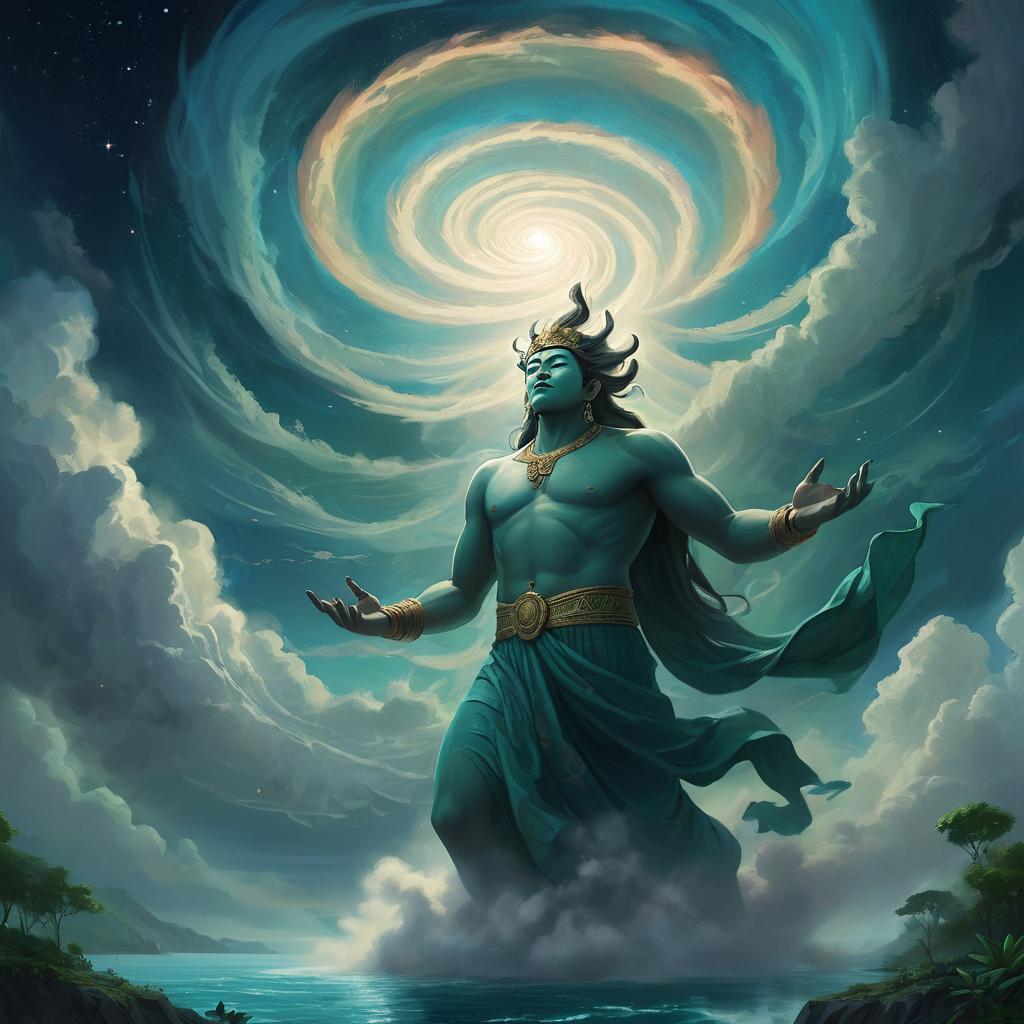
For modern artistic interpretations, Anulap can therefore be represented as a dignified supernatural figure associated with the open sky and the spiritual world. Any specific clothing, physical features, or visual symbols should be treated as artistic interpretations rather than established elements of traditional mythology.
Family
Anulap occupies an important place within several Chuukic divine genealogies. One tradition identifies him with Ligobubfanu, a creator goddess, with whom he is associated in accounts concerning the creation or ordering of the world. Their son is known in different traditions as Lugeilang or Lukeilang.
Lukeilang subsequently becomes the father of Olofat, also known as Olifat or Wonofáát, one of the best-known trickster figures in the mythology of the Caroline Islands. Through this relationship, Anulap stands at the beginning of a lineage that eventually produces one of Micronesia’s most celebrated culture heroes and tricksters.
The names and relationships within this genealogy vary between islands and narrative traditions. These variations reflect the oral nature of Chuukic mythology, where stories were transmitted through different communities and adapted over generations. Nevertheless, the recurring relationship between Anulap, Lukeilang, and Olofat establishes Anulap as an important ancestral figure within the supernatural family.
His connection with Olofat is particularly significant because the two represent very different aspects of the mythological world. Anulap embodies supernatural knowledge and divine authority, while Olofat is characterized by cleverness, mischief, transformation, and the ability to challenge established boundaries.
Other Names
Anulap is the most commonly recognized name for the deity, but variations appear in sources documenting the languages and traditions of the Caroline Islands. Enúúnap, sometimes written as Enuunap or Anunap, is one of the principal variant forms associated with him. Differences in spelling and pronunciation reflect the linguistic diversity of Micronesia and the way oral traditions were recorded by outside researchers. The same mythological figure can therefore appear under slightly different names depending on the island, language, or transcription system being used.
These variations are particularly important when studying Chuukic mythology because the traditions of individual islands were not always identical. Rather than indicating entirely separate gods, different names can preserve regional forms of the same or closely related supernatural figure.
Powers and Abilities
Anulap is most strongly associated with magic and knowledge. Traditional accounts describe him as a source of supernatural knowledge who passed magical abilities and understanding to humanity. This makes him an important intermediary between the supernatural realm and the human world.
His knowledge was not limited to ordinary learning. Magic in traditional Micronesian societies could encompass specialized forms of supernatural power, ritual knowledge, healing practices, divination, and techniques believed to influence circumstances beyond normal human control. Anulap’s association with magic therefore reflects the broader importance of esoteric knowledge within traditional Chuukic society.
Anulap is also connected with the sky and the higher spiritual realm. His position among the powerful sky-associated beings gives him authority beyond that of ordinary spirits and places him near the highest levels of the traditional supernatural order.
Some traditions further connect Anulap with creation and cosmic ordering. In these accounts, his relationship with the creator goddess Ligobubfanu places him within stories explaining how the world came into existence or acquired its structure. However, creation narratives vary among Chuukic communities, and Anulap’s exact role differs from one tradition to another.
His most enduring characteristic remains his possession and transmission of knowledge. Through this role, Anulap represents the belief that important forms of wisdom are not merely discovered by humans but can originate from the supernatural world.
Modern Day Influences
Anulap remains an important figure for understanding the traditional religious heritage of Chuuk and the wider Caroline Islands. Although the traditional religious system in which he was worshipped has undergone major changes through Christianity, colonial contact, modernization, and social transformation, Anulap continues to appear in discussions of Chuukese mythology and cultural history.
His importance today is particularly visible through scholarship, oral tradition, cultural documentation, and the preservation of indigenous stories. Researchers studying traditional Chuukic religion continue to encounter Anulap in accounts concerning supernatural power, divine genealogies, spirit relationships, and the transmission of magical knowledge.
The stories surrounding Anulap also remain significant because they connect several major themes in Micronesian storytelling: the relationship between humans and supernatural beings, the origin of sacred knowledge, the structure of the spiritual world, and the complicated relationship between divine authority and human agency.
His connection to Olofat gives his mythology an additional cultural legacy. Stories of Olofat became widely known throughout the Caroline Islands, and understanding the trickster’s supernatural ancestry provides a broader context for those narratives.
Anulap therefore represents more than a single sky deity. He embodies an older Chuukic understanding of knowledge as something powerful, sacred, and capable of crossing the boundary between the human and supernatural worlds. His mythology preserves a worldview in which magic, wisdom, ancestry, and the forces of the sky were deeply interconnected.
For modern audiences, Anulap offers a window into the intellectual and spiritual traditions of Chuuk. His stories demonstrate that Micronesian mythology is not simply a collection of tales about supernatural beings but a complex system of ideas concerning where knowledge comes from, how it is transmitted, and how humans relate to the unseen world.
Related Images


Sources
Encyclopedia.com. (n.d.). Micronesian religions: Mythic themes. In Encyclopedia of Religion. Retrieved October 31, 2025, from https://www.encyclopedia.com/environment/encyclopedias-almanacs-transcripts-and-maps/micronesian-religions-mythic-themes
Wikipedia contributors. (2025, October 31). Micronesian mythology. In Wikipedia, The Free Encyclopedia. Retrieved from https://en.wikipedia.org/wiki/Micronesian_mythology
Wikipedia contributors. (2025, October 31). Anulap. In Wikipedia, The Free Encyclopedia. Retrieved from https://en.wikipedia.org/wiki/Anulap
Pantheon.org. (n.d.). Anulap – Micronesian god of knowledge and magic. In Encyclopedia Mythica. Retrieved October 31, 2025, from https://pantheon.org/articles/a/anulap.html
Marshall Islands Mission of the Micronesian Seminar (MICSEM). (n.d.). Summoning the powers beyond: The religion of the Chuukic-speaking islands. Retrieved October 31, 2025, from https://www.micsem.org/pubs/books/Summoning-the-Powers-Beyond.pdf
Pulotu Database. (n.d.). Chuuk culture. Retrieved October 31, 2025, from https://pulotu.com/culture/chuuk
Leach, M. (Ed.). (1984). Funk & Wagnalls Standard Dictionary of Folklore, Mythology, and Legend (Vol. 1–2). New York, NY: Harper & Row.
Frequently Asked Questions
Who is Anulap in Chuukese mythology?
Anulap is one of the central deities in Chuukese (Micronesian) mythology, revered as a god of wisdom, knowledge, and creation. He is often depicted as a cosmic teacher who imparts skills, moral understanding, and the arts of civilization to humankind. Along with his wife, Ligobubfanu, and his grandson, Luk, Anulap plays a vital role in shaping both the physical and spiritual world.
What is Anulap known for in Chuukese culture?
Anulap is primarily known as a creator and teacher. He is credited with giving humanity essential knowledge—such as navigation, craftsmanship, and moral conduct—making him a patron of both intellect and ethics. In some traditions, he also participates in the creation of the universe and is regarded as a divine architect of order from chaos.
Who are the family members of Anulap?
In Chuukese mythology, Anulap is married to the goddess Ligobubfanu, and together they have a grandson named Luk, who is often associated with human creation and the shaping of the islands. This divine triad—Anulap, Ligobubfanu, and Luk—represents the cosmic lineage of creation and the transmission of divine wisdom across generations.
How does Anulap influence human life and values?
Anulap’s teachings form the foundation of Chuukese cultural identity. He embodies the principles of balance, respect, and knowledge, guiding humans to live harmoniously with nature and each other. His influence is often reflected in navigation traditions, oral storytelling, and ethical codes that value wisdom over force.
Is Anulap worshipped or remembered in modern Chuukese traditions?
While formal worship of Anulap has diminished with the spread of Christianity in Micronesia, his legacy endures through oral traditions, folklore, and cultural rituals that celebrate ancestral wisdom. Modern Chuukese people still recognize Anulap as a symbol of intelligence, leadership, and the sacred duty to preserve knowledge for future generations.


