Chuukese Mythology
Chuukese mythology reflects the diverse traditional beliefs of the people of Chuuk, a group of islands and atolls in the Federated States of Micronesia. These traditions developed within a world shaped by lagoons, reefs, ocean voyages, tropical forests, and powerful storms. Rather than forming one uniform religious system, Chuukese traditions varied between communities and islands, with spiritual beliefs closely connected to everyday concerns such as food, fishing, weather, illness, warfare, death, and the transmission of knowledge.
At the center of traditional Chuukese religion was a broad spiritual world known as énú. The term could refer to spirits, gods, ghosts, demons, and the souls of the dead. Spirits were understood to inhabit different parts of the natural and supernatural worlds, including the sky, ocean, reefs, and other significant places. Some were associated with particular communities or activities and could be approached for protection, knowledge, or assistance.
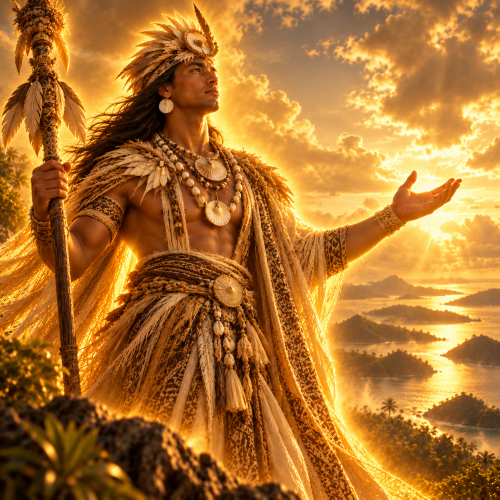
Among the most important supernatural figures was Anulap, whose name is often translated as “Great Spirit.” Traditional accounts describe him as an uncreated sky deity and place him at the beginning of an important divine genealogy. Anulap is associated with Lugeilang, while Lugeilang’s descendants include the famous trickster Olofat. The precise relationships and attributes of these figures vary between traditions, reflecting the localized character of Chuukic religion.
Ligobubfanu is also identified in traditional accounts as a creator goddess and the wife of Anulap. She is described as the mother of Lugeilang, making her part of the divine lineage that eventually leads to Olofat. Surviving sources provide considerably less narrative material about Ligobubfanu than about Olofat, so her role is best presented through this genealogy rather than through elaborate attributes that may belong to later interpretations.
Perhaps the best-known character in Chuukese mythology is Olofat, also spelled Olifat, Wolfat, or Iolofath. He is a powerful trickster figure and the subject of numerous traditional stories. Olofat is clever, mischievous, unpredictable, and frequently challenges other supernatural beings. Some traditions describe him as the grandson of Anulap, while stories from the wider Caroline Islands preserve related versions of his adventures.
Olofat’s stories often involve deception, transformation, conflict with other supernatural beings, and attempts to obtain knowledge or useful things for humanity. Fire is particularly important in some versions of his mythology, where Olofat is associated with bringing fire to humans. These stories present him not simply as a hero but as an unpredictable figure whose intelligence allows him to overcome beings more powerful than himself.
Traditional Chuukese religion also included specialists known as sowu, who possessed roong, or specialized spiritual knowledge. Such knowledge could be used in rituals and other interactions with supernatural powers. This demonstrates that mythology was not separated from practical life but formed part of a broader system for understanding illness, food production, natural disasters, social relationships, and other challenges facing island communities.
Chuukese mythology therefore cannot be reduced to a single creation story or fixed pantheon. It is better understood as a collection of interconnected traditions in which sky gods, ancestral spirits, supernatural beings, specialists, and culture heroes occupy different roles. The stories of Anulap, Ligobubfanu, Lugeilang, and especially Olofat preserve a distinctive Micronesian tradition in which the supernatural world remains closely connected to the practical realities of island life.