


Am Fear Liath Mòr : The Scottish Big Grey Man of Ben MacDhui
At a glance
| Description | |
|---|---|
| Origin | Scottish Mythology |
| Classification | Spirits |
| Family Members | N/A |
| Region | Scotland |
| Associated With | Ben MacDhui, Cairngorms, Mountain mist, Unexplained footsteps, Fear, Isolation |
The Mythlok Perspective
In Mythlok’s Perspective, Am Fear Liath Mòr is more compelling than many cryptids because its power comes from uncertainty rather than physical evidence. Unlike Bigfoot, which is imagined as a tangible creature, the Grey Man remains inseparable from the mountain itself—heard more often than seen and experienced more often than explained. That makes him closer to a landscape spirit than a cryptid, turning Ben MacDhui’s mist, isolation and danger into an active part of the legend.
Am Fear Liath Mòr
Introduction
Am Fear Liath Mòr, meaning “Big Grey Man” in Scottish Gaelic, is one of the most unsettling figures associated with the mountains of Scotland. The legend centres on Ben MacDhui, the highest mountain in the Cairngorms and the second-highest mountain in Britain after Ben Nevis. Here, mountaineers have reported hearing unexplained footsteps, sensing an unseen presence, or glimpsing a huge human-like figure moving through mist and poor visibility.
The modern story of Am Fear Liath Mòr is closely connected with Professor J. Norman Collie, a chemist and experienced mountaineer. In 1925, Collie described an experience from 1891 in which he heard repeated crunching footsteps behind him while descending Ben MacDhui in mist. He could not see anyone, yet the sound seemed to follow him, producing an intense and inexplicable terror that caused him to flee several miles from the summit. Importantly, Collie himself did not originally call the presence Am Fear Liath Mòr. His account was later connected with the already developing Grey Man tradition because of its similarity to other mountain encounters.
The legend therefore sits somewhere between folklore, ghost story and mountaineering mystery. Some witnesses have interpreted the experience as an encounter with a supernatural being, while others have suggested exhaustion, weather, isolation, optical illusions or misidentified natural sounds. Modern folklore research treats both interpretations as part of the story’s cultural significance.
Physical Traits
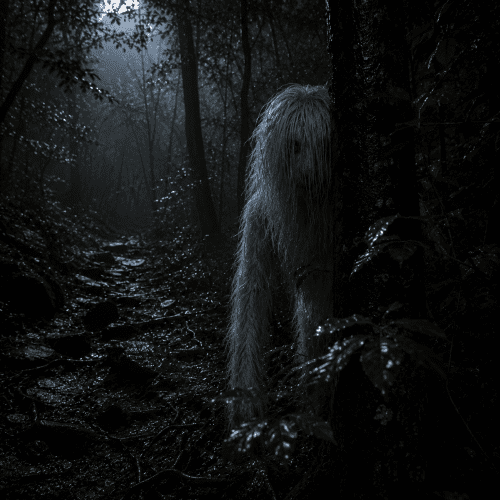
Descriptions of Am Fear Liath Mòr are remarkably inconsistent, which is one of the reasons the figure is difficult to define as a conventional mythological creature. When the Grey Man is perceived visually, accounts generally describe a very tall, human-shaped figure appearing through mist. Recent folklore research identifies roughly ten feet as a recurring estimate, although popular retellings sometimes give considerably greater heights.
The most reliable descriptions emphasize scale and silhouette rather than detailed anatomy. The figure is often perceived as taller than an ordinary human, with a vaguely humanoid shape that becomes difficult to distinguish from the surrounding landscape. Mist, rain and snow are recurring elements in these encounters, making the Grey Man appear indistinct and almost inseparable from the mountain itself.
Later retellings have expanded this image into a much more monstrous creature, sometimes giving it long arms, broad shoulders, grey or brown hair, unusual feet, pointed ears and other exaggerated features. These details should be treated cautiously. They are not consistently present in the earliest accounts, and the 2025 folkloristic study notes that actual encounters are often visually vague. In many reported experiences, the Grey Man is not seen at all. Instead, people hear footsteps or simply experience the disturbing conviction that something is nearby.
This uncertainty is central to the character. Am Fear Liath Mòr is frightening precisely because the witness may never know whether there was a figure on the mountain or whether the mountain itself created the impression of one.
Family
Am Fear Liath Mòr has no recorded family, parents, offspring or established lineage. Unlike gods, legendary heroes or supernatural races with identifiable genealogies, the Grey Man is tied almost completely to a particular landscape rather than to a supernatural family.
The strongest association is with Ben MacDhui and the wider Cairngorms, although accounts connected with the Grey Man have also appeared elsewhere in the Scottish mountains. The 2025 study notes that the figure has been reported on other Cairngorm summits, demonstrating that the legend is broader than a single peak even though Ben MacDhui remains its defining location.
There are also comparisons with other grey or mountain-associated supernatural figures, but these should not be treated as relatives. Such parallels are useful for comparative folklore rather than evidence of a shared family tree. Am Fear Liath Mòr is best understood as a solitary mountain presence whose identity is inseparable from the landscape where people claim to encounter it.
Other names
The most common name is Am Fear Liath Mòr, usually translated as “Big Grey Man.” The figure is also known in English as the Big Grey Man of Ben MacDhui or simply the Grey Man or Greyman. Historical and folkloric sources also contain spelling variations such as Fear Liath Mòr, Ferla Mòr and related forms. The name itself is descriptive rather than genealogical. It identifies the figure through appearance and scale while connecting him directly with the Highland landscape.
The Grey Man is sometimes compared with other supernatural figures, including the Welsh Brenin Llwyd, or Grey King, and with broader traditions of mountain ghosts and wild men. Such comparisons highlight recurring folklore themes: isolated landscapes, poor visibility, unexplained sounds and encounters with mysterious human-like figures.
Am Fear Liath Mòr is also frequently discussed alongside the Brocken spectre, an optical phenomenon in which an observer’s shadow can be projected onto mist or cloud and appear enormously enlarged. A Brocken spectre may explain some visual experiences associated with the legend, although it cannot account for every reported encounter, particularly those involving unexplained footsteps or a purely auditory sense of presence.
Powers and Abilities
Traditional accounts do not provide Am Fear Liath Mòr with a formal set of supernatural powers. Instead, the figure is defined by the effects witnesses associate with its presence.
The most prominent characteristic is the ability to inspire sudden and overwhelming fear. Norman Collie’s experience is the classic example: he heard footsteps behind him but could see nothing, and the unexplained presence produced such intense terror that he ran from the mountain. Other witnesses have similarly described feeling watched, followed, uncomfortable or compelled to leave the summit.
The Grey Man is also associated with unexplained sounds, particularly footsteps crunching across snow, gravel or rocky ground. These sounds may appear to follow the witness even when no person can be found. Some accounts involve sudden environmental changes, such as increasing cold, darkness or worsening visibility, although these experiences are closely intertwined with the naturally severe conditions of the Cairngorms.
Stealth and obscurity are therefore better understood as characteristics of the legend than literal magical abilities. The Grey Man is rarely encountered clearly and seems to emerge from fog, rain, snow and isolation.
Natural explanations remain an important part of the tradition. Mountaineers have suggested falling rocks, wind moving through the terrain, animals, fatigue, disorientation and heightened perception. The Brocken spectre and pareidolia have also been proposed for some visual encounters. Contemporary Scottish mountaineers interviewed for a 2025 study generally regarded the Grey Man as a folkloric figure rather than a physically existing creature, while still accepting that earlier witnesses experienced something genuinely frightening.
Modern Day Influence
Am Fear Liath Mòr continues to occupy an unusual position between Scottish folklore, mountaineering culture and modern cryptid lore. The story remains strongly associated with Ben MacDhui, where the combination of extreme weather, isolation, mist and difficult terrain provides a natural setting for supernatural storytelling. Academic research has shown that the legend has become part of the way people understand and engage with the Cairngorm landscape, regardless of whether they believe the Grey Man actually exists.
The story has also entered popular culture. The 2024 horror film Am Fear Liath, directed by Pauric Brennan, draws directly on the legend, demonstrating how the Grey Man has moved beyond mountaineering folklore into contemporary horror.
Yet the enduring appeal of Am Fear Liath Mòr does not depend on proving that a giant creature walks the Cairngorms. Its power lies in the uncertainty surrounding the encounters. A sound behind a lone climber, a shadow enlarged by mist, a sudden wave of fear or a human shape glimpsed through cloud can become something much larger in the imagination.
That makes the Grey Man particularly distinctive within Scottish mythology. He is not a god demanding worship or a heroic figure remembered for great deeds. He is a presence created at the meeting point between human perception and an unforgiving landscape. Whether understood as a ghost, spirit, illusion or legend, Am Fear Liath Mòr remains the shadow of Ben MacDhui: a figure whose greatest mystery is that nobody can say with certainty what, if anything, was actually there.
Related Images



Source
Borthwick, A. (1939). Always a little further. D. McKay.
Eberhart, G. M. (2002). Mysterious creatures: A guide to cryptozoology. ABC-CLIO.
Grey, A. (1970). The big grey man of Ben MacDhui. Impulse Books.
Knight, J. (1980). A–Z of ghosts and supernatural. Lutterworth Press.
Lamont-Brown, R. (1939). Scottish folklore. Batsford.
MacKillop, J. (2004). Dictionary of Celtic mythology. Oxford University Press.
McEwan, G. J. (1986). Mystery animals of Britain and Ireland. Robert Hale.
Redfern, N. (2004). Three men seeking monsters: Six weeks in pursuit of werewolves, lake monsters, giant cats, ghostly devil dogs, and ape-men. Paraview Pocket Books
Affifi, T. (2024, March 16). Who or what is the Big Grey Man of Ben Macdui? BBC News. https://www.bbc.com/news/articles/c2lwxj4dq5go
Frequently Asked Questions
What is Am Fear Liath Mòr?
Am Fear Liath Mòr is a Scottish Gaelic name meaning “Big Grey Man.” It refers to a legendary, ghost-like human presence associated primarily with Ben MacDhui in the Cairngorms.
Where is Am Fear Liath Mòr said to live?
The Grey Man is primarily associated with Ben MacDhui, the highest mountain in the Cairngorms and the second-highest mountain in Britain after Ben Nevis. Accounts have also connected the phenomenon with other Scottish mountain summits.
What does Am Fear Liath Mòr look like?
Reports usually describe a very tall, indistinct human-like figure appearing in mist. Detailed descriptions vary considerably, while many encounters involve no visual sighting at all and instead feature footsteps or a powerful sense of presence.
Is Am Fear Liath Mòr a cryptid?
Am Fear Liath Mòr is sometimes treated as a cryptid in modern popular culture, but Scottish folklore and recent academic research more commonly frame it as a ghost-like or supernatural mountain presence. There is no confirmed physical evidence establishing it as a real creature.
What explains the legend of the Big Grey Man?
Proposed explanations include mist and poor visibility, exhaustion, isolation, misidentified sounds, pareidolia and the Brocken spectre optical phenomenon. These explanations may account for some experiences, but the folklore remains culturally significant regardless of whether the phenomenon has a natural or supernatural explanation.


