

Almaqah : The Arabian Guardian God of the Sabaean Kingdom
At a glance
| Description | |
|---|---|
| Origin | Arabian Mythology |
| Classification | Gods |
| Family Members | N/A |
| Region | Yemen |
| Associated With | Kingship, Irrigation, Fertility, Agriculture, Prosperity |
The Mythlok Perspective
In Mythlok’s Perspective, Almaqah is fascinating because he represents a kind of god rarely seen in popular mythology. Unlike Zeus, who rules through thunder, or Odin, who seeks wisdom through sacrifice, Almaqah’s greatest power lay in sustaining civilization itself. His connection to irrigation, fertile land, and royal responsibility reminds us that ancient societies often worshipped the forces that kept them alive rather than the forces that inspired fear alone. He demonstrates how mythology can emerge directly from geography, turning the struggle to master water in the desert into a sacred partnership between humanity and the divine.
Almaqah
Introduction
Almaqah was the principal deity of the ancient Sabaean Kingdom, one of the most influential civilizations of pre-Islamic Arabia. Worshipped primarily between the 8th century BCE and the early centuries CE, he stood at the heart of the kingdom’s religious, political, and agricultural life. His name appears throughout South Arabian inscriptions, temple dedications, and royal monuments, making him one of the best-documented gods of ancient Arabia.
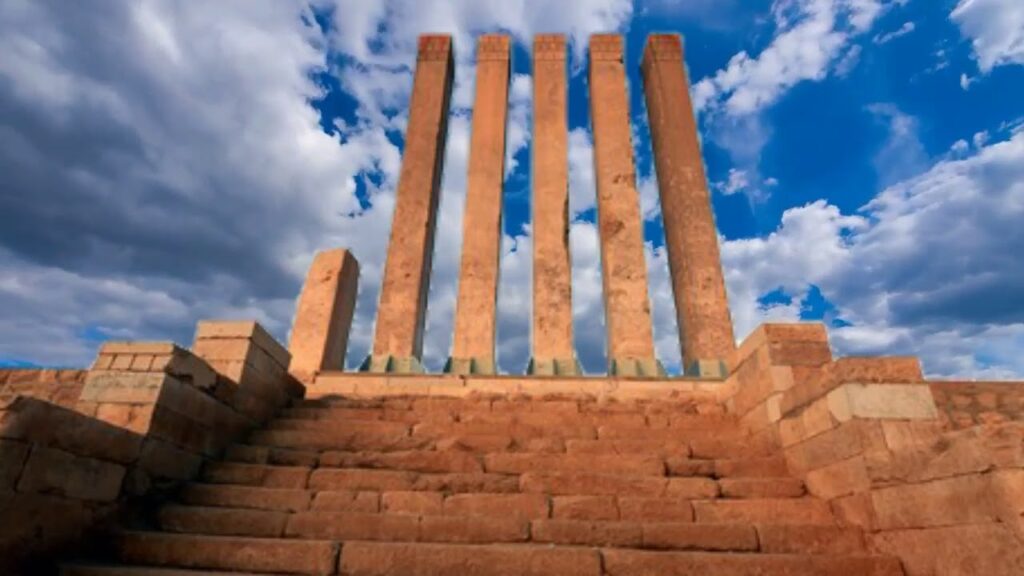
His most famous sanctuary was the magnificent Awwam Temple—also known as Maḥram Bilqīs—near the Sabaean capital of Ma’rib in present-day Yemen. Kings, nobles, and ordinary worshippers visited this sacred complex to seek divine favor, offer sacrifices, and dedicate monuments celebrating military victories, successful harvests, or major public works. Because the prosperity of Saba depended on carefully managed irrigation systems, Almaqah naturally became associated with fertility, abundance, and the protection of the kingdom’s water resources.
For many years, scholars identified Almaqah primarily as a moon god because of crescent imagery found in his cult. Modern research, however, presents a more complex picture. Rather than being exclusively lunar, Almaqah appears to have embodied several interconnected roles, combining celestial symbolism with kingship, agriculture, state protection, and the prosperity of the Sabaean people. His worship also spread across the Red Sea into the Kingdom of Dʿmt and later influenced religious traditions in parts of ancient Ethiopia and Eritrea, demonstrating the far-reaching influence of Sabaean culture.
Physical Traits
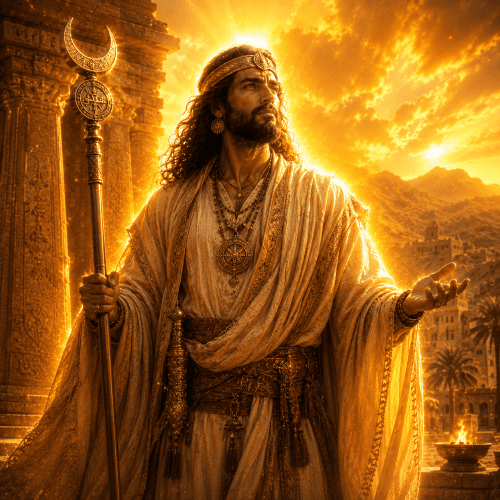
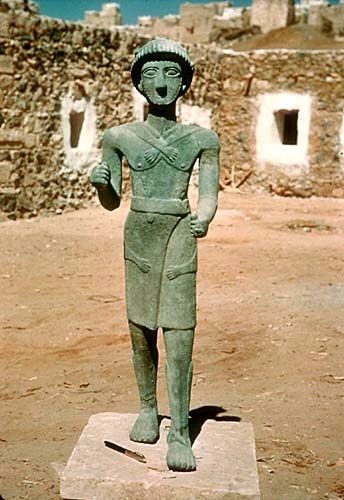
Unlike many gods of Greece or Egypt, Almaqah was rarely depicted in a fully human form. Instead, his presence was expressed through powerful religious symbols that reflected his authority over nature, fertility, and royal power.
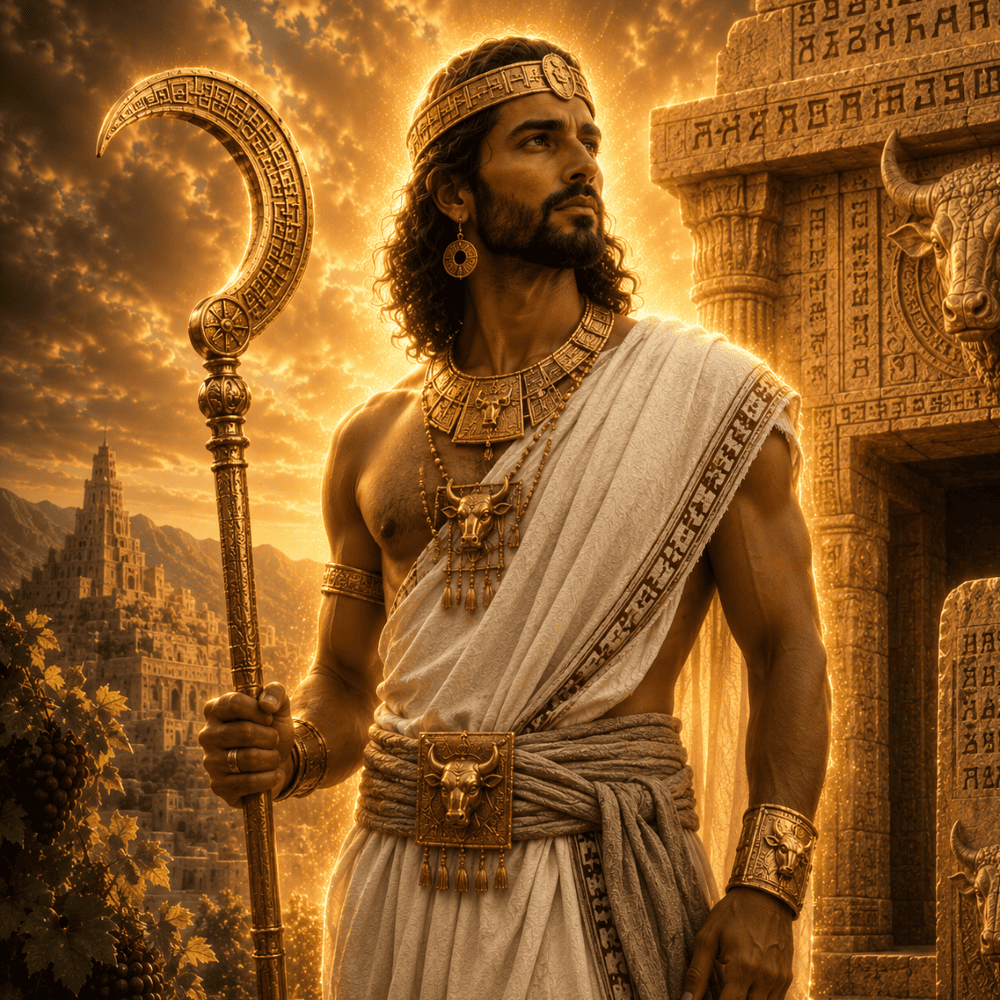
The bull was his most recognizable sacred animal. Bull heads frequently decorated temples, altars, and carved stone monuments dedicated to him, representing strength, endurance, agricultural prosperity, and the fertility upon which the Sabaean Kingdom depended. Ibex imagery also appears in some religious contexts connected with his worship, although bulls remained his dominant symbol.
Another distinctive emblem associated with Almaqah is a curved weapon resembling either a sickle, crescent, or ceremonial club. Ancient reliefs often portray this symbol surrounded by radiating lines or lightning-like motifs. Scholars continue to debate its exact meaning. Some interpret it as evidence of lunar symbolism, while others believe it represented divine authority or ritual power rather than a celestial body alone.
Vegetal imagery also featured prominently in his iconography. Grapevines, vines, and flourishing plant motifs decorated several monuments dedicated to his cult, reinforcing his close relationship with agriculture and the fertile landscape sustained by the famous Ma’rib irrigation system. Together, these symbols presented Almaqah not as a distant celestial deity but as the divine force responsible for sustaining life in one of Arabia’s harshest environments.
Family
Very little survives regarding Almaqah’s divine genealogy. Unlike the detailed family trees found in Greek or Norse mythology, South Arabian religion focused more on ritual worship and royal devotion than on elaborate mythological narratives.
Almaqah belonged to the wider South Arabian pantheon alongside important deities such as Shams, the sun goddess, and Athtar, the deity associated with the planet Venus. Some scholarly interpretations suggest that Shams may have been viewed as his sister or divine companion in certain regional traditions, although surviving inscriptions do not establish a universally accepted family relationship.
Rather than emphasizing divine parentage, Sabaean inscriptions consistently highlight Almaqah’s special relationship with the royal family. Several kings described themselves as being under his protection or symbolically descended from him, using this sacred connection to reinforce their legitimacy. These claims were political and religious statements rather than literal genealogies, presenting the king as the chosen representative of the kingdom’s chief god.
Because ancient South Arabian myths survive mainly through inscriptions instead of narrative literature, much of Almaqah’s family relationships remain uncertain. What is clear is that he occupied the highest position within the Sabaean state religion and served as the divine patron of its rulers.
Other names
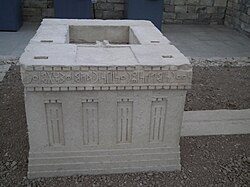
The name Almaqah appears in several forms across ancient inscriptions and later scholarly works. In Sabaean Musnad script, his name is written as 𐩱𐩡𐩣𐩤𐩠 (ʾlmqh), which has been transliterated into English as Almaqah, Almuqah, Ilmuqah, Ilumquh, and Almouqah.
Regional pronunciation and linguistic differences account for these variations rather than indicating different gods. As Sabaean influence expanded across southern Arabia and the Horn of Africa, local languages naturally adapted the pronunciation of his name.
Several inscriptions also preserve important cult titles. Among the best known is “Lord of Awwam,” referring to his principal sanctuary near Ma’rib. Later inscriptions include the epithet Ṯahwān, while other titles associate him with sacred animals and particular temple complexes. These epithets reflected his connection to specific places of worship rather than separate divine identities.
Powers and Abilities
Almaqah’s influence extended across nearly every aspect of Sabaean society, making him both a national protector and a practical guardian of everyday life. His greatest responsibility was safeguarding agriculture through irrigation. The prosperity of the Sabaean Kingdom depended on sophisticated engineering projects, particularly the famous Ma’rib Dam, which transformed seasonal rainfall into fertile farmland. Numerous inscriptions ask Almaqah to protect canals, reservoirs, and water systems, highlighting his vital role in sustaining crops and preventing famine.
He also served as the divine patron of kingship. Sabaean rulers dedicated temples, public buildings, and military victories to him, believing that successful leadership depended upon his approval. Royal inscriptions frequently invoke his blessings before recording major political achievements, suggesting that his favor legitimized both the ruler and the kingdom itself.
Military protection formed another important aspect of his worship. Soldiers and kings thanked Almaqah for successful campaigns, safe journeys, and victories over rival kingdoms. Rather than being solely a war god, he functioned as a guardian whose protection ensured the survival and stability of the state.
Almaqah was additionally associated with prophecy and divine guidance. The Awwam Temple appears to have functioned as an important religious center where pilgrims sought answers through ritual practices, offerings, and possibly forms of divination. This made his sanctuary not only a place of worship but also a center of political and religious decision-making.
Although earlier historians often described him simply as a moon deity, most modern scholars now view Almaqah as a multifaceted god whose authority combined celestial symbolism with fertility, royal power, irrigation, and national prosperity. This broader interpretation better reflects the evidence preserved in South Arabian inscriptions.
Modern Day Influence
Almaqah’s worship ended long ago, but his importance continues through archaeology, history, and the study of ancient Arabia. The ruins of the Awwam Temple and the nearby Bar’an Temple remain among Yemen’s most significant archaeological sites. Thousands of inscriptions discovered there have transformed our understanding of South Arabian civilization, revealing the religious beliefs, political organization, and engineering achievements of the Sabaean Kingdom.
Modern historians also study Almaqah to better understand how religion shaped one of Arabia’s greatest trading powers. His close association with irrigation demonstrates how environmental challenges influenced the development of ancient belief systems. Instead of separating religion from everyday survival, the Sabaeans saw divine favor as essential to maintaining the water systems that sustained their civilization.
Interest in Almaqah has also grown within comparative mythology. Scholars compare his complex celestial symbolism with deities such as the Mesopotamian moon god Sin, while recognizing that Almaqah developed into a uniquely South Arabian god whose identity cannot be reduced to a single celestial function.
Today, despite ongoing challenges to archaeological preservation in Yemen, museum collections, published inscriptions, and continuing academic research ensure that Almaqah remains one of the best-known gods of ancient Arabian mythology. His story offers a rare window into a civilization whose prosperity depended as much on engineering and agriculture as it did on faith.
Related Images



Source
Robin, C. (2005). Almaqah. In Encyclopaedia Britannica Online. Retrieved from https://www.britannica.com/topic/Ilumquh
“Almaqah.” (n.d.). In Wikipedia. Retrieved from https://en.wikipedia.org/wiki/Almaqah
Kitchen, K. A. (ed.). (2006). Studies in the Archaeology and Epigraphy of South Arabia.
Finkel, I., & Parpola, S. (2014). Early South Arabian religion: inscriptions and iconography (selected studies). Journal of Semitic Studies, 59(2), 123–147.
Tesauro de Historia Antigua y Mitología. (n.d.). Almaqah entry. Retrieved from https://www.tesaurohistoriaymitologia.com/es/52643-almaqah
Beeston, A. F. L. (1984). Sabaean Religion and Society. Cambridge University Press.
Breton, J.-F. (1999). Arabia Felix: From the Time of the Queen of Sheba. University of Notre Dame Press.
Ryckmans, J. (1993). Les religions arabes préislamiques. Brill.
Robin, C. J. (2006). “South Arabia, Religion and Society.” In The Cambridge History of Religions in the Ancient World. Cambridge University Press.
Frequently Asked Questions
Who was Almaqah?
Almaqah was the chief god of the ancient Sabaean Kingdom in present-day Yemen and the patron deity of kingship, irrigation, agriculture, and prosperity.
Was Almaqah a moon god?
Earlier scholars often identified Almaqah as a moon god, but modern research suggests he had broader roles connected to kingship, fertility, irrigation, and state protection, making his identity more complex than a purely lunar deity.
Where was Almaqah worshipped?
His principal place of worship was the Awwam Temple near Ma’rib in Yemen, although his cult also spread into parts of ancient Ethiopia and Eritrea through Sabaean influence.
What symbols are associated with Almaqah?
Almaqah is commonly associated with bulls, vine motifs, a curved ceremonial weapon, and symbols representing fertility, royal authority, and agricultural abundance.
Why is Almaqah important in Arabian mythology?
Almaqah is one of the most significant gods of pre-Islamic Arabia because surviving inscriptions, temples, and monuments provide exceptional insight into the religion, politics, and engineering achievements of the ancient Sabaean civilization.