

Anbay : The Arabian God of Justice and Divination
Listen
At a glance
| Description | |
|---|---|
| Origin | Arabian Mythology |
| Classification | Gods |
| Family Members | N/A |
| Region | Yemen |
| Associated With | Justice, Record Keeping |
Mythlok Perspective
In Mythlok’s Perspective, Anbay represents the deeply rooted connection between justice, prophecy, and divine authority in ancient Arabian civilization. Unlike warrior gods or storm deities, Anbay was tied to legal order and sacred judgment, showing how early Arabian societies viewed fairness and truth as divine responsibilities. His role within Qatabanian religion suggests that law and prophecy were closely intertwined, with divine beings guiding rulers and tribes through sacred decisions. Across cultures, Anbay shares similarities with Thoth from Egyptian tradition and Shamash from Mesopotamian belief, both of whom were linked to justice and wisdom. Yet Anbay remains uniquely Arabian because his worship reflects the legal and tribal foundations of South Arabian civilization, where divine judgment played a central role in maintaining order.
Anbay
Introduction
Anbay was a deity worshipped in pre-Islamic South Arabia, particularly within the ancient Kingdom of Qataban. He was associated with justice, divination, prophecy, and legal matters, making him one of the more important deities connected to governance and sacred judgment in Arabian religion. Much of what is known about Anbay comes from inscriptions discovered in ancient Yemen and surrounding regions, where his name appears in religious and legal contexts.
Unlike many mythological gods whose stories survive through epic narratives, knowledge of Anbay is preserved mainly through archaeology and epigraphy. Ancient South Arabian civilizations left behind inscriptions carved into stone monuments, temples, and official records. These inscriptions reveal that religion played a central role in political and social life, with deities like Anbay acting as divine protectors of justice and legal order.
Anbay was closely linked to the moon god Amm, one of the chief deities of Qatabanite religion. Inscriptions suggest that Anbay served an important role within the divine hierarchy connected to law and oracular decisions. His worship reflects the importance of contracts, tribal alliances, and judicial systems in ancient Arabian society. Today, Anbay remains an important figure for historians studying the religious traditions of pre-Islamic Arabia.
Physical Traits
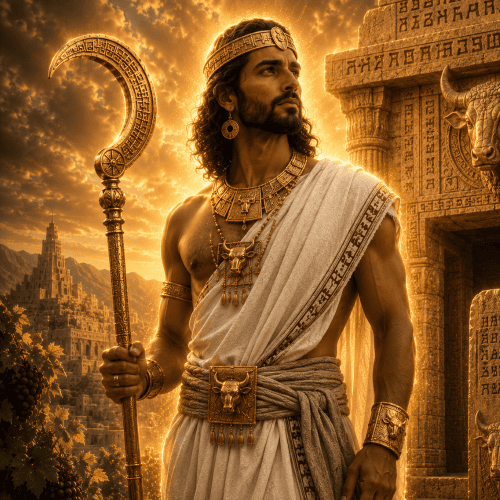
There are no surviving detailed physical descriptions of Anbay from ancient sources. Unlike the gods of Greek or Egyptian traditions, many South Arabian deities were not extensively described through mythology or surviving artistic narratives. Most information about Anbay comes from inscriptions rather than statues or illustrated manuscripts. Because of this, historians cannot confirm specific physical traits, symbols, or artistic depictions associated with the deity.
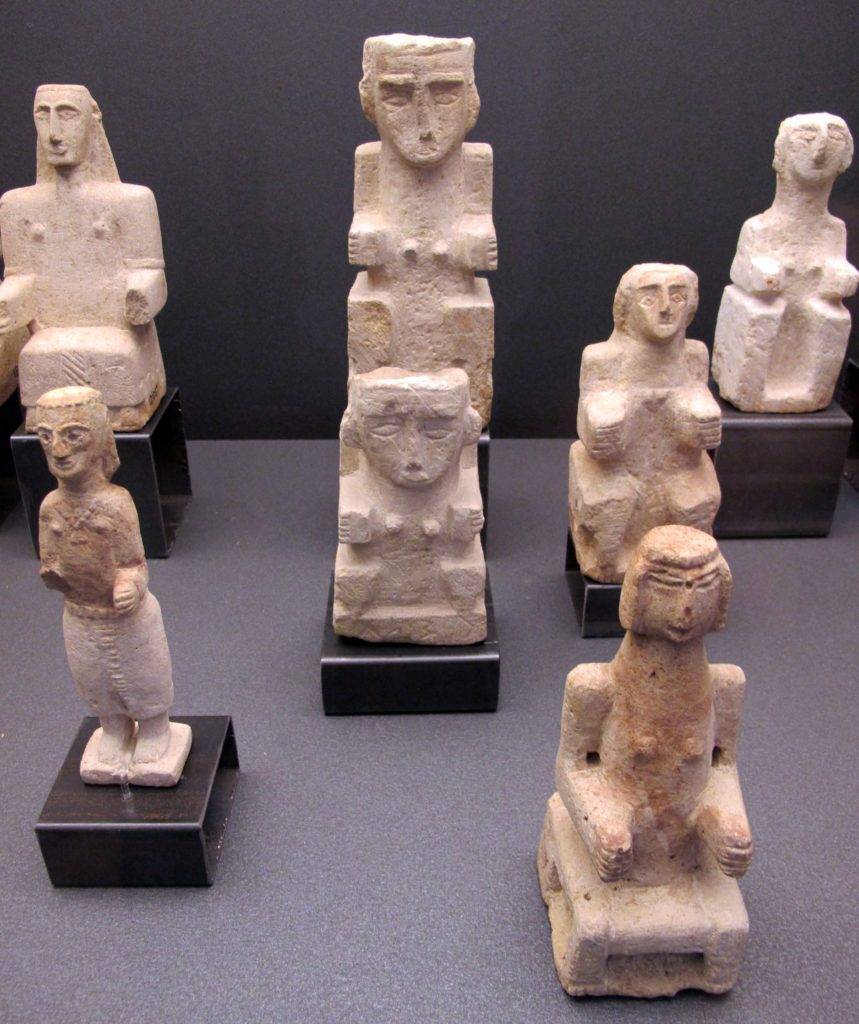
Ancient South Arabian religious art generally portrayed gods in stylized or symbolic forms rather than highly detailed human representations. In some cases, deities were represented through sacred symbols, altars, inscriptions, or temple objects instead of anthropomorphic statues. As a result, it is uncertain whether Anbay was regularly depicted in human form or primarily worshipped through symbolic representation.
Archaeological discoveries from Qataban and neighboring kingdoms show that South Arabian religion favored monumental inscriptions and temple worship over elaborate mythological imagery. This means that while Anbay clearly held religious importance, little factual evidence survives regarding his visual appearance. Modern artistic depictions of Anbay are therefore largely speculative and not based on confirmed historical descriptions.
Family
Anbay was associated with the moon god Amm, who served as one of the chief deities in Qatabanite religion. Ancient inscriptions indicate that Amm occupied a central role in the religious system of the Kingdom of Qataban, while Anbay functioned as a connected deity involved in justice, legal authority, and divination. However, surviving sources do not clearly define a biological or familial relationship between the two gods.
South Arabian religion included complex pantheons made up of regional and tribal deities. These divine systems often linked gods together through shared temples, rituals, or religious functions rather than detailed mythological family trees. Because few narrative myths from Qataban survive today, historians know very little about how these gods interacted in storytelling traditions.
Unlike mythologies such as those of Greece or Mesopotamia, where divine genealogies were extensively recorded, South Arabian religion focused more heavily on ritual worship, offerings, and inscriptions. As a result, there is limited evidence regarding Anbay’s divine relatives, offspring, or marital associations. The surviving historical evidence mainly connects him to judicial and prophetic functions within the broader Qatabanite religious structure.
Other Names
The deity is primarily known by the name Anbay in surviving inscriptions and historical studies. The name appears in ancient South Arabian texts written in epigraphic South Arabian script. Due to differences in transliteration from ancient languages into modern alphabets, minor spelling variations may appear in academic works, though Anbay remains the standard English form.
Some scholars connect the deity’s name linguistically to concepts involving announcement, declaration, or communication. These interpretations align with Anbay’s association with prophecy and divination. However, historians remain cautious about drawing direct conclusions because surviving evidence is limited and many ancient Arabian languages remain only partially understood.
Unlike major mythological figures who accumulated numerous titles and regional names over centuries, Anbay is not known to possess a large number of alternate identities. This is partly because the surviving evidence for pre-Islamic South Arabian religion is fragmented. Most references simply identify him directly as Anbay in legal, religious, or dedicatory inscriptions.
Powers and Abilities
Anbay was associated primarily with justice, divination, prophecy, and legal authority. Inscriptions from ancient Qataban indicate that he played a role in matters involving contracts, judgments, and sacred decision-making. His connection to legal systems suggests that worshippers viewed him as a divine overseer of fairness and truth.
The deity’s association with divination also points to an oracular function within South Arabian religion. Ancient Arabian societies often sought divine guidance in political, legal, and tribal matters, and deities connected with prophecy were considered essential to maintaining order. Anbay’s role likely involved the interpretation of sacred signs, oaths, or judicial decisions under divine authority.
Unlike warrior gods associated with storms or destruction, Anbay’s powers were connected more closely to social and spiritual order. His importance came not from physical strength but from his role in preserving justice and guiding important decisions. This reflects the significance of law, tribal agreements, and sacred contracts in ancient South Arabian civilization.
Modern Day Influence
Anbay is not widely recognized in mainstream popular culture, but he remains important within academic studies of Arabian history and religion. Archaeologists and historians studying pre-Islamic Arabia frequently examine inscriptions mentioning Anbay to better understand how ancient South Arabian societies organized religion, governance, and law.
Interest in lesser-known mythologies has also introduced Anbay to modern audiences through online mythology communities, documentaries, and historical discussions. As more archaeological discoveries emerge from the Arabian Peninsula, figures like Anbay are receiving increased attention as examples of the region’s rich religious heritage before Islam.
Anbay’s association with justice and prophecy also makes him significant in comparative mythology studies. Scholars often compare him with deities linked to law and wisdom in neighboring civilizations, including Shamash from Mesopotamia and Thoth from Egypt. Although Anbay remains relatively obscure compared to these figures, his role demonstrates that ancient Arabian religion possessed sophisticated systems of divine authority and sacred law.
Today, Anbay survives mainly through inscriptions, academic research, and historical reconstruction. His legacy reflects the complexity of pre-Islamic Arabian civilization and the important role religion played in shaping social and political order across the ancient Arabian Peninsula.
Related Images





Sources
Encyclopaedia Iranica Foundation. (n.d.). Arabia ii. In the Islamic period and medieval Arabic tradition. Encyclopaedia Iranica. https://iranicaonline.org/articles/arabia-ii
Smithsonian Institution. (2018, January 30). The little-known history of pre-Islamic Arabia. Smithsonian Magazine. https://www.smithsonianmag.com/history/little-known-history-pre-islamic-arabia-180967813/
Encyclopaedia Britannica. (n.d.). Ancient Arabian religion. Encyclopaedia Britannica. https://www.britannica.com/topic/Arabian-religion
Wikipedia contributors. (n.d.). Anbay. Wikipedia. https://en.wikipedia.org/wiki/Anbay
Hoyland, R. G. (2002). Arabia and the Arabs: From the Bronze Age to the coming of Islam. Routledge.
Healey, J. F. (2001). The religion of the Nabataeans: A conspectus. Brill.
Robin, C. J. (2012). Arabia and Ethiopia. Oxford University Press.
Al-Jallad, A. (2021). Ancient North Arabian religion and deities in epigraphic sources. Arabian Archaeology and Epigraphy, 32(2), 145–168. https://doi.org/10.1111/aae.12189
Frequently Asked Questions
Who was Anbay?
Anbay is a deity from the ancient Arabian pantheon, worshipped by some pre-Islamic tribes. Little is known about Anbay, but he was likely associated with natural elements or fertility. With the advent of Islam, worship of Anbay and other pagan gods was replaced by monotheistic belief in Allah.
Where was Anbay worshipped?
Who converted Yemen to Islam?
Yemen was gradually converted to Islam primarily through the efforts of Muslim missionaries and traders following the emergence of Islam in the early 7th century. The process of conversion was not instantaneous but occurred over several decades, beginning with the mission of the Prophet Muhammad’s companions and continuing through subsequent caliphates.