


Agwé : The Sea Spirit of Haitian Vodou and Protector of Sailors
At a glance
| Description | |
|---|---|
| Origin | Vodou Mythology |
| Classification | Spirits |
| Family Members | La Sirène (Wife) |
| Region | Haiti |
| Associated With | Sea, Marine life, Ships, Sailors, Fishermen, Maritime travel, Navigation |
The Mythlok Perspective
In Mythlok’s Perspective, Agwé represents more than the authority of a sea spirit; he reflects humanity’s dependence on forces it cannot fully control. Like Poseidon in Greek tradition, he embodies the ocean’s power, but his place within Haitian Vodou connects that power to living religious relationships and cultural memory. Agwé reminds readers that the sea can sustain communities while exposing their vulnerability, making his significance both spiritual and deeply human.
Agwé
Introduction
Agwé, also spelled Agwe, is an important lwa, or spirit, in Haitian Vodou associated with the sea, marine life, ships, and maritime travel. Known in some traditions as Agwe Tawoyo or Mèt Agwe, he is particularly significant to sailors, fishermen, and communities whose livelihoods depend on the ocean. His spiritual domain reflects the sea’s importance as a source of food, a route for travel, and a powerful force that can sustain or endanger human life.
In Haitian Vodou, lwa are spiritual beings who maintain relationships with practitioners through prayer, offerings, music, and ceremonial service. They are not simply characters in a collection of myths but form part of a living religious tradition shaped by African spiritual heritage and the historical experiences of Haiti.
Agwé is commonly associated with the Rada tradition, one of the spiritual nations within Haitian Vodou. His maritime identity is expressed through his vèvè, a ritual symbol frequently depicted as a boat. This imagery connects him with navigation, ocean journeys, and the resources found beneath the waves. His worship also reflects the wider Atlantic history of Haiti, where the sea represents commerce, migration, displacement, and enduring connections with African ancestral traditions.
Physical Traits
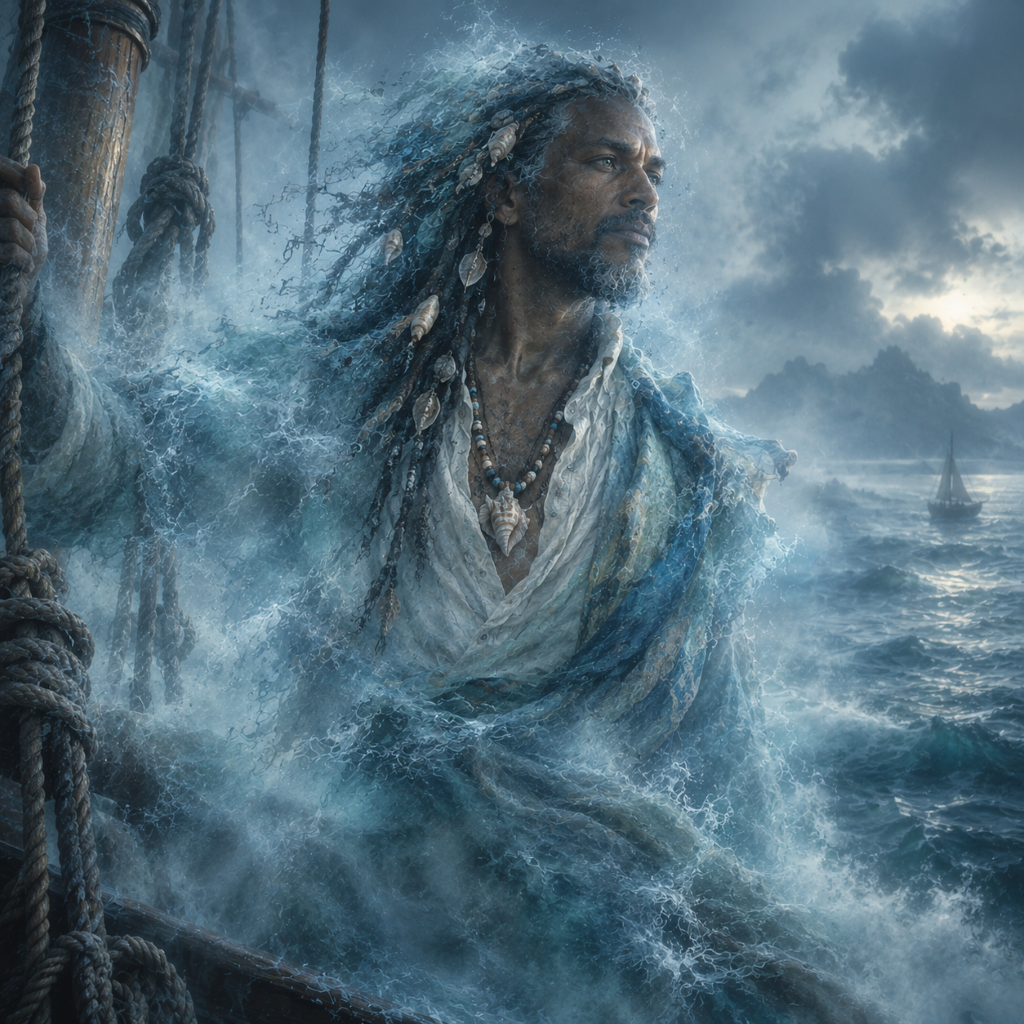
Agwé’s appearance varies across religious accounts, artistic representations, and the traditions of individual Vodou communities. He is frequently imagined as a commanding male figure associated with maritime authority. Some descriptions portray him with green eyes and a lighter or mixed complexion, while others represent him as an older, bearded man. These differences demonstrate that there is no single universally established physical appearance for Agwé.
In popular devotional imagery, Agwé sometimes wears a naval officer’s uniform or the clothing of a ship’s captain. Such representations communicate his association with ships, sailors, and the management of dangerous sea journeys. His appearance should therefore be understood as a culturally shaped spiritual representation rather than a fixed physical description.
Agwé’s most recognizable visual symbol is his boat-shaped vèvè. Blue, white, and green are commonly associated with him, reflecting his connection with ocean waters. Shells, oars, paddles, and miniature ships also appear in descriptions of his ritual associations. Some representations connect Agwé with Saint Ulrich of Augsburg, reflecting the Catholic imagery incorporated into certain Vodou traditions. However, such associations are examples of religious syncretism, not evidence that the saint and the lwa are identical in every theological context.
Family
Agwé is frequently associated with La Sirène, also written Lasirèn, a powerful water lwa often represented as a mermaid. In several accounts, she is described as his wife or consort. Their relationship brings together two complementary expressions of the sea: Agwé’s association with ships and maritime authority, and La Sirène’s connection with aquatic beauty, attraction, and the mysteries of underwater existence.
The relationship between these spirits is significant in understanding how Haitian Vodou represents the natural world. The ocean is not reduced to a single personality or power. Instead, different lwa may embody distinct dimensions of water and its influence on human life. Agwé is also linked with Èzili Freda in some accounts, where their relationship is described as romantic or marital. However, these relationships vary across sources and religious lineages. They should not be treated as a universally accepted family structure.
Similarly, although some traditions connect Agwé with other spiritual figures through ancestry or ritual relationships, a complete and consistently documented genealogy is not available. His place within the wider community of lwa is better established than any single account of his parents, siblings, or descendants.
Other names
Agwé appears under several names and spellings in descriptions of Haitian Vodou. Agwe is the common alternative spelling, while Agwe Tawoyo is a significant form found in Rada religious songs and other references to the sea spirit. Mèt Agwe, meaning approximately “Master Agwe,” is another title associated with his authority over the ocean.
Agoué and Agoueh also appear as alternative spellings in descriptions of the lwa. Differences in spelling reflect the linguistic history of Vodou, including Haitian Creole usage and the transmission of African-derived religious traditions across generations. Agwé is sometimes associated with a ceremonial vessel named Imamou. This name appears in descriptions of his maritime symbolism and rituals, although accounts do not always distinguish consistently between the spirit’s ritual boat and the vessel used to carry offerings.
Other poetic titles and epithets appear in popular reference works, but their usage is less consistently documented. For that reason, Agwe, Agwe Tawoyo, and Mèt Agwe provide a more reliable starting point for understanding his principal names without treating every reported title as universally recognized.
Powers and Abilities
Agwé’s principal domain is the sea and the life sustained by it. He is particularly associated with fishermen, sailors, ships, and people who travel across the water. His importance comes from the understanding that maritime journeys depend on forces beyond human control, including changing weather, currents, and the unpredictable behaviour of the ocean.
As a patron of sailors and fishermen, Agwé is associated with safe passage and the resources of the sea. Practitioners may honour him when seeking spiritual assistance with maritime journeys or work connected with fishing. His boat-shaped vèvè reinforces this relationship with navigation and ocean travel. Agwé’s domain also includes marine life, particularly fish and aquatic plants. This connection places him within a broader Vodou understanding of nature, in which natural forces and environments are associated with spiritual powers that can be approached through ritual service.
His symbolism extends beyond practical protection. The sea has a complicated place in Haitian historical memory, connecting African ancestry, Atlantic migration, forced displacement, and the movement of people between distant shores. Agwé’s maritime associations can therefore carry cultural and spiritual significance beyond the immediate concerns of fishing or navigation.
Some accounts also connect his boat with the passage of deceased souls toward their final destination. This association appears in descriptions of Vodou vèvè and maritime symbolism, although the precise role assigned to Agwé in the journey of the dead is not consistently described across sources.
Ritual offerings provide another expression of his relationship with the sea. Ceremonies may involve placing offerings on a raft or small boat and sending it into the water. The Brooklyn Public Library documents traditions in which such offerings are carried out to sea and their return or sinking is interpreted within the ritual context. These practices should be understood as expressions of religious devotion rather than a single procedure followed by every Vodou community.
Modern Day Influence
Agwé remains an important figure in contemporary representations of Haitian Vodou. His presence extends beyond religious ceremonies into literature, music, painting, and cultural education. These representations help introduce wider audiences to a spiritual tradition that is frequently misunderstood or reduced to supernatural stereotypes.
One example of his cultural presence is the painting Immamou (Ceremony for Lwa Agwe) by Haitian artist André Pierre, preserved in the Trinity College Art Collection. The work connects Agwé with ceremonial boats and the artistic expression of Vodou religious practice. It also demonstrates how his maritime identity can be represented through Haitian visual culture. Agwé also appears in Rosa Guy’s novel My Love, My Love, or The Peasant Girl, illustrating the movement of Vodou spiritual figures into literary storytelling. Recorded performances and religious songs provide further examples of how his name and identity continue to circulate through cultural expression.
For contemporary audiences, Agwé offers an opportunity to explore the relationship between spirituality and the natural world without separating religion from the historical experiences of its practitioners. His association with the ocean encompasses livelihood, uncertainty, movement, and ancestral memory.
Comparisons with sea deities such as Poseidon can help readers understand his broad maritime domain, but the comparison has limits. Agwé belongs to Haitian Vodou, a living Afro-Caribbean religion with its own rituals, spiritual relationships, and historical foundations. He is not simply a Caribbean equivalent of a Greek sea god. Understanding Agwé therefore requires more than identifying him as a ruler of the waters. His significance lies in the relationships between people, spiritual forces, and the sea that have shaped Haitian religious life across generations.
Related Images

Source
Britannica. (2016, May 26). Lwa: History, beliefs & rituals. https://www.britannica.com/topic/lwa-Vodou
Britannica. (2016, November 2). Vèvè: Haitian Vodou, rituals & meaning. https://www.britannica.com/topic/veve
Brown, K. M. (2001). Mama Lola: A Vodou priestess in Brooklyn (Updated and expanded ed.). University of California Press.
Erzulie’s Voodoo. (2025, November 4). Vodou lwa Agwe. https://www.erzulies.com/vodou-lwa-agwe/
Hitchhiker’s Guide to Religion. (2026, May 9). Agwe and the kingdom below the sea.
https://www.hitchhikersguidetoreligion.com/lore/agwe-ocean-kingdom/
Ledan, R. (2023). Vèvè Vodou Haïti. AYITI BÈL. https://rezonodwes.com/2024/11/le-livre-veve-vodou-haiti-de-roxane-ledan-taino-l-ou-leblouissante-traversee-dun-univers-pictural-exceptionnel/
Métraux, A. (1972). Voodoo in Haiti. Schocken Books.
North Carolina State University. (n.d.). Vodou. JoUVERT, 3(2). https://legacy.chass.ncsu.edu/jouvert/v3i12/vodou.htm
Frequently Asked Questions
Who is Agwé in Haitian Vodou?
Agwé is a lwa in Haitian Vodou associated with the sea, marine life, ships, sailors, and fishermen. He is honoured for his connection with ocean travel and maritime life.
What powers does Agwé have?
Agwé is associated with the sea, marine resources, and maritime journeys. Practitioners may honour him when seeking spiritual assistance with travel or fishing.
Who is Agwé's wife?
La Sirène, the mermaid-like water lwa, is commonly described as Agwé’s wife or consort. Some traditions also associate him with Èzili Freda.
What is Agwé's symbol in Haitian Vodou?
Agwé’s vèvè, or ritual symbol, is commonly represented as a boat. Ships and other maritime objects also reflect his connection with the sea.
How do people honour Agwé?
Some Vodou ceremonies honour Agwé with offerings carried on a small boat or raft and sent out to sea. Ritual practices vary among communities and religious lineages.


