

Svarozhich : The Slavic God of Fire and the Hearth
At a glance
| Description | |
|---|---|
| Origin | Slavic Mythology |
| Classification | Gods |
| Family Members | Svarog (Father), possibly connected with Dazhbog |
| Region | Russia, Poland, Czech Republic, Slovakia, Ukraine, Belarus |
| Associated With | Fire, Hearth, Sunlight, Protection, War, Purification, Fertility |
The Mythlok Perspective
In Mythlok’s Perspective, Svarozhich represents more than a simple fire god. He embodies humanity’s earliest understanding of controlled power. Fire was warmth, survival, warfare, creation, and spiritual transformation all at once. Unlike many mythological deities who ruled distant heavens, Svarozhich existed directly within the home through the sacred hearth flame. His symbolism closely mirrors other sacred fire figures across cultures. He shares thematic parallels with Agni from Indian tradition and Hephaestus from Greek mythology. Yet Svarozhich remains uniquely Slavic because his power is deeply tied to community survival, seasonal cycles, and ancestral continuity. His mythology reminds us that fire was once viewed not merely as a tool, but as a living divine force.
Svarozhich
Introduction
Svarozhich is one of the most fascinating and mysterious figures in Slavic mythology. Revered as a god of fire, sunlight, and the sacred hearth, he represented the living flame that sustained both the household and the spiritual life of ancient Slavic communities. His name translates to “Son of Svarog,” directly linking him to Svarog, the celestial creator and divine blacksmith of the Slavic pantheon.
Historical references to Svarozhich appear in medieval chronicles between the 11th and 14th centuries, making him one of the few Slavic gods with documented worship in written sources. Among the Polabian Slavs, especially the Redarii tribe, he was honored at the famous temple-city of Rethra, where sacred rituals and divination ceremonies were held in his name. Some historical texts even associate him with the deity Radegast, though scholars continue to debate whether the two were separate gods or regional variations of the same divine figure.
Svarozhich was not simply a destructive fire god. To ancient Slavs, fire represented life itself. The hearth fire warmed homes during harsh winters, purified ritual spaces, and connected mortals with the divine. Because of this, Svarozhich became a symbol of protection, renewal, and cosmic order. His sacred flames embodied both creation and destruction, reflecting nature’s balance between nourishment and devastation.
Modern interpretations of Svarozhich often place him within broader Indo-European traditions of solar and fire deities. His role shares similarities with gods associated with sacred fire across Europe and Asia, reinforcing the importance of flame in early human civilization and spirituality.
Physical Traits
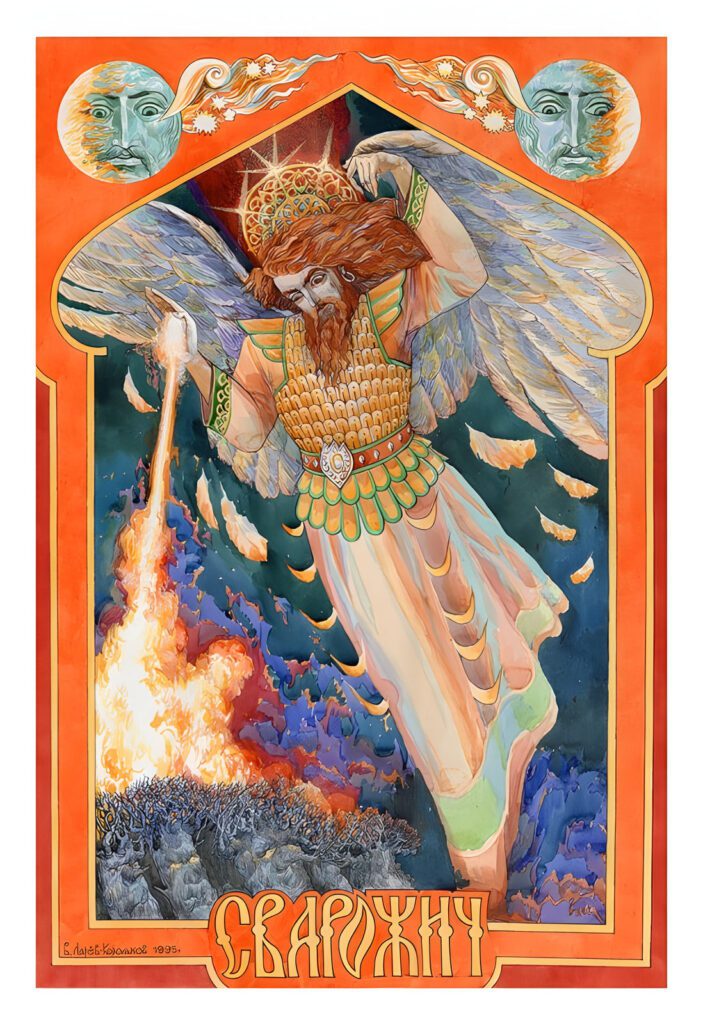
Unlike many mythological gods who were described in detail through epics and legends, Svarozhich has no universally accepted ancient physical description. Most surviving Slavic sources focus more on his divine role than on his appearance. Because of this, modern artistic depictions are largely symbolic reconstructions inspired by his fiery nature.
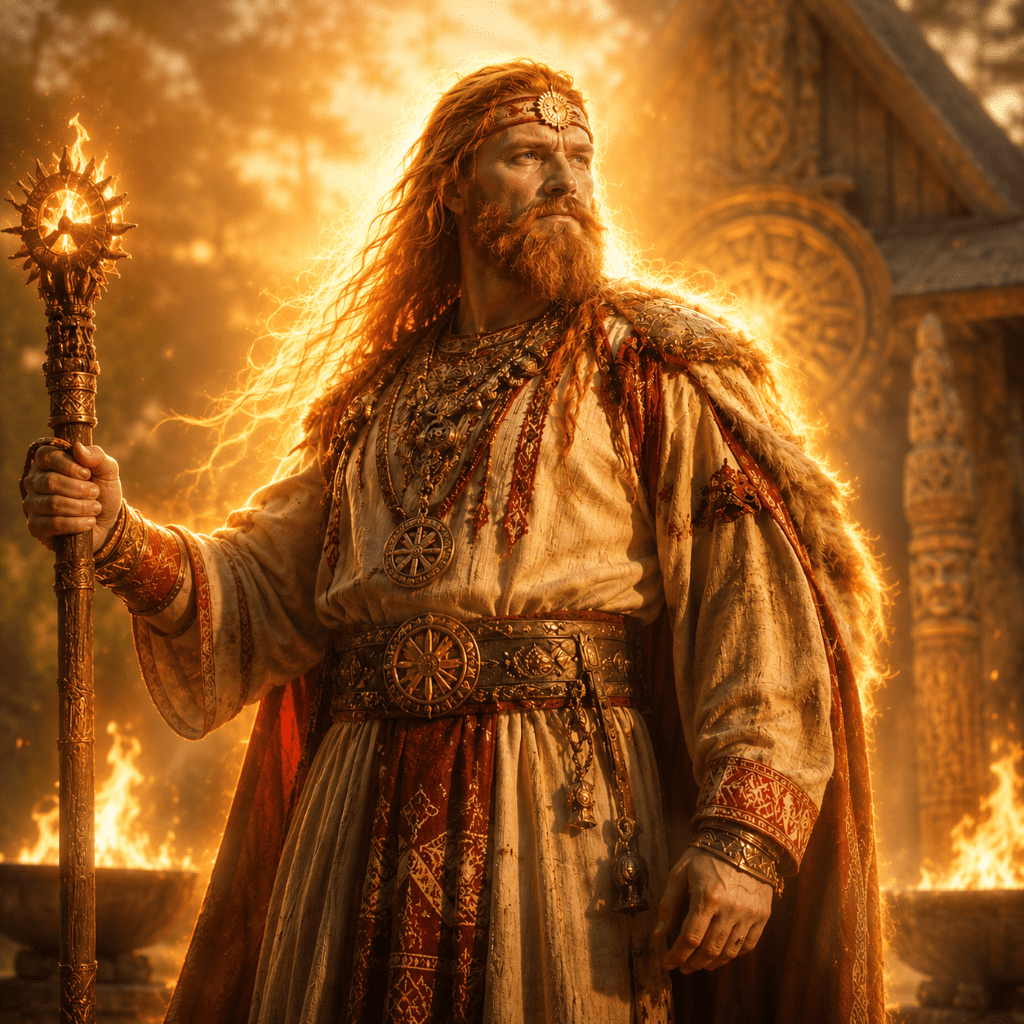
Svarozhich is commonly portrayed as a radiant warrior or celestial figure surrounded by blazing flames and golden light. Artists frequently depict him with glowing red or copper-colored hair, representing the intensity of fire and the warmth of the sun. His eyes are often imagined as bright embers or molten gold, reinforcing his association with divine flame.
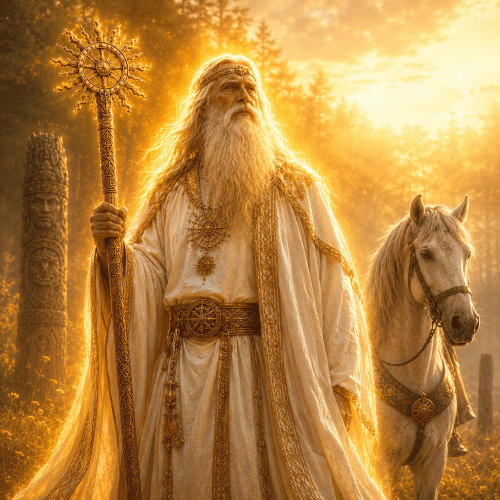
In some interpretations influenced by Polabian Slavic traditions, Svarozhich appears as a warrior deity carrying a spear and standing beside a sacred horse. Medieval accounts of the temple at Rethra mention ritual horses used for divination, linking the god to warfare, prophecy, and protection.
His visual symbolism usually includes solar wheels, burning hearths, blacksmith tools, and fire altars. Rather than representing physical beauty, these images emphasize power, energy, and transformation. Fire itself was considered his truest form, making the sacred flame more important than any human-like depiction.
Family
Svarozhich’s identity is deeply tied to his father, Svarog, one of the highest divine figures in Slavic mythology. Svarog was regarded as the heavenly smith, the creator of cosmic order, and the master of celestial fire. Through this lineage, Svarozhich inherited authority over earthly flames and the sacred hearth.
The relationship between Svarog and Svarozhich reflects a common Indo-European mythological theme where a sky father passes divine authority to younger gods who actively interact with humanity. While Svarog governed the celestial realm, Svarozhich represented fire in its practical and spiritual forms among mortals.
Some Slavic traditions also connect Svarozhich with Dazhbog, another major solar deity. In certain interpretations, Dazhbog and Svarozhich are treated as brothers, while other traditions consider them different aspects of the same divine force associated with sunlight and prosperity. Due to the fragmented nature of Slavic mythology, these relationships remain debated among historians and folklorists. Unlike Greek or Norse mythology, Slavic traditions rarely preserved detailed divine genealogies. As a result, Svarozhich’s family structure remains relatively simple compared to other mythological pantheons.
Other names
Svarozhich was known by several regional names and spellings across different Slavic territories. These variations developed through linguistic changes, local traditions, and medieval translations by foreign chroniclers.
One of the most common alternate forms is Svarozhits or Svarozic, both derived from the same patronymic meaning “Son of Svarog.” Medieval Latin texts sometimes recorded his name as Zuarasici or Zuarasiz, reflecting attempts by Christian chroniclers to transliterate Slavic pronunciation into Latin.
Among the Polabian Slavs, Svarozhich became strongly associated with Radegast or Radogost, a deity worshipped at Rethra. Some scholars believe Radegast was originally a title or regional version of Svarozhich rather than a completely separate god.
In Slovene folklore, the mythic hero Kresnik shares several similarities with Svarozhich, particularly through his connection to fire, summer festivals, and solar symbolism. Although they are not identical figures, many researchers see Kresnik as a cultural evolution of older Slavic fire myths. These multiple names demonstrate how Slavic mythology evolved differently across regions while still preserving core religious ideas centered on fire, light, and divine protection.
Powers and Abilities
Svarozhich ruled over sacred fire in all its forms. He governed the hearth flame that sustained families, the ritual fires used in worship, and the solar energy that nourished the earth. Ancient Slavs believed that fire connected humanity with the gods, making Svarozhich one of the most spiritually significant deities in the pantheon.
As a hearth god, he protected homes and families. The household fire was considered sacred, and keeping it alive symbolized continuity, prosperity, and ancestral blessing. Extinguishing the hearth flame could be viewed as a sign of misfortune or spiritual imbalance.
Svarozhich also possessed destructive powers. Fire could cleanse and renew, but it could also consume forests, crops, and enemies. This dual nature made him both feared and respected. Among the Polabian Slavs, he gained a martial aspect and was invoked during warfare for protection and victory.
Solar imagery further expanded his divine influence. Some traditions described his fiery rays as heavenly weapons that pierced darkness and brought warmth to the world. His flames were believed to purify evil, strengthen warriors, and bless agricultural fertility. In modern Rodnover interpretations, Svarozhich is often viewed as a spiritual force of inner strength and transformation. His sacred fire symbolizes determination, purification, courage, and rebirth.
Modern Day Influence
Although Christianity gradually replaced traditional Slavic paganism, the legacy of Svarozhich survived in folklore, seasonal rituals, and cultural symbolism. Today, he remains an important figure in modern Slavic Native Faith movements known collectively as Rodnovery.
Contemporary practitioners honor Svarozhich during fire festivals, solstice celebrations, and ancestral ceremonies. Sacred bonfires continue to symbolize purification, protection, and the cycle of renewal, preserving traditions connected to ancient fire worship.
Svarozhich has also become popular in modern art, fantasy literature, and video games inspired by Slavic folklore. Franchises such as The Witcher 3: Wild Hunt and Thea: The Awakening helped introduce global audiences to Slavic mythological themes, including gods associated with fire and the sun.
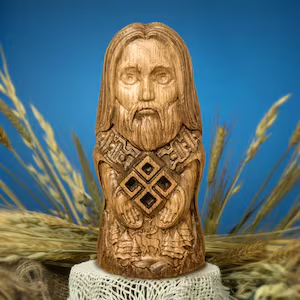
Modern spiritual symbolism linked to Svarozhich often includes solar wheels, blacksmith imagery, and protective talismans believed to channel strength and purification. These interpretations are mostly modern reconstructions rather than direct continuations of ancient practices, but they reflect a renewed interest in Slavic heritage and mythology.
Today, Svarozhich stands as a symbol of endurance, sacred energy, and humanity’s ancient relationship with fire. His mythology continues to resonate because fire itself remains one of the most powerful symbols of life, transformation, and survival.
Related Images


Source
Bryant, J. P. (2004). The Mythology of all races: Slavic (Vol. 3). Kessinger Publishing.
Wikisource. (n.d.). The mythology of all races, Vol. 3: Celtic and Slavic. https://en.wikisource.org/wiki/The_Mythology_of_All_Races/Volume_3/Slavic/Part_3/Chapter_3
Mitologicus. (2024‑12‑18). Svarozhich – Slavic fire and sun deity. https://mitologicus.com/eslava/svarozhich/
Alexander‑Samvel. (2017‑08‑31). Svarozhich – Slavic fire deity. http://www.alexander‑samvel.com/graphic/svarozhich?language_content_entity=en
Talismo.ru. (2024‑10‑12). Obereg Svarozhich: history, meaning and how to unlock its power. https://talismano.ru/slavyanskie/oberegi/svarozhich
Wikibrief. (n.d.). Svarozhits. https://es.wikibrief.org/wiki/Svarozhits
Palladium Books. (2009). Forums of the Megaverse® – Svarog and Svarozhich discussion thread. https://palladiumbooks.com/forums/viewtopic.php?t=105516
Gieysztor, A. (1982). Mythology of the Slavs. Warsaw: Polish Scientific Publishers.
Ivanov, V. V., & Toporov, V. N. (1974). Studies in Slavic Mythology. Moscow: Nauka.
Rybakov, B. A. (1987). Paganism of Ancient Rus. Moscow: Nauka.
Frequently Asked Questions
Who is Svarozhich in Slavic mythology?
Svarozhich is the Slavic god of fire, the hearth, and sacred solar energy, often described as the son of Svarog.
What does the name Svarozhich mean?
The name Svarozhich translates to “Son of Svarog,” connecting him to the Slavic sky and blacksmith god Svarog.
Was Svarozhich a sun god?
Svarozhich was mainly associated with sacred fire and hearth flames, though he also had strong solar connections.
Is Svarozhich connected to Radegast?
Many historians believe Svarozhich and Radegast were either linked deities or regional versions of the same god.
Is Svarozhich still worshipped today?
Yes, modern Slavic Native Faith movements such as Rodnovery continue to honor Svarozhich in rituals and festivals.