


Yang Asha : The Chinese Goddess of Beauty and Love
At a glance
| Description | |
|---|---|
| Origin | Chinese Mythology |
| Classification | Gods |
| Family Members | N/A |
| Region | China |
| Associated With | Beauty, Water, Love, Purity, Perseverance, Feminine grace |
The Mythlok Perspective
In Mythlok’s Perspective, Yang Asha offers an interesting parallel to Aphrodite from Greek mythology. While both are celebrated for extraordinary beauty and their association with love, their narratives reveal different cultural priorities. Aphrodite represents the powerful and sometimes disruptive nature of desire, whereas Yang Asha’s story places greater emphasis on emotional endurance, personal choice and the pursuit of genuine affection.
Yang Asha
Introduction
Yang Asha, also written as Yang’asha (仰阿莎), is a legendary figure revered as the goddess of beauty by the Miao people of southwestern China. Her story originates in the oral traditions of southeastern Guizhou, particularly along the Qingshui River and in the communities surrounding Jianhe County. Unlike the better-known gods and goddesses of mainstream Chinese religious traditions, Yang Asha belongs to the distinctive cultural and spiritual heritage of the Miao people.
Her legend survives through an extensive narrative song known as Yang Asha, which is among the longest recorded examples of Miao narrative folk literature. Traditionally performed through singing, the story recounts the experiences of a beautiful young woman born from water and explores themes of love, hardship, personal choice and human relationships. Its emotional narrative has made Yang Asha an enduring cultural figure.
In 2008, the Yang Asha narrative was included in China’s second batch of National Intangible Cultural Heritage projects under the category of folk literature. This recognition acknowledged not simply the legendary woman but also the traditional storytelling and musical practices through which her story has survived. Although frequently described as a goddess, Yang Asha is equally important as a representation of Miao identity, feminine beauty and cultural memory.
Physical Traits
Yang Asha is celebrated primarily for her extraordinary beauty. Miao oral traditions portray her as an exceptionally beautiful young woman whose appearance represents the community’s ideal of feminine grace and natural elegance. Her association with water is particularly important because her legendary birth is connected with a well or body of clear water.
Some local descriptions identify her as the Clear Water Maiden, connecting her identity with the natural landscape of the Qingshui River region. Water consequently becomes an important symbolic element in representations of Yang Asha, reflecting purity, beauty and the relationship between people and their natural surroundings.
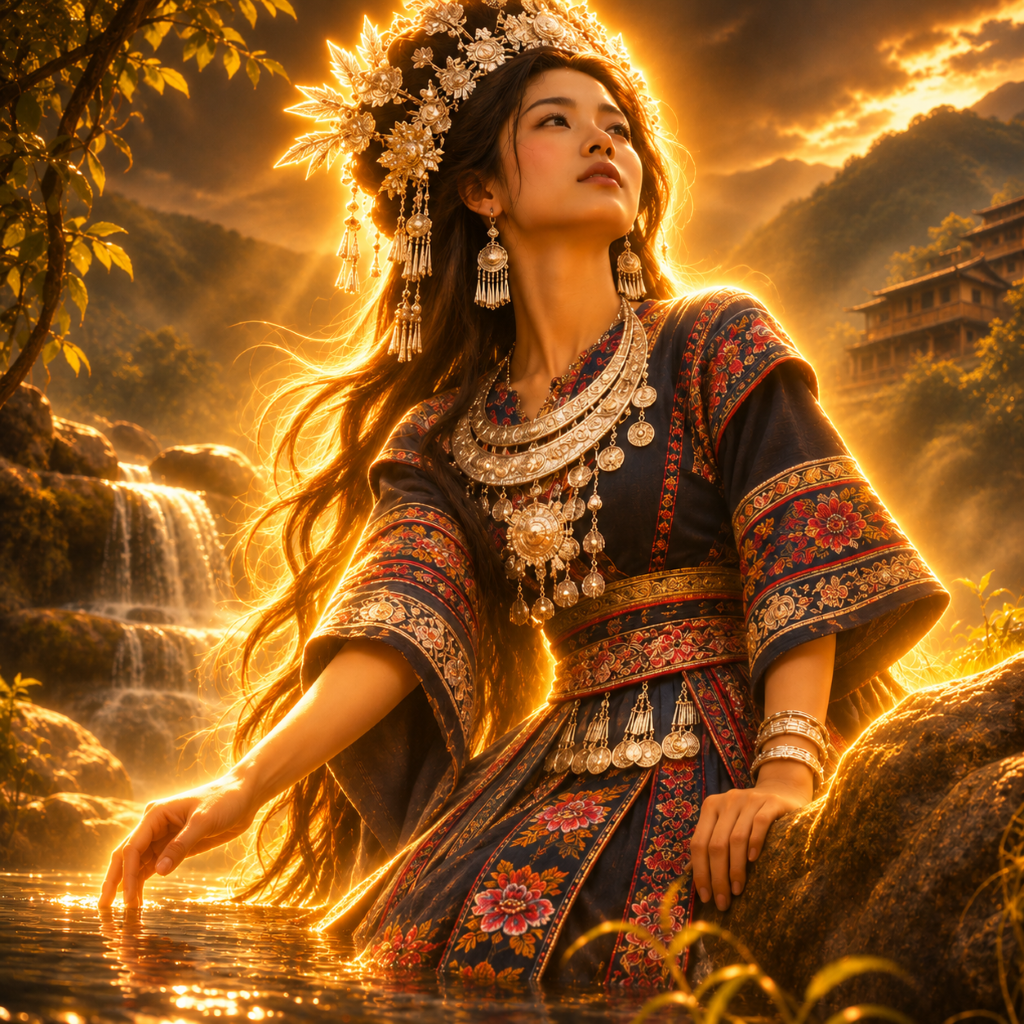
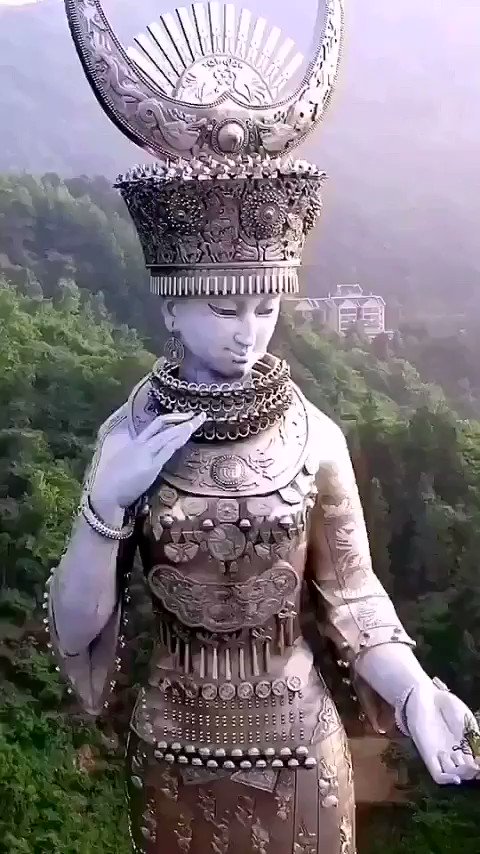
Her traditional appearance is generally represented through Miao cultural clothing, elaborate ornaments and graceful presentation. These visual elements reflect the artistic heritage of the communities that preserve her story rather than a single universally established description of her supernatural appearance. Modern artistic interpretations frequently portray Yang Asha as a young Miao woman dressed in traditional attire, sometimes surrounded by flowing water. Her enormous statue in Jianhe County follows this cultural representation.
Family
Yang Asha’s origins are closely connected with the natural and spiritual landscape of Miao tradition. The best-documented version of her story describes her as a beautiful young woman born from water. This unusual birth establishes her as a figure whose identity transcends an ordinary human origin. However, surviving accounts do not provide a universally accepted genealogy identifying her parents, siblings or children. Her mythology is preserved through regional oral traditions, and different communities have developed variations of the narrative.
Some popular retellings place Yang Asha within a celestial love story involving the Sun and the Moon. In one version, she is deceived into marrying the Sun, who subsequently leaves her for an extended period. She eventually falls in love with the Moon, identified as the Sun’s brother, and the two pursue a life together despite the difficulties surrounding their relationship.
This version gives her story a strong emotional dimension, exploring abandonment, affection and the freedom to choose a partner. However, the precise relationships and sequence of events should be understood as elements of particular retellings rather than a universally established family history. Yang Asha is also sometimes described in modern cultural representations as an ancestral figure of the Miao people. This association reflects her importance as a symbol of collective identity, although it should not be confused with a consistently documented genealogical tradition.
Other names
Yang Asha is known through several spellings resulting from the translation and romanisation of her original Miao name. The most widely recognised English forms are Yang Asha and Yang’asha. Her Chinese name is written as 仰阿莎, which is the form used in official Chinese cultural heritage documentation. Another spelling, Yangesha, occasionally appears in English-language publications and media reports. These variations generally refer to the same legendary figure rather than separate deities.
She is also frequently identified by descriptive titles such as the Miao Goddess of Beauty and the Clear Water Maiden. These titles reflect different aspects of her cultural identity, particularly her association with feminine beauty and her legendary birth from water. The exact linguistic interpretation of her name is not consistently established in the available authoritative documentation. Therefore, the different spellings are best understood as transliteration variations rather than names with independently verified meanings.
Powers and Abilities
Yang Asha is not traditionally characterised by an extensive collection of supernatural powers or magical weapons. Her significance comes primarily from her symbolic identity, legendary origins and place within Miao oral literature. Her extraordinary beauty is her most recognised attribute. It represents more than physical appearance, expressing ideals of feminine grace, natural purity and cultural identity. Through her story, beauty becomes an important element of the relationship between individuals and their community.
Her connection with water is another defining characteristic. Being born from water establishes a symbolic relationship with the natural environment, particularly the rivers, springs and landscapes associated with her traditional homeland. Some regional retellings also describe her transforming into a river to protect her homeland, although this should not be treated as a universally documented supernatural ability. Yang Asha is also associated with love, perseverance and personal freedom. Her narrative explores the difficulties of relationships and the desire to pursue genuine affection despite social and personal obstacles.
Some folkloric interpretations associate her with traditional feminine accomplishments, including singing, weaving and embroidery. These qualities reflect the cultural importance of artistic skills within Miao communities, although they are not consistently established as supernatural abilities. Rather than portraying her as a warrior or creator deity, Miao tradition presents Yang Asha as a culturally significant figure whose identity is rooted in beauty, nature, emotional endurance and the human experience.
Modern Day Influence
Yang Asha continues to occupy an important position in the cultural identity of the Miao people, particularly in Guizhou Province. Her legend has moved beyond oral storytelling to become an important subject of cultural preservation, literature, performing arts and regional tourism.
One of the most significant milestones came in June 2008, when the Yang Asha narrative was recognised as part of China’s National Intangible Cultural Heritage. Official documentation identifies it as an exceptionally long Miao narrative song, extending to more than ten thousand lines. Traditionally performed through singing, it preserves elements of Miao literature, music, social customs and cultural memory.
The recognition also highlighted concerns about the survival of the tradition. The number of people capable of performing the complete narrative has declined, with many of its remaining skilled performers belonging to older generations. Cultural preservation initiatives have therefore focused on documenting the song and supporting its transmission to younger generations.
Jianhe County has become particularly associated with Yang Asha. In 2017, a monumental stainless-steel statue dedicated to her was completed near the Qingshui River. The structure stands 88 metres tall, including a 66-metre figure and a 22-metre pedestal. Its dimensions incorporate symbolic references to traditional Miao festivals.
The monument has also attracted public controversy. Its construction involved an investment of approximately 86 million yuan, prompting questions about public spending and the priorities of a county that had previously been classified as impoverished. Local authorities subsequently stated that the project was financed through company funds and bank financing rather than national poverty-alleviation funds.
Beyond the monument, Yang Asha continues to inspire cultural festivals, artistic representations and tourism initiatives throughout the region. Her story provides an important connection between traditional Miao literature and contemporary cultural expression. Today, Yang Asha represents much more than an ideal of feminine beauty. She embodies the survival of an oral tradition, the cultural identity of the Miao people and the continuing importance of preserving regional folklore in modern China.
Related Images




Source
Asia Book of Records. (2024, June 5). Largest statue of the goddess Yang’asha. https://www.asiabookofrecords.com/largest-statue-of-the-goddess-yangasha/
Bradsher, K. (2020, November 26). A soaring monument to beauty in China is stirring passions. Mostly anger. The New York Times. https://www.nytimes.com/2020/11/26/world/asia/china-statue-yang-asha.html
China Daily. (2013, July 17). Guizhou Jianhe Yang’asha Culture Festival kicks off. https://www.chinadaily.com.cn/regional/2013-07/17/content_16787523.htm
China Daily. (2020, October 22). Giant statue comes under fire online. https://www.chinadaily.com.cn/a/202010/22/WS5f90daefa31024ad0ba802a0.html
Lonely Planet. (2017, April 20). See incredible pictures of a giant statue of the Goddess of Beauty being built in China. https://www.lonelyplanet.com/articles/giant-statue-goddess-beauty-china
People’s Daily Online. (2017, April 17). Statue of legendary Miao beauty built to promote local tourism. http://en.people.cn/n3/2017/0417/c90000-9207255.html
Straits Times. (2020, November 27). Statue of Yang Asha, goddess of beauty, sparks debate in China. https://www.straitstimes.com/asia/east-asia/statue-of-yang-asha-goddess-of-beauty-sparks-debate-in-china
World Record Certification. (n.d.). The largest statue of the goddess Yang’asha in the world. https://www.worldrecordcertification.com/record/the-largest-statue-of-the-goddess-yangasha-in-the-world-1496-28
Frequently Asked Questions
Who is Yang Asha in Chinese mythology?
Yang Asha is a legendary goddess of beauty revered by the Miao people of southwestern China. Her story survives through an ancient oral narrative song.
What is Yang Asha the goddess of?
Yang Asha is primarily associated with beauty, feminine grace, love and purity. Her legendary birth from water also connects her with nature.
Where does the legend of Yang Asha originate?
Yang Asha originates from Miao oral traditions in southeastern Guizhou, China, particularly the communities surrounding Jianhe County and the Qingshui River.
Why is Yang Asha associated with water?
According to Miao tradition, Yang Asha was born from water. This legendary origin connects her with purity, natural beauty and the landscapes of Guizhou.
Is Yang Asha recognised as Chinese cultural heritage?
Yes. The Yang Asha narrative song was included in China’s National Intangible Cultural Heritage List in 2008, recognising its importance in Miao folk literature.


