


Wanema : The Divine Patriarch of the Baganda
At a glance
| Description | |
|---|---|
| Origin | Baganda Mythology |
| Classification | Gods |
| Family Members | Kibuka, Mukasa (Children) |
| Region | Uganda, Republic of the Congo, Democratic Republic of the Congo, Gabon. |
| Associated With | Divine Lineage |
Mythlok Perspective
In Mythlok’s Perspective, Wanema represents far more than the father of two celebrated deities. His significance lies in the quiet power of ancestry, where influence is measured not by legendary exploits but by the legacy passed to future generations. Like Borr in Norse mythology, Wanema stands behind figures who became far more prominent than himself. Yet, while his descendants shaped the spiritual life of the Baganda people, Wanema reminds us that mythology often reserves its greatest respect for those who lay the foundation upon which legends are built.
Wanema
Introduction
Wanema is a lesser-known but important figure in the mythology of the Baganda people of Uganda. Although he is not as prominently revered as Katonda, Mukasa, or Kibuka, he occupies a significant place in the Baganda pantheon as the father of two of its most influential deities. Through his lineage, Wanema represents the continuity of divine ancestry that underpins many Baganda myths and traditions.
Unlike many major balubaale (deities), Wanema rarely appears as the central figure in surviving myths. Instead, his importance is reflected through his descendants, whose roles in war, prosperity, and the protection of the kingdom made them among the most widely venerated gods in Buganda. His place within this sacred genealogy ensures his lasting significance in Baganda mythology.
Physical Traits
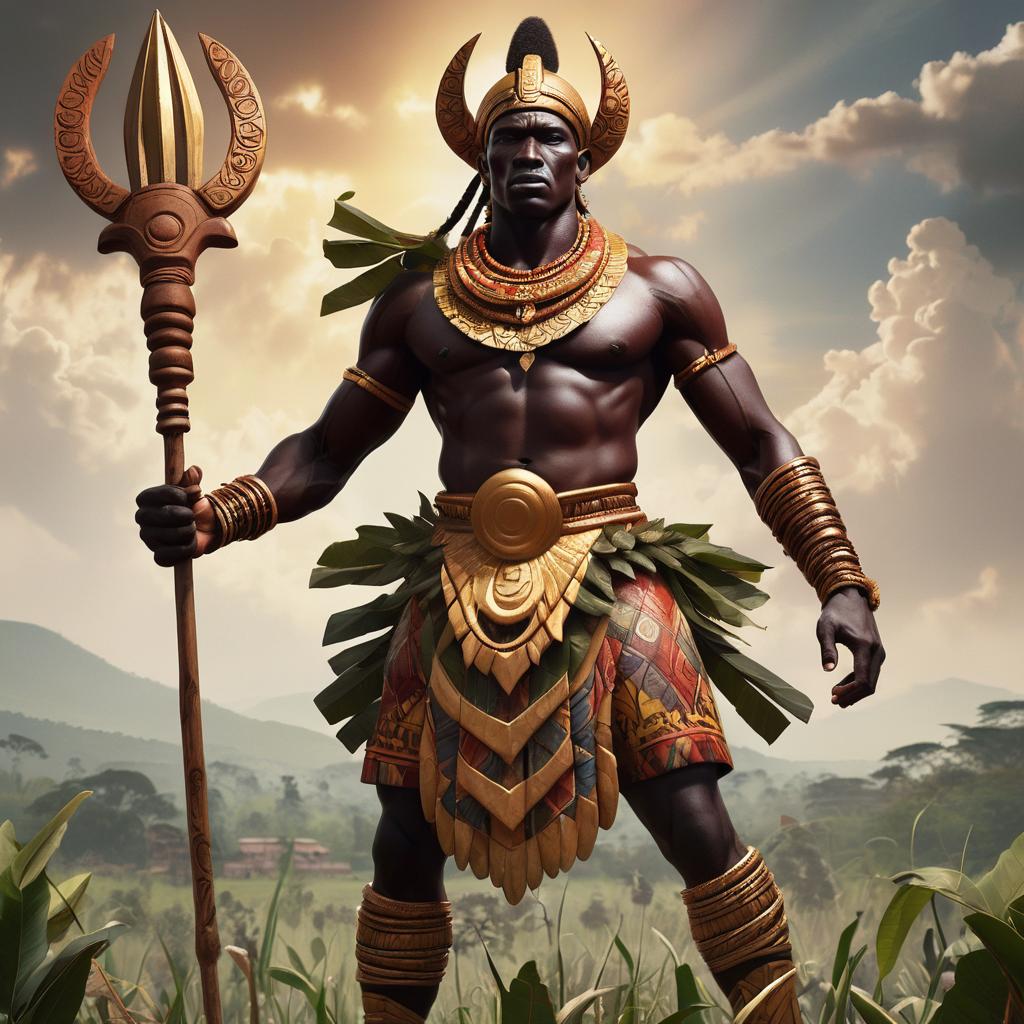
Traditional Baganda oral traditions provide very little information about Wanema’s physical appearance. Unlike many mythological figures whose attributes or symbols are clearly described, Wanema is remembered primarily through his ancestry and his place within the divine lineage rather than through detailed physical characteristics.
Because of this lack of description, modern artistic portrayals often depict him as a dignified elder or powerful ancestral deity. These interpretations are creative representations rather than images based on traditional accounts, which leave his appearance largely undefined.
Family
Wanema’s greatest importance in Baganda mythology lies in his family connections. He is traditionally regarded as the father of Mukasa and Kibuka, two of the most celebrated balubaale in the Buganda kingdom. Through them, Wanema became part of one of the most significant divine lineages in Baganda religious tradition.
His son Kibuka is revered as the god of war and is remembered for aiding King Nakibinge during the wars against Bunyoro. According to tradition, Kibuka was mortally wounded during the conflict and later became one of the kingdom’s most respected protective deities. Mukasa, Wanema’s other son, is associated with Lake Victoria and is widely honored as a deity of prosperity, fertility, health, and abundance. His worship spread throughout Buganda and neighboring regions, making him one of the most influential gods in the pantheon.
Wanema is also traditionally described as the son of Musisi, the deity associated with earthquakes. This places him within an ancient divine lineage that links several important figures in Baganda mythology.
Other Names
Few alternative names for Wanema survive in historical records or oral traditions. Unlike deities such as Mukasa or Kibuka, whose worship became widespread, Wanema appears only occasionally in surviving myths and genealogies. Most traditional sources simply refer to him by his original name.
The scarcity of alternate titles reflects his role as an ancestral figure rather than a deity with an extensive body of independent myths. His identity has remained relatively consistent throughout the traditions in which he appears.
Powers and Abilities
Unlike many prominent Baganda deities, Wanema is not credited with a large collection of supernatural feats or clearly defined domains. The surviving traditions focus primarily on his role within the divine family rather than on individual acts of power.
His significance instead comes from his position as the father of Mukasa and Kibuka, whose influence shaped important aspects of Baganda religious life. Through this lineage, Wanema symbolizes the continuity of divine authority and the transmission of sacred heritage from one generation of gods to the next.
Although relatively little is recorded about his own deeds, his place within the pantheon highlights the importance of ancestry and kinship in Baganda mythology. His legacy lives on through the enduring prominence of his descendants, who became central figures in the kingdom’s spiritual traditions.
Modern Day Influence
Wanema is not widely worshipped in modern Uganda, but his place in Baganda mythology continues to be preserved through oral traditions, historical writings, and studies of the balubaale. His role within the divine genealogy remains an important part of understanding the origins and relationships of the Baganda gods.
While devotion today is more commonly directed toward well-known figures such as Mukasa and Kibuka, Wanema remains an essential ancestral figure whose story provides context for their significance. His inclusion in traditional genealogies illustrates the value the Baganda place on lineage, heritage, and the continuity of sacred traditions.
As interest in African mythology continues to grow, Wanema has gained renewed attention through academic research, cultural preservation efforts, and educational resources. Although his mythology is less extensive than that of many other Baganda deities, his role in the divine family ensures that he remains an enduring part of Uganda’s rich mythological heritage.
Related Images

Source
Kaggwa, A. (1934). The customs of the Baganda. Columbia University Press.
Lugira, A. M. (2009). African traditional religion. Chelsea House Publishers.
Roscoe, J. (1911). The Baganda: An account of their native customs and beliefs. Macmillan and Co. https://archive.org/details/bagandaanaccount00rosc
Roscoe, J. (2011). The Baganda. Cambridge University Press. (Original work published 1911). https://doi.org/10.1017/CBO9780511707571
Wikipedia contributors. (n.d.). Mukasa (deity). Wikipedia. Retrieved July 23, 2026, from https://en.wikipedia.org/wiki/Mukasa_(deity)
Frequently Asked Questions
Who is Wanema in Baganda mythology?
Wanema is a divine ancestor in Baganda mythology and the father of Mukasa and Kibuka. Though little is recorded about him, he occupies an important place in the genealogy of the balubaale.
What is Wanema the god of?
Unlike many Baganda deities, Wanema is not linked to a specific domain. He is primarily remembered as an ancestral figure whose importance comes from his place in the divine lineage.
Who are Wanema's children?
Wanema is the father of Mukasa, the deity of prosperity and health, and Kibuka, the god of war. Both became among the most revered deities in traditional Baganda religion.
Is Wanema still worshipped today?
Wanema is not widely worshipped today. However, his legacy survives through Baganda oral traditions, historical records, and the continued cultural importance of his descendants.
Why is Wanema important in Baganda mythology?
Wanema is important because he is the father of two major Baganda deities, Mukasa and Kibuka. His role highlights the significance of ancestry and divine lineage in Baganda mythology.
