
Yomi-no-kuni : The Shadowy Underworld of Japanese Belief
| Description | |
|---|---|
| Mythology | Japanese Mythology |
| Description | Shadowy underworld beneath earth |
| Ruler/Guardian | Izanami |
| Inhabitants | Souls of the dead |
| Nature | Neutral |
Mythlok Perspective
In Mythlok’s Perspective, Yomi-no-kuni is less an underworld and more a philosophy of endings. It does not threaten with punishment but confronts with stillness, making death feel natural yet deeply unsettling. Unlike Greek Hades or Norse Hel, which organize the dead into structured realms, Yomi dissolves identity into decay. It mirrors the Chinese concept of Diyu in origin but rejects its moral framework, instead embracing inevitability. This makes Yomi one of the most human visions of death—quiet, absolute, and impossible to reverse.
Yomi-no-kuni
Introduction
Yomi-no-kuni stands as one of the most haunting and philosophically rich concepts in early Japanese belief systems. Recorded in ancient texts like the Kojiki and Nihon Shoki, it represents the realm where the dead reside after life ends. Unlike many afterlife traditions that focus on judgment or punishment, Yomi-no-kuni presents something far more unsettling—an irreversible descent into decay and stillness.
The term itself is often translated as “Land of Yellow Springs” or “Hidden Land,” linking it conceptually to older East Asian underworld traditions. Within early Japanese cosmology, Yomi exists alongside Takamagahara, the heavenly realm, and Ashihara-no-nakatsukuni, the world of the living. Together, they form a layered universe where life, divinity, and death coexist but remain firmly separated. At its core, Yomi-no-kuni is not about moral consequence. It is about transformation—where vitality fades into impurity, and where separation between the living and the dead becomes absolute.
Description
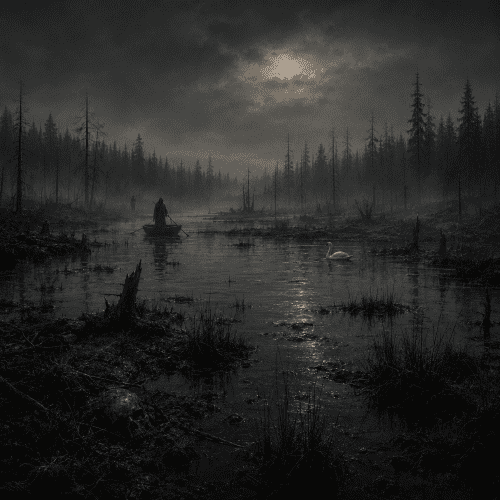
Yomi-no-kuni is often imagined as a vast, shadow-filled domain beneath the earth, though early texts leave its exact location ambiguous. Some interpretations connect it to mountains or deep natural spaces, reflecting ancient burial practices where bodies returned to the earth.
What defines Yomi is not geography but atmosphere. It is a realm devoid of light, warmth, and movement. Everything within it suggests stagnation. The imagery associated with Yomi emphasizes decay—rotting flesh, crawling insects, and an overwhelming sense of stillness. This is not a fiery hell but a silent, suffocating existence.
In Shinto thought, death introduces kegare, or impurity. Yomi embodies this concept completely. It stands in direct contrast to the living world, which is vibrant, fertile, and constantly renewed. The existence of Yomi reinforces the need for purification rituals among the living, ensuring that the boundary between life and death remains intact.
Ruler/Guardian
The ruler of Yomi-no-kuni is Izanami no Mikoto, once a creator goddess who shaped the Japanese islands alongside Izanagi. Her transformation into the sovereign of the underworld is one of the most tragic shifts in Japanese myth.
After dying while giving birth to the fire deity Kagutsuchi, Izanami descends into Yomi and becomes Yomotsu-Ōkami, the Great Deity of the Underworld. Her role is not simply that of a ruler, but of a being who embodies death itself.
In myth, she is no longer the radiant creator she once was. Instead, she becomes a figure tied to decay and inevitability. When Izanagi attempts to retrieve her, he discovers that she has already become part of Yomi’s corruption. This transformation reflects a deeper belief: death changes not just the body, but the very nature of existence.
Inhabitants
The inhabitants of Yomi-no-kuni are the souls of the deceased, but their existence is far from peaceful. Unlike structured afterlives that separate souls based on virtue or sin, Yomi offers no hierarchy and no judgment. Everyone who enters shares the same fate—a shadowed, stagnant continuation of existence.
These spirits are often imagined as reflections of their physical state, gradually succumbing to decay. The myth of Izanagi’s descent describes grotesque beings such as thunder deities and terrifying female figures who pursue him as he flees.
Rather than forming a society, the inhabitants of Yomi exist in isolation. This lack of structure reinforces the idea that death is not a transition to another life, but a separation from all that gives life meaning—movement, connection, and growth.
Access
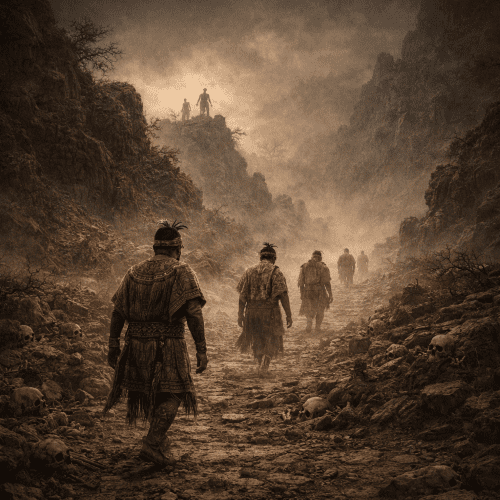
Entry into Yomi-no-kuni is not a journey one chooses. It is the natural destination after death. However, myths describe specific gateways that connect the living world to this hidden realm. The most famous of these is Yomotsu Hirasaka, a slope in the Izumo region believed to mark the boundary between life and death. After escaping Yomi, Izanagi seals this entrance with a massive boulder, symbolizing the permanent divide between the two worlds.
A crucial rule governs Yomi: consuming its food binds a soul to the realm forever. This detail appears in the myth of Izanami and echoes similar motifs across global traditions. It reinforces the idea that once death is accepted—physically or symbolically—there is no return.
Instances of Visit
The defining narrative of Yomi-no-kuni is Izanagi’s descent into the underworld. Grieving the loss of Izanami, he ventures into Yomi in an attempt to bring her back. At first, Izanami agrees to seek permission to return, asking him not to look at her. But driven by impatience, Izanagi breaks his promise. What he sees is not the goddess he remembers, but a decomposing figure overtaken by decay.
Terrified, he flees, pursued by Izanami and the beings of Yomi. His escape culminates in the sealing of the underworld’s entrance, marking a permanent separation between the realms of the living and the dead. This story is central to Japanese cosmology. It explains not only the nature of death but also the origins of purification rituals and the birth of major deities through Izanagi’s cleansing.
Symbolism
Yomi-no-kuni represents more than an afterlife. It is a reflection of how early Japanese belief systems understood death—as a state of impurity and irreversible change. The contrast between Izanagi and Izanami highlights duality. Life and death, purity and decay, creation and destruction all exist as interconnected forces. The sealing of Yomi’s entrance symbolizes the boundary that must be maintained between these states. The act of purification that follows Izanagi’s return is equally important. It demonstrates that while death cannot be undone, its influence can be cleansed. This idea remains central to Shinto practice even today.
Comparative Analysis
When compared to other underworld traditions, Yomi-no-kuni stands apart in its simplicity and tone. Greek Hades offers structured regions and occasional escape narratives, while Norse Hel presents a cold but defined realm. Buddhist Naraka introduces cycles of punishment and rebirth.
Yomi, however, remains unstructured and absolute. It does not judge, reward, or punish. It simply exists as a final state of being. This absence of moral judgment makes Yomi uniquely philosophical. It shifts the focus away from ethics and toward the inevitability of decay. In doing so, it aligns more closely with natural cycles than with systems of divine justice.
Modern Influence
Yomi-no-kuni continues to influence Japanese culture in subtle yet powerful ways. Its imagery appears frequently in anime, manga, and video games, often reimagined as a mysterious or dangerous underworld. References to Yomotsu Hirasaka and the Izanagi myth appear in popular franchises, bridging ancient belief with modern storytelling.
At a cultural level, the concept of Yomi reinforces traditional attitudes toward death. Rather than focusing on eternal punishment, Japanese practices emphasize remembrance, purification, and respect for ancestral spirits. Festivals like Obon reflect this balance, where the dead are honored without invoking the fear associated with Yomi itself. Globally, Yomi has become a powerful metaphor in storytelling, symbolizing grief, loss, and the emotional weight of irreversible separation.

Sources
Wikipedia. (n.d.). Yomi. https://en.wikipedia.org/wiki/Yomi
World History Encyclopedia. (2017, May 14). Yomi. https://www.worldhistory.org/Yomi/
Godchecker. (2023, June 15). YOMI – the Shinto legendary place of the Underworld. https://www.godchecker.com/japanese-mythology/YOMI/
The Enlightenment Journey. (2024, February 12). Yomi: Shinto Underworld And Realm Of The Dead. https://theenlightenmentjourney.com/yomi-shinto-underworld-and-realm-of-the-dead/
Philippi, D. L. (Trans.). (1968). Kojiki. University of Tokyo Press.
Aston, W. G. (Trans.). (1972). Nihongi: Chronicles of Japan from the earliest times to A.D. 697. Tuttle Publishing. (Original work published 1896)
Ouwehand, C. (1964). Namazu-e and their themes: An interpretative approach to some aspects of Japanese folk religion. Brill.
Naumann, N. (1972). The Yomi journey in the Kojiki. Monumenta Nipponica, 27(3), 285–304. https://doi.org/10.2307/2383623
Frequently Asked Questions
What is Yomi-no-kuni in Japanese belief?
Yomi-no-kuni is the Japanese land of the dead where souls exist in decay and darkness without judgment or punishment.
Who rules Yomi-no-kuni?
Izanami, once a creator goddess, becomes the ruler of Yomi after her death and transformation.
Can someone return from Yomi-no-kuni?
No, especially after consuming food there, which binds souls permanently to the underworld.
Is Yomi-no-kuni the same as Hell?
No, it is not a place of punishment but a shadowy realm of decay and stillness.
Where is Yomi-no-kuni located?
It is believed to exist beneath the earth or beyond hidden boundaries like Yomotsu Hirasaka.