


Ukunduka : The Sexual Predatory Spirit of Pemba
At a glance
| Description | |
|---|---|
| Origin | Pemba Mythology |
| Classification | Spirits |
| Family Members | N/A |
| Region | Tanzania |
| Associated With | Parasitic spirits, Sex, Nocturnal attack |
The Mythlok Perspective
In Mythlok’s Perspective, the Ukunduka demonstrates how different cultures explain unseen dangers through supernatural narratives. While European folklore imagined vampires draining blood, Pemba mythology envisioned a spirit that feeds on human vitality itself. Both traditions reflect universal fears of vulnerability during the night, yet the Ukunduka remains distinctly East African, shaped by the spiritual beliefs, healing practices, and oral traditions of the Swahili Coast.
Ukunduka
Introduction
The Ukunduka is one of the lesser-known but deeply feared supernatural beings found in the folklore of Pemba Island, part of the Zanzibar Archipelago off the coast of present-day Tanzania. Pemba has long been associated with traditional healing, spirit beliefs, and the practice of local occult traditions, making it one of the most spiritually significant regions of the Swahili Coast. Within this rich cultural landscape, stories of spirits are woven into everyday life, and the Ukunduka occupies a particularly unsettling place among them.
Unlike protective ancestral spirits or nature beings, the Ukunduka is regarded as a dangerous entity whose survival depends on exploiting human victims. Local traditions portray it as a parasitic spirit that seeks intimate contact with people to drain their vitality rather than simply frighten them. Because of this association, it is often grouped with other harmful supernatural beings known collectively as mashetani (singular: shetani), a broad Swahili term for spirits that can range from mischievous to openly malevolent.
The mythology surrounding the Ukunduka reflects the cultural blending that has shaped the Swahili Coast for centuries. African traditions mixed with Arab and Persian influences created a spiritual worldview where unseen beings were considered active participants in daily life. Within this belief system, the Ukunduka represents the fear of hidden supernatural dangers that operate beyond ordinary human perception, especially during the night.
Physical Traits
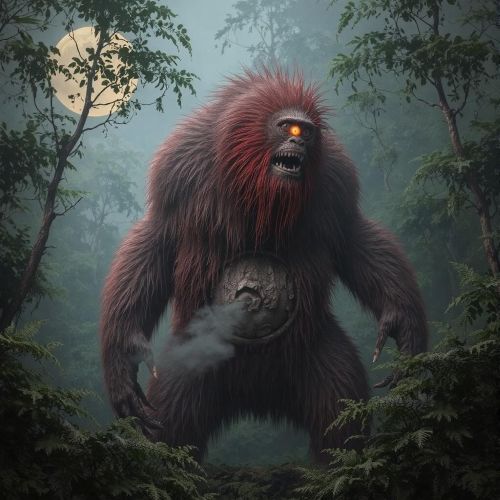
Unlike many legendary creatures that have a fixed appearance, the Ukunduka is rarely described with a single, consistent form. Traditional accounts instead emphasize the disturbing nature of its presence, portraying it as something unmistakably unnatural. Witnesses often describe it as having a twisted or corrupted body that immediately reveals it is not human.
In broader Swahili folklore, many mashetani possess the ability to alter their appearance, taking the shape of ordinary people or animals before revealing their true forms. The Ukunduka is generally believed to share this deceptive quality, making it particularly difficult to recognize before it attacks. Rather than relying on brute strength, it uses concealment and fear to approach its victims.
Some modern artistic interpretations have given the spirit aquatic or reptilian features because of Pemba’s island environment, but these characteristics are not consistently found in traditional folklore. What remains constant across most stories is the unsettling impression it leaves behind. Its appearance is meant to communicate corruption, predation, and an existence outside the natural order rather than serve as a detailed physical description.
Family
The Ukunduka does not belong to a biological family in the way gods or legendary heroes often do. Instead, it belongs to the wider class of supernatural beings known as mashetani, spirits that occupy an important place in Swahili belief systems throughout East Africa.
These spirits encompass a wide range of personalities and functions. Some are associated with natural places, others with emotions or misfortune, while a number are viewed as actively hostile toward humans. The Ukunduka falls firmly into this last category. It is often discussed alongside other dangerous spirits from the region, although each possesses distinct behaviors and characteristics.
Unlike famous figures such as the Popobawa, whose folklore became widely known during the twentieth century, the Ukunduka remains primarily rooted in local oral traditions on Pemba. There are no widely accepted myths describing its parentage, descendants, or divine ancestry. Instead, its significance comes from its place within the broader spiritual hierarchy of East African folklore, where malevolent spirits are believed to exist alongside humans and occasionally interfere with everyday life.
Other names
The name Ukunduka is the primary title used in Pemba traditions for this particular spirit. Outside the island, however, it is more commonly identified under the broader category of shetani, with the plural form mashetani referring collectively to supernatural spirits.
Researchers studying African folklore have sometimes described the Ukunduka as a vampiric spirit because of its parasitic relationship with human life force. While this comparison helps modern readers understand its role, it should not be interpreted as meaning the Ukunduka is equivalent to the European vampire. Its methods, symbolism, and cultural origins are distinctly East African.
The spirit has also occasionally been compared to the succubus and incubus of European folklore because of its association with sexual encounters. These comparisons are descriptive rather than traditional and do not originate from Swahili belief itself. Although modern fiction and games have borrowed the name for supernatural enemies or corrupted creatures, these portrayals are creative adaptations rather than authentic representations of Pemba mythology.
Powers and Abilities
The defining characteristic of the Ukunduka is its ability to sustain itself by drawing energy from human beings through sexual encounters. Traditional belief describes this process as a supernatural form of parasitism in which the victim is physically and spiritually weakened while the spirit grows stronger.
Stories commonly place the Ukunduka among the spirits that operate under the cover of darkness. It is believed to visit sleeping victims, creating terrifying encounters that blur the boundary between dreams and reality. These experiences often leave victims exhausted, frightened, or emotionally distressed, reinforcing the belief that the spirit has consumed part of their life force.
Another important trait attributed to the Ukunduka is its ability to remain hidden. Rather than openly confronting people, it relies on stealth, deception, and psychological fear. This invisibility enhances its reputation as a persistent supernatural threat because ordinary physical defenses offer little protection against it.
Like many spirits in Swahili folklore, the Ukunduka is also believed to be vulnerable to traditional spiritual practices. Communities have historically sought protection through respected healers, ritual cleansing, prayers, and other local methods intended to repel harmful spirits. These beliefs highlight the important role traditional healers continue to play within Pemba’s cultural heritage.
Modern Day Influence
Although belief in spirits has changed with modernization, the Ukunduka remains an important part of Pemba’s cultural identity and oral tradition. Stories about dangerous mashetani continue to be shared within families and communities, preserving local understandings of the supernatural while reinforcing traditional values surrounding caution and spiritual protection.
The wider artistic tradition of East Africa has also helped preserve similar spirit figures. The renowned Makonde woodcarvers of Tanzania and northern Mozambique produce expressive shetani sculptures, depicting supernatural beings with exaggerated and surreal forms. While these carvings do not specifically represent the Ukunduka, they reflect the broader Swahili belief in spirits that exist beyond ordinary human experience.
Outside traditional culture, the name Ukunduka has occasionally appeared in fantasy media and video games as inspiration for corrupted or parasitic creatures. These adaptations borrow elements of the folklore but often reshape them for fictional settings.
Today, the legend of the Ukunduka serves as more than a frightening ghost story. It offers a glimpse into the spiritual worldview of Pemba Island, where folklore, healing traditions, and community memory continue to preserve beliefs that have endured for generations despite the influence of the modern world.
Related Images


Source
Frequently Asked Questions
What is the Ukunduka in Pemba mythology?
The Ukunduka is a malevolent shetani (spirit) from Pemba Island folklore that is believed to prey upon humans by draining their vitality through supernatural encounters.
Is the Ukunduka considered a demon?
Not exactly. In Swahili tradition, the Ukunduka is classified as a shetani, a broad category of spirits that includes both harmful and neutral supernatural beings, rather than fitting the Western concept of a demon.
Where does the legend of the Ukunduka come from?
The legend originates from Pemba Island in Tanzania’s Zanzibar Archipelago, where Swahili spiritual traditions blend African, Arab, and Persian cultural influences.
Can the Ukunduka change its appearance?
Traditional folklore suggests that many mashetani can disguise themselves or alter their appearance, and the Ukunduka is commonly believed to possess similar deceptive abilities.
Is the Ukunduka still part of local belief today?
Yes. While beliefs vary between individuals, stories about the Ukunduka and other mashetani remain part of Pemba’s oral traditions and continue to influence local folklore and cultural identity.


