


Tanit : The Great Libyan Goddess of Carthage and North Africa
At a glance
| Description | |
|---|---|
| Origin | Libyan Mythology |
| Classification | Gods |
| Family Members | Baal Hammon (Husband) |
| Region | Libya |
| Associated With | Fertility, Motherhood, Protection, Wisdom, Civilization, Agriculture, Prosperity, Moon, Stars, Heavens |
The Mythlok Perspective
In Mythlok’s Perspective, Tanit represents one of the strongest examples of how indigenous North African beliefs merged with wider Mediterranean traditions. While many remember her as the great goddess of Carthage, her deeper significance lies in her role as a protector, mother, and symbol of cultural continuity. Unlike war-focused deities who gained fame through conquest, Tanit’s power came from nurturing life and preserving society. Her evolution mirrors that of goddesses such as Athena and Neith, who also combined wisdom with protection. Across cultures, she embodies the enduring archetype of the divine guardian whose strength is measured not by destruction, but by the ability to sustain civilization.
Tanit
Introduction
Tanit was one of the most important goddesses of the ancient Mediterranean world and the supreme female deity of Carthage. Revered across North Africa, particularly in regions connected with modern Tunisia and Libya, she represented fertility, protection, wisdom, and the sustaining forces of life. Although she is most commonly associated with the Punic civilization of Carthage, many scholars believe her roots may extend into older Libyan and Berber religious traditions that existed long before Phoenician settlers arrived in North Africa.
From around the fifth century BCE onward, Tanit became one of the most widely worshipped deities in the western Mediterranean. Her influence spread through Carthaginian trade networks into Sicily, Sardinia, Malta, Spain, and other coastal regions. She was frequently worshipped alongside Baal Hammon, the chief male deity of Carthage, and together they formed the central divine partnership of Punic religion.
Unlike many ancient goddesses who were limited to a single domain, Tanit embodied several aspects of existence. She was associated with fertility and motherhood, the heavens and celestial bodies, civic protection, and the prosperity of communities. Her enduring legacy can still be seen today through archaeological discoveries, cultural traditions, and symbols that remain part of North African identity.
Physical Traits
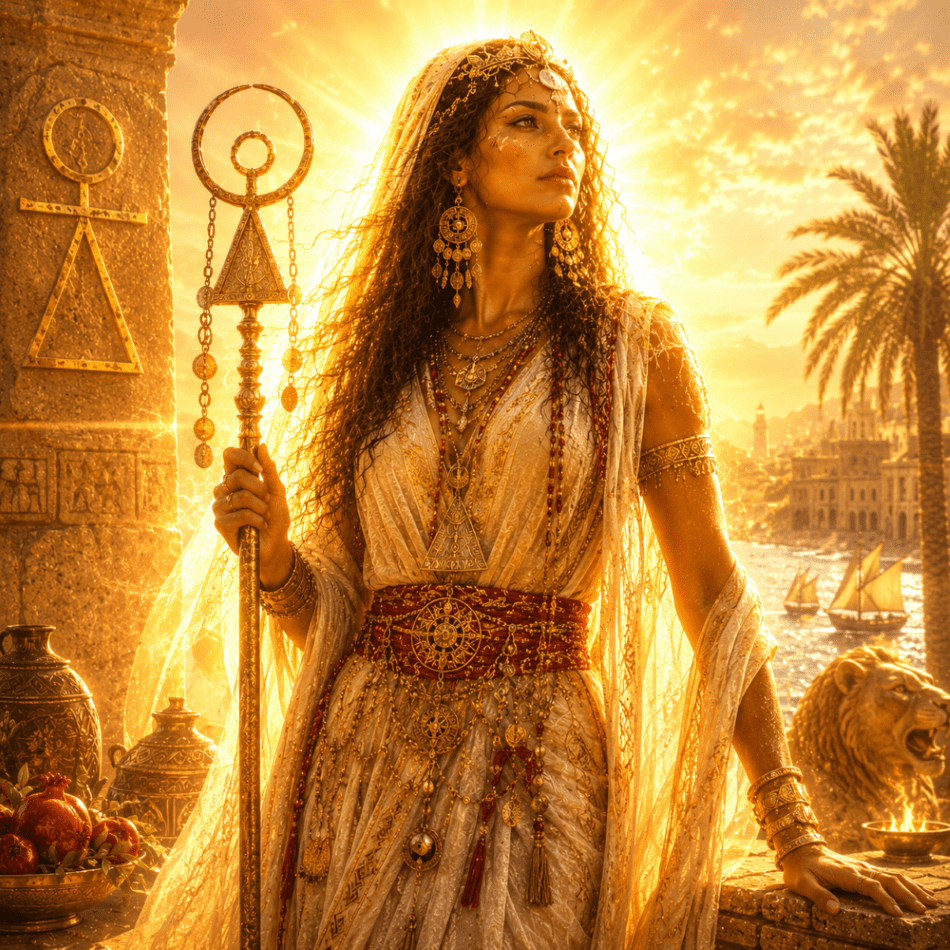
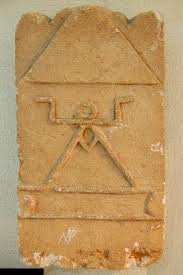
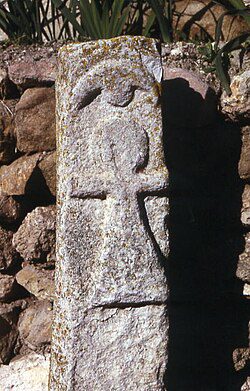
Unlike many ancient deities who were regularly portrayed in human form, Tanit was most commonly represented through a powerful symbol now known as the Sign of Tanit. This emblem consisted of a triangle or trapezoid representing the body, a horizontal line symbolizing outstretched arms, and a circle representing the head. The symbol appeared on temples, monuments, pottery, jewellery, and funerary stelae throughout the Punic world.
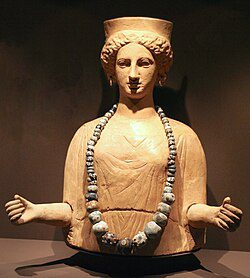
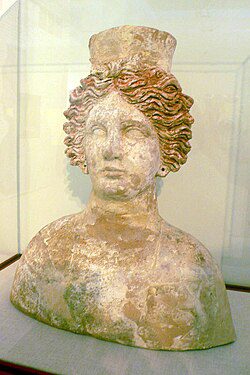
When depicted as a goddess, Tanit usually appeared as a dignified woman wearing long flowing robes. Ancient artworks often associated her with symbols of abundance such as pomegranates, grapes, palm branches, and other fertility-related imagery. These elements emphasized her role as a provider of prosperity and life.
Several artistic representations also link Tanit with animals. The dove was one of her most sacred creatures and symbolized peace, fertility, and divine blessing. Lions occasionally appeared alongside her as symbols of strength and protection. In some North African and Punic depictions, she is shown riding a lion or carrying a sceptre, highlighting her status as a guardian deity capable of defending her people.
Celestial imagery was another important part of her iconography. Crescents, stars, and solar symbols frequently accompanied representations of Tanit, reflecting her connection to the heavens and the cycles of nature.
Family
The most significant relationship in Tanit’s mythology was her partnership with Baal Hammon, the chief male deity of Carthage. Together they formed the principal divine pair of the Punic religious system and were frequently worshipped side by side.
Baal Hammon was associated with fertility, vegetation, and renewal, while Tanit embodied protection, motherhood, and prosperity. Their complementary roles made them the spiritual guardians of Carthaginian society. Numerous inscriptions found throughout North Africa invoke both deities together, demonstrating the importance of their partnership.
Unlike many mythological figures from Greece or Rome, Tanit was not the subject of extensive surviving myths concerning children or divine family disputes. Instead, she was revered primarily as a universal mother figure whose relationship with the people of Carthage was more important than any specific genealogy. Her maternal nature defined much of her worship and contributed to her reputation as a protector of life and community.
Some later traditions attempted to connect her with broader Mediterranean divine lineages, but these associations remain speculative and are not firmly supported by surviving Punic sources.
Other names
Tanit was known by several names and spellings throughout the ancient world. In Punic inscriptions, she frequently appears as Tinnit or Tnt, while Greek and Roman writers recorded variations such as Tanith, Tinnith, and Tennit. Despite these differences, all of these names refer to the same goddess.
As Carthage interacted with neighboring cultures, Tanit became associated with several prominent female deities across the Mediterranean. The Phoenicians often linked her with Astarte, a goddess connected to fertility and celestial power. Following the Roman conquest of Carthage, her worship continued under the name Juno Caelestis, allowing many of her attributes to survive well into the Roman era.
Greek writers occasionally identified Tanit with Hera because of her maternal qualities and with Aphrodite Ourania because of her heavenly associations. In North Africa, some scholars have noted similarities between Tanit and the Egyptian goddess Neith, as well as the Greek goddess Athena, particularly in their roles as protectors and guardians of civilization. These cultural connections demonstrate how Tanit evolved into a widely recognized divine figure whose influence extended across multiple societies and religious traditions.
Powers and Abilities
Tanit possessed a diverse range of powers that reflected her importance within Carthaginian religion. Above all, she was regarded as a goddess of fertility and life. Farmers prayed for successful harvests under her protection, while families sought her blessings for healthy children and prosperity.
As a protector goddess, Tanit watched over cities, homes, and communities. Her symbol was frequently placed on monuments and household objects as a sign of divine safeguarding. The people of Carthage believed she provided security during times of uncertainty and helped preserve the wellbeing of society.
Tanit was also associated with the heavens. Ancient imagery frequently connects her to the moon, stars, and celestial cycles. These associations linked her to the rhythms of nature, seasonal renewal, and the continued balance of the world.
Some North African traditions further connected her with wisdom, craftsmanship, and social order. She was viewed as a civilizing force who encouraged stability, creativity, and cooperation among communities. Although she possessed protective and martial qualities, she was not primarily a war goddess. Instead, her strength was expressed through guardianship and preservation rather than conquest.
Because she united fertility, protection, wisdom, and celestial power within a single divine figure, Tanit became one of the most versatile and respected goddesses of the ancient Mediterranean.
Modern Day Influence
The legacy of Tanit remains visible throughout North Africa more than two thousand years after the fall of Carthage. Archaeological discoveries continue to uncover temples, stelae, inscriptions, and religious objects dedicated to her, helping historians better understand the religious traditions of the ancient Mediterranean.
One of her most enduring legacies is the Sign of Tanit, which remains a powerful cultural symbol in Tunisia and other parts of North Africa. The symbol frequently appears in modern artwork, jewellery, handicrafts, and cultural heritage projects celebrating the region’s ancient past.
Tanit has also become an important figure in literature, historical fiction, and academic research. Writers and scholars continue to explore her significance as a goddess who bridged indigenous North African traditions and the broader Mediterranean world. Her story offers valuable insights into the cultural exchanges that shaped ancient civilizations.
Among some Berber communities, echoes of ancient customs connected to fertility, rain, and protection survive in folklore and local traditions. While these practices have evolved over centuries, they demonstrate the remarkable longevity of beliefs associated with Tanit. Today, Tanit stands as a symbol of North Africa’s rich spiritual heritage and remains one of the most recognizable female deities from the ancient Mediterranean world.
Related Images





Source
Britannica, E. (2025). Tanit | Phoenician Goddess, Carthage, Moon Goddess. Encyclopædia Britannica. https://www.britannica.com/topic/Tanit
Flaubert, G. (1862). Salammbô. Pagnerre.
Herodotus. (c. 440 BCE). The histories (IV.189).
Markoe, G. E. (2000). Phoenicians. University of California Press.
The Archaeologist. (2025). The Worship of Tanit: The Punic Goddess of Carthage. https://www.thearchaeologist.org/blog/the-worship-of-tanit-the-punic-goddess-of-carthage
Wikipedia. (2004). Tanit. https://en.wikipedia.org/wiki/Tanit
Wikipedia. (2018). Sign of Tanit. https://en.wikipedia.org/wiki/Sign_of_Tanit
Xella, P. (1984). Child sacrifice at Carthage: Religious rite or population control. Biblical Archaeology Review, 10(1), 30-51.
Frequently Asked Questions
Who was Tanit?
Tanit was the chief goddess of Carthage, associated with fertility, protection, wisdom, and the heavens throughout North Africa and the Mediterranean.
What was Tanit the goddess of?
Tanit was the goddess of fertility, motherhood, protection, prosperity, celestial forces, and the welfare of cities and communities.
What is the Sign of Tanit?
The Sign of Tanit is a Punic symbol featuring a triangle, horizontal line, and circle that represented the goddess and divine protection.
Was Tanit a Libyan goddess?
Many scholars believe Tanit had roots in indigenous Libyan-Berber traditions before becoming the principal goddess of Carthage.
Who was Tanit's husband?
Tanit was worshipped alongside Baal Hammon, the chief male deity of Carthage, who was regarded as her divine consort.
