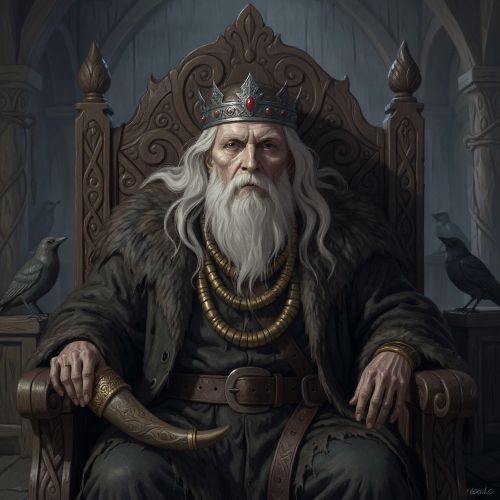


Signy : The Tragic Avenger of the Volsung Saga
Listen
At a glance
| Description | |
|---|---|
| Origin | Norse Mythology |
| Classification | Mortals |
| Family Members | Volsung (Father), Hljod (Mother), Sigmund (Twin brother), Siggeir (Husband), Sinfjotli (Son) |
| Region | Iceland |
| Associated With | Revenge, Loyalty, Fate |
The Mythlok Perspective
In Mythlok’s Perspective, Signy represents one of the most morally complex figures in Norse heroic tradition. She is neither a goddess nor a warrior, yet her choices shape the destiny of an entire legendary bloodline. Her story reveals how vengeance in Norse culture could become a sacred duty tied to family honor. Across cultures, similar figures appear where loyalty and revenge intertwine. Signy’s relentless resolve echoes characters like Medea, whose actions blur the boundary between justice and destruction, and the fierce devotion of Draupadi, whose humiliation ignited a devastating war. These parallels suggest that the archetype of the avenging woman transcends cultures, reflecting humanity’s deep fascination with justice pursued at any cost.
Signy
Introduction
Signy is one of the most tragic and complex figures in the Völsunga Saga, a medieval Icelandic epic that preserves ancient Germanic heroic traditions. Her story unfolds within the legendary Volsung family, a bloodline said to descend from Odin through the hero Sigi. Unlike many mythological figures who rely on divine power or supernatural strength, Signy’s legacy is shaped by unwavering determination, loyalty to her family, and a relentless pursuit of vengeance.
The tale begins when Signy, the daughter of King Volsung, is married against her will to Siggeir, the king of Gautland. Although the marriage appears to be a political alliance, Signy senses danger from the beginning. Her fears soon prove justified when Siggeir betrays her family and orchestrates a massacre that kills her father and most of her brothers. Only her twin brother Sigmund survives.
From that moment, Signy dedicates her life to revenge. Her story is not one of heroic glory but of grim sacrifice and moral ambiguity. Through cunning strategies, difficult choices, and devastating personal losses, she works to restore the honor of the Volsung bloodline. The tragic culmination of her plan destroys both her enemies and herself, turning Signy into one of the most unforgettable figures in Norse heroic literature.
Physical Traits
The surviving Norse texts offer very little description of Signy’s physical appearance. Like many characters in early Scandinavian sagas, the focus of the narrative lies on actions, reputation, and fate rather than detailed physical traits. However, the saga does provide subtle hints that help shape an image of her character.
Signy is described as a wise and beautiful maiden whose reputation spreads across the surrounding lands. This suggests that she possessed the grace and bearing expected of a royal daughter in the Volsung lineage. Her noble upbringing and royal status imply a dignified presence rather than the exaggerated physical features often attributed to mythic beings.
One scene in the saga describes Signy during the feast where her marriage to Siggeir is arranged. Her expression is described as pale and stern, reflecting her foreboding sense that the union will bring disaster. The moment captures the emotional depth of the character rather than focusing on external appearance.
Later in the story, Signy temporarily exchanges appearances with a sorceress through magical means in order to conceive a child with her brother Sigmund. This moment indicates that shape-shifting magic existed within the world of the saga, though it was not her own innate power. The transformation serves a narrative purpose rather than providing insight into her physical features. Overall, Signy’s identity in the saga is defined far more by her psychological strength and tragic determination than by her physical appearance.
Family
Signy belongs to the legendary Volsung family, one of the most famous heroic dynasties in Norse literature. Her father, King Volsung, ruled a powerful kingdom and was considered a descendant of Odin through the legendary ancestor Sigi. This divine lineage elevated the Volsung family above ordinary rulers and gave their story a mythic dimension.
Her mother was Hljod, the daughter of the giant Hrímnir. This connection links the Volsung line not only to the gods but also to the ancient race of giants, a common theme in Norse mythological genealogies.
Signy had nine brothers, making her the only daughter among ten children. Her twin brother Sigmund became the most important figure in her life. When Siggeir betrayed the Volsungs and slaughtered most of her brothers, Sigmund was the only one who survived the massacre. Signy secretly helped him escape and remain hidden in the forest.
Her marriage to Siggeir produced several sons, but the saga presents a grim twist in her quest for revenge. Determined to create a worthy avenger for the Volsung bloodline, Signy tested her sons by sending them to assist Sigmund. When they failed to show courage, she ordered Sigmund to kill them. The ruthless decision illustrates how completely she prioritized vengeance and family honor over maternal instinct.
Believing that only a child of pure Volsung blood could accomplish her goal, Signy later conceived a son with her brother Sigmund while disguised through sorcery. The child born from this union was Sinfjotli, who eventually became a fierce warrior and helped Sigmund destroy Siggeir. Through these relationships, Signy’s story becomes inseparable from the violent destiny of the Volsung family.
Other names
Signy’s name appears in several forms depending on language and literary tradition. The original Old Norse spelling is Signý, which appears in Icelandic manuscripts of the Völsunga Saga. In Scandinavian retellings, the name is often simplified to Signe, reflecting regional linguistic changes over time.
In German adaptations of Norse legend, particularly in later literary works, the character evolved into Sieglinde. This version became widely known through the opera cycle Der Ring des Nibelungen by Richard Wagner, where elements of the Volsung story inspired the characters Siegmund and Sieglinde.
Despite similarities in spelling, Signy should not be confused with Sigyn, the loyal wife of Loki in Norse mythology. The two figures belong to entirely different narratives within the Norse tradition. These variations show how the story of Signy traveled across cultures and centuries, adapting to new languages while preserving the core themes of betrayal and vengeance.
Powers and Abilities
Signy is not portrayed as a goddess or supernatural being. She is fundamentally a mortal princess whose abilities lie in intelligence, resilience, and strategic thinking. Her strength is psychological rather than magical. One of her greatest abilities is foresight. Even before the betrayal occurs, Signy senses that Siggeir cannot be trusted. She warns her father against accepting Siggeir’s invitation to visit his lands, but the warning goes unheeded. The tragic outcome reinforces the idea that Signy possessed a sharp understanding of human motives.
Her most remarkable skill is strategic planning. After her family is destroyed, she carefully constructs a long-term plan for revenge. Rather than confronting Siggeir directly, she works quietly for years, protecting Sigmund and eventually raising Sinfjotli to become a warrior capable of destroying their enemy.
Signy also demonstrates emotional endurance. The saga shows her making horrifying decisions, including sacrificing her own children to preserve the Volsung legacy. These acts highlight the harsh moral framework of heroic sagas, where loyalty to family honor could outweigh personal relationships.
Although she does not wield magic herself, she briefly relies on sorcery through a witch who exchanges appearances with her. This allows Signy to conceive Sinfjotli with Sigmund without revealing her identity. The episode reveals how mythic narratives often combine human agency with supernatural elements.In the end, Signy’s greatest ability is her unwavering resolve to fulfill her family’s revenge, even when the cost is her own life.
Modern Day Influence
The story of Signy continues to influence literature, music, and modern storytelling. Her narrative from the Völsunga Saga has become one of the foundational sources for later interpretations of Germanic heroic legends.
The most famous adaptation appears in Der Ring des Nibelungen, where Wagner reworked elements of the Volsung legend into the characters Siegmund and Sieglinde. Although the opera alters many details, the themes of forbidden love, destiny, and heroic tragedy echo the original saga.
Scholars of comparative mythology often analyze Signy as an example of female agency in early medieval literature. While the saga world is dominated by male warriors, Signy emerges as the central architect of the revenge that drives the story forward. Her actions demonstrate how women in heroic narratives could wield influence through intelligence and long-term planning.
Modern retellings of Norse legends, including books by Neil Gaiman, continue to introduce new audiences to characters like Signy. Elements of the Volsung story have also inspired themes in fantasy literature, video games, and television series that draw on Norse heroic traditions. Through these adaptations, Signy’s story remains relevant as a powerful exploration of loyalty, vengeance, and the destructive power of destiny.
Related Images





Source
Byock, J. (1990). The Saga of the Volsungs. University of California Press.
Colum, P. (1920). The children of Odin: A book of northern myths. Macmillan.
Faulkes, A. (Trans.). (1987). Edda (Snorri Sturluson). Everyman.
Morris, W., & Magnusson, E. (Trans.). (1870). The story of Sigurd the Volsung. Roberts Brothers.
Orchard, A. (1997). Dictionary of Norse myth and legend. Cassell.
Simek, R. (2007). Dictionary of Northern Mythology (A. Hall, Trans.). D.S. Brewer.
Timeless Myths. (2025). Signy – Norse Mythology. https://timelessmyths.com/norse/valhalla/valkyries/signy
Völsunga Saga. (c. 13th century). Icelandic manuscript
Frequently Asked Questions
Who was Signy in Norse legend?
Signy was a tragic heroine in the Völsunga Saga, the daughter of King Volsung and twin sister of Sigmund. She is remembered for orchestrating a long and ruthless revenge against her husband Siggeir after he betrayed and murdered her family.
Was Signy a goddess in Norse mythology?
No, Signy was not a goddess. She was a mortal princess from the Volsung family whose story appears in heroic saga literature rather than divine mythology.
Why did Signy have a child with Sigmund?
Signy believed that only a child with pure Volsung blood could defeat Siggeir. To ensure this, she secretly conceived Sinfjotli with her brother Sigmund through a magical disguise.
What happened to Signy at the end of the saga?
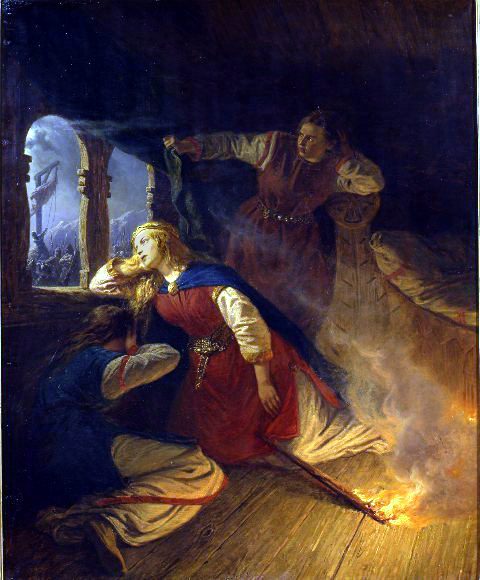
After Sigmund and Sinfjotli destroyed Siggeir’s hall, Signy revealed the truth about Sinfjotli’s birth and chose to die in the flames of the burning hall, completing her revenge.
What is the importance of Signy in Norse literature?
Signy represents one of the strongest female figures in Norse heroic sagas. Her actions drive the central revenge plot of the Völsunga Saga and highlight themes of fate, loyalty, and sacrifice.