


Shapash : The Ugaritic Sun Goddess Who Walked Between Worlds
At a glance
| Description | |
|---|---|
| Origin | Ugaritic Mythology |
| Classification | Gods |
| Family Members | El (Father) |
| Region | Syria |
| Associated With | Sun, Justice, Royal authority, Underworld journeys, Protection, Healing, Drought |
The Mythlok Perspective
In Mythlok’s Perspective, Shapash represents a fascinating alternative to the familiar image of the sun as a purely masculine divine force. Unlike Mesopotamian Shamash, she combines solar illumination with an intimate connection to the underworld. Her mythology makes the sun a traveller between worlds—an observer, messenger and guide whose light reaches even the realm of the dead.
Shapash
Introduction
Shapash was the female sun deity of Ugarit, the Late Bronze Age city-state whose remains are located at modern Ras Shamra in northern Syria. Her name, written špš in Ugaritic, is connected with the Semitic word for “sun.” She appears in the religious texts of Ugarit as a powerful divine figure whose influence extended far beyond the simple function of illuminating the sky.
Shapash occupies a distinctive place in Ugaritic mythology because she connects the celestial world with the realm of the dead. Her daily movement of the sun was understood as a journey through the heavens and, during the night, through the underworld. This made her a deity associated with both visibility and the hidden world beneath the earth. Modern scholarship consequently describes Shapash as a partly chthonic solar deity who connects gods, humans, and the dead.
Her importance is particularly clear in the Baal Cycle, the major surviving body of Ugaritic mythological literature. After Baal is killed by Mot, the god associated with death, Shapash becomes involved in the search for Baal and his recovery. Later, during the renewed confrontation between Baal and Mot, she intervenes and warns Mot about the consequences of challenging the authority of El.
Shapash was therefore not simply a personification of sunlight. She acted as a divine messenger, an observer of events, a mediator and a figure associated with the boundary between life and death. Her portrayal provides an important example of how solar deities could have different genders and functions across ancient Near Eastern cultures.
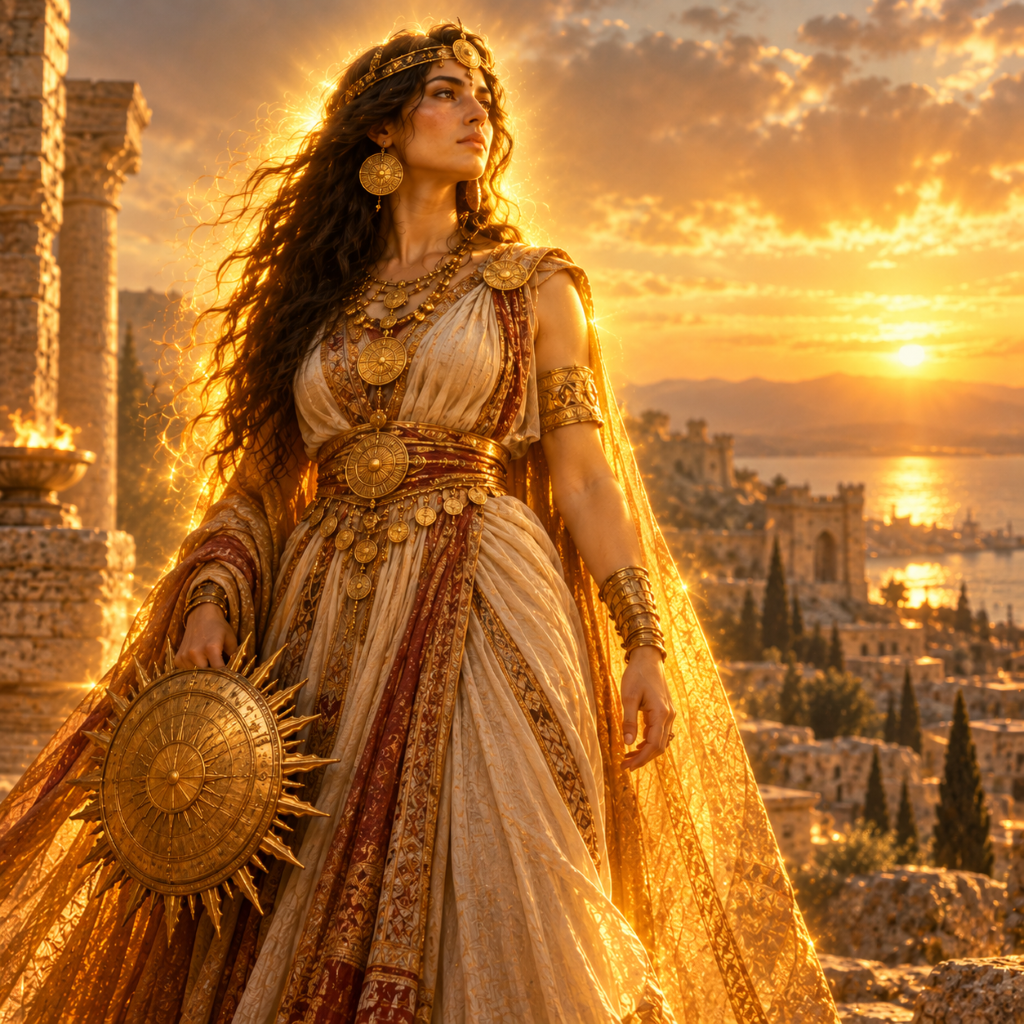
Physical Traits
The surviving Ugaritic texts do not provide a detailed description of Shapash’s physical appearance. Unlike Baal, whose iconography includes recognizable attributes such as a horned headdress and weapons, Shapash is primarily defined through her function as the sun and through the actions attributed to her in the texts. Her most important visual characteristic is therefore radiance. She is called “Shapash, Lamp of the Gods”, with the Ugaritic expression nrt ʾilm špš commonly translated using terms such as “lamp,” “torch” or “luminary of the gods.”
The imagery surrounding Shapash is closely tied to the movement of the sun. She travels across the heavens and then passes into the underworld, creating a mythological explanation for the sun’s disappearance at night. This movement gives her a distinctive connection with darkness and the dead without making her a goddess of darkness herself.
Some modern interpretations associate Shapash with solar imagery such as a radiant disk or rays, but the evidence for a standardized visual iconography is limited. A female solar figure appearing in ancient Near Eastern art cannot automatically be identified as Shapash. Any reconstruction of her appearance should therefore remain cautious rather than presenting speculative artistic details as established fact.
Her character is better understood through what she does: she illuminates, observes, travels between realms and intervenes in divine affairs. The absence of a detailed physical description is itself significant because Ugaritic texts preserve her identity primarily through her cosmic role rather than through a fixed portrait.
Family
Shapash’s genealogy is less certain than some popular summaries suggest. Ugaritic sources connect her closely with El, the supreme god of the Ugaritic pantheon, and she functions as his messenger in several passages. Scholarly treatments commonly describe her as a daughter of El, although the surviving texts do not provide a complete genealogical account comparable to the family trees found in some later mythological traditions.
The identification of Asherah or Athirat as Shapash’s mother is much less secure. Asherah was El’s consort and the mother of the gods in Ugaritic religion, but the available evidence does not establish Shapash’s maternal parentage with the same confidence. For this reason, descriptions of Shapash as definitively the daughter of El and Asherah should be treated as a reconstruction rather than an undisputed fact.
The texts also do not establish a husband or a conventional divine marriage for Shapash. Her relationship with other gods is instead defined largely through her functions. She interacts with El, Baal, Anat, Mot and other members of the Ugaritic divine world, particularly during episodes involving kingship, death and cosmic order.
One Ugaritic incantation addresses Shapash using maternal language, but this does not necessarily indicate that she had biological children. The expression may have a ritual or honorific meaning, and scholars have therefore been cautious about interpreting it as evidence for a literal family relationship. Her strongest familial association remains her connection with El and his divine authority. Through this relationship, Shapash becomes more than a celestial body: she operates as an agent within the political and cosmic structure of the Ugaritic pantheon.
Other names
Shapash appears in scholarship under several transliterations because the original Ugaritic name špš is represented differently when rendered into modern alphabets. Shapash, Shapshu and Shapsh are common forms, while Shamshu occurs in discussions of related Northwest Semitic forms.
The name is connected with the Semitic word for “sun,” and Shapash is therefore directly identified with the solar sphere. Her relationship to the Mesopotamian sun god Shamash is linguistic and cultural rather than evidence that the two figures were simply identical. Ugaritic pantheon lists equate Shapash with the Akkadian sun deity, while the Ugaritic tradition nevertheless preserves Shapash as a female solar deity.
Her best-known epithet is “Lamp of the Gods” or “Torch of the Gods.” Other expressions associated with her include “Great Lady Shapash” and “Eternal Shapash.” These titles emphasize her importance within the divine hierarchy and her enduring relationship with the sun.
The comparison with Shamash is particularly useful because it demonstrates that solar divinity did not have one universal gender or personality in the ancient Near East. In Mesopotamia, Shamash was generally male, while at Ugarit the solar deity was female. This difference illustrates the distinct religious traditions that existed within neighboring cultures.
Powers and Abilities
Shapash’s powers derive primarily from her position as the sun and from her ability to move between different realms. Her daily journey across the heavens made her a deity of illumination and observation, while her nightly passage through the underworld connected her with death and the unseen world. As El’s messenger, Shapash could carry information and communicate divine decisions. Her role becomes particularly important when disputes over kingship threaten the established order. In the Baal Cycle, she warns Mot that continuing his challenge against Baal would bring the consequences of El’s authority upon him.
Her connection with Baal’s death demonstrates another important function. After Mot kills Baal, Shapash becomes involved in locating and recovering the dead god. Her ability to move between the worlds of the living and the dead makes her uniquely suited to this task. Shapash is also associated with protection and healing in texts outside the Baal Cycle. The Ugaritic material known as KTU 1.100 connects the solar deity with horses, while KTU 1.107 associates her with protection against snakebite and the treatment of injuries caused by serpents.
Her solar power could have a harsher dimension as well. Scholarly studies connect the burning sun with drought, death and Mot, showing that sunlight in Ugaritic thought was not necessarily understood as universally benevolent. The same sun that illuminated the world could also scorch it. This combination makes Shapash a complex divine figure. She represents light without being exclusively benevolent, death without being a death goddess, and justice without functioning simply as a formal judge. Her authority comes from her ability to see, travel and intervene.
Modern Day Influence
Shapash has no securely documented continuous modern cult comparable to the surviving religious traditions of some ancient deities. Her modern significance comes primarily through archaeology, Ugaritic studies, comparative mythology and the interpretation of ancient Near Eastern religion.
The discovery and study of the Ugaritic tablets transformed understanding of Bronze Age religion in the Levant. Texts such as the Baal Cycle and other tablets provide evidence for Shapash’s role as a solar deity, messenger and figure associated with the underworld. Recent academic work continues to examine her movement between heaven and the underworld, as well as her connections with justice, royal authority, horses and healing.
Shapash is also important for comparative studies of solar religion. Her feminine identity contrasts with the predominantly masculine representation of the sun in Mesopotamian religion, while her relationship with the underworld reveals a broader ancient Near Eastern idea that the setting sun could symbolize a journey into the realm of the dead.
Her presence in Ugaritic religious texts also contributes to the wider study of Northwest Semitic religion and its relationship with later Israelite traditions. Such comparisons can be valuable, but direct claims that Shapash herself became a specific biblical figure are not established by the surviving evidence.
Today, Shapash remains compelling because her mythology resists a simple definition. She is the sun, but she also travels through darkness. She carries divine messages, but she also intervenes in conflicts. She is associated with royal authority, protection and healing, yet her burning rays can be connected with drought and death. Shapash ultimately represents the ancient Ugaritic understanding of the sun as a force capable of illuminating every boundary—even the boundary between life and death.
Related Images





Source
Azize, J. (2020). The Phoenician solar deity and the question of gender. In Religions of the Ancient Near East. Cambridge University Press.
Britannica. (2009). Shapash. https://www.britannica.com/topic/Shapash
Day, J. (2000). Yahweh and the gods and goddesses of Canaan. Sheffield Academic Press.
Pardee, D. (2002). Ritual and cult at Ugarit. Society of Biblical Literature.
Smith, M. S. (2014). The Ugaritic Baal cycle: Volume II. Brill.
Wikipedia. (2025). Shapshu. https://en.wikipedia.org/wiki/Shapash
Wyatt, N. (2002). Religious texts from Ugarit (2nd ed.). Sheffield Academic Press.
Frequently Asked Questions
Who is Shapash in Ugaritic mythology?
Shapash is the female sun goddess of Ugarit, known as the Lamp or Torch of the Gods and associated with divine messages and journeys through the underworld.
What was Shapash the goddess of?
Shapash was primarily the goddess of the sun and was also associated with light, divine communication, order, royal authority, protection and the realm of the dead.
Was Shapash the daughter of El?
Shapash is generally regarded as a daughter of El in scholarship, although the surviving Ugaritic texts do not provide a complete genealogy or clearly establish her mother.
What role did Shapash play in the Baal Cycle?
Shapash helped recover Baal after his death and later warned Mot against continuing his conflict with Baal, invoking the authority of El.
Is Shapash the same as Shamash?
Shapash and Mesopotamian Shamash are related solar deities whose names are linguistically connected, but Ugaritic Shapash is distinctly female.
