


Rokola : The Fijian God of Carpenters and Canoe Builders
At a glance
| Description | |
|---|---|
| Origin | Fijian Mythology |
| Classification | Gods |
| Family Members | Degei (Father), Mbuivesi (Mother), Nakausabaria, Thirikaumoli (Sons) |
| Region | Fiji |
| Associated With | Carpentry, Woodworking, Canoe building |
The Mythlok Perspective
In Mythlok’s Perspective, Rokola is Fiji’s answer to Hephaestus, but their craftsmanship serves very different purposes. While the Greek god forged weapons and treasures for the gods, Rokola’s mastery of carpentry and canoe building was connected to movement, survival and community. His story reminds us that technology becomes sacred when it carries generations of knowledge—and, quite literally, carries people across the ocean.
Rokola
Introduction
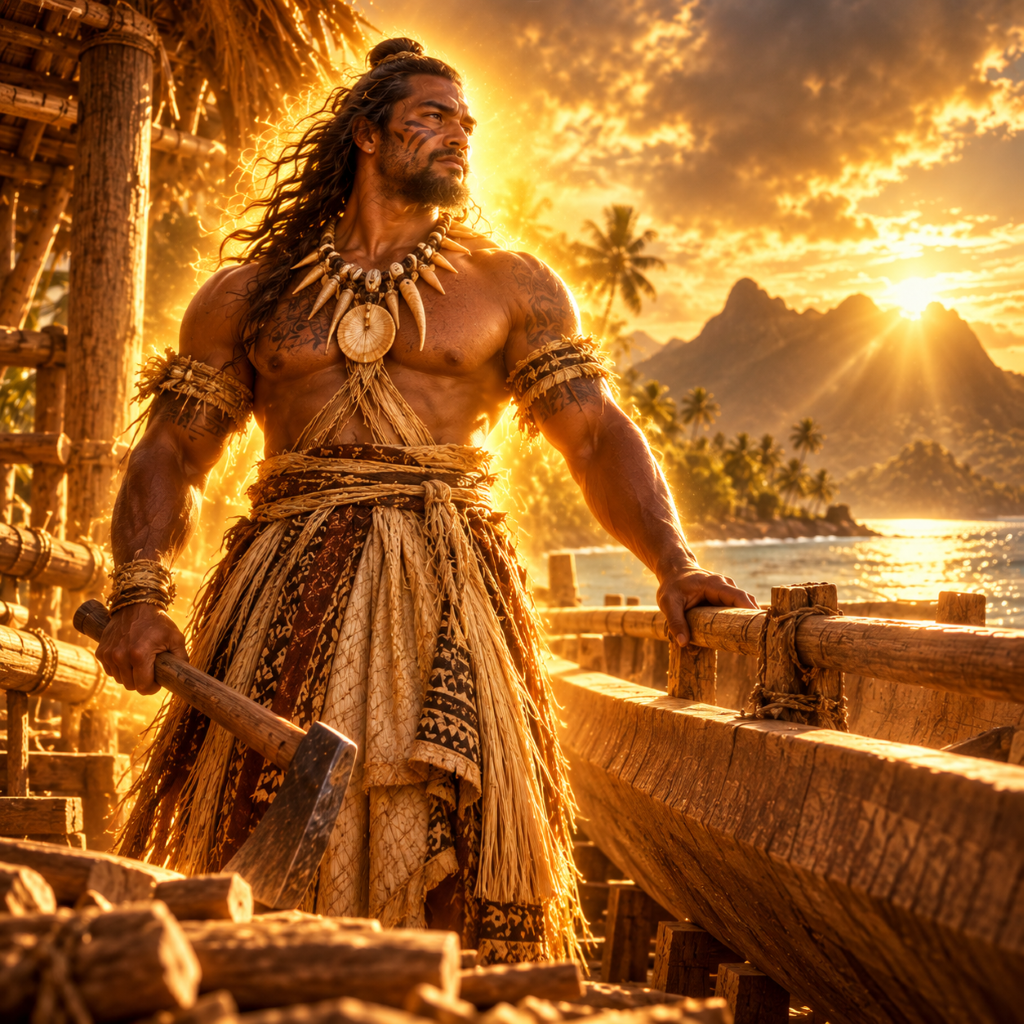
Rokola is a deity of Fijian mythology whose identity is closely tied to one of the most important skills in traditional island society: woodworking and canoe construction. Historical and ethnographic sources describe Rokola as a patron of carpenters and canoe-builders, while Fijian oral traditions also remember him as a master craftsman associated with the mataisau, hereditary groups of skilled carpenters. One Fijian-English dictionary describes Rokola as a legendary master boat-builder and carpenter, while identifying him as a founder figure for the mataisau carpenter communities.
Rokola is also linked with Degei, one of the most important divine figures in traditional Fijian belief. Several sources identify Rokola as Degei’s son, although Fijian traditions are diverse and do not preserve one universally consistent genealogy.
His importance becomes especially clear when considering Fiji’s maritime culture. Canoes were not simply practical transport. They connected communities, supported fishing and warfare, enabled inter-island movement and formed part of the wider technological knowledge of Pacific voyaging societies. Rokola therefore represents more than a supernatural carpenter: he embodies the sacred importance of skilled craftsmanship.
Some traditions also place Rokola within stories of a great flood, where he appears alongside another carpenter deity or superior figure and helps preserve survivors using large double canoes. These accounts vary, demonstrating why Rokola should not be presented as having one fixed biography across all Fijian traditions.
Physical Traits
Unlike deities whose appearance is described in elaborate mythological narratives, Rokola is primarily defined by his craft. Most sources do not provide a consistent description of his face, clothing, height, complexion or bodily form. For this reason, presenting him with a specific costume or physical appearance as though it were universally established would go beyond the available evidence.
One distinctive tradition does, however, associate Rokola with eight arms. Anthropologist Fergus Clunie’s research on Fijian and Western Polynesian voyaging traditions records that the mataisau described Rokola as having eight arms. This unusual characteristic can be understood as an expression of extraordinary craftsmanship: multiple arms symbolically reinforce the idea of a being capable of simultaneously managing tools, materials and complex construction.
Importantly, the eight-armed description should be treated as a particular traditional representation rather than a universal physical characteristic of Rokola. Other sources simply identify him as a master carpenter or boat-builder without mentioning unusual anatomy.
Family
Rokola’s best-attested familial connection is his relationship with Degei, the powerful serpent deity associated with creation and ancestral origins in many Fijian traditions. Sources including Fijian cultural references identify Rokola as Degei’s son and place him within the wider network of divine figures associated with particular occupations and communities.
Some traditions connect Rokola with the Ciri or Nakauvadra twins, Nakausabaria and Thirikaumoli, who are associated with canoe building. A Fijian-English dictionary records that the twins travelled with Rokola, describing him as their protector and the founder of the mataisau people. Other secondary traditions describe the twins as Rokola’s sons. Because these genealogical details differ between traditions, they are best presented as variant accounts rather than a single definitive family tree.
The goddess Mbuivesi is also identified as the mother of the twins in some later retellings, but this relationship is less securely established than Rokola’s association with Degei. A careful account of Rokola should therefore distinguish between widely repeated genealogical traditions and details preserved in particular versions of the stories.
Other names
The name Rokola appears in several historical and modern sources, although spelling and transliteration vary. Rakola is one form encountered in references to the Fijian pantheon, while older texts and related traditions can produce other spellings because Fijian names were recorded by European writers using different orthographic conventions.
Rokola is also closely associated with Rokova, another carpenter deity appearing in historical Fijian traditions. This relationship is significant because some accounts treat Rokova as a senior carpenter deity and Rokola as his head workman or foreman. In flood traditions, for example, Rokova and Rokola appear together in large double canoes, with Rokola functioning as the chief craftsman beneath Rokova.
These variations illustrate the fluid nature of Fijian oral traditions. Rather than assuming that every source describes exactly the same divine hierarchy, Rokola’s identity is better understood through his consistent association with carpentry, canoe building and the communities of specialist craftsmen who revered him.
Powers and Abilities
Rokola’s power is fundamentally the power of craftsmanship. He is associated with carpentry and the knowledge required to transform timber into useful and highly sophisticated structures. Historical accounts specifically describe him as a patron of carpenters and canoe-builders.
His connection with canoe construction is particularly important. Traditional Fijian canoe building involved specialist hereditary craftsmen, sacred knowledge and ritual practices. Research on Pacific maritime traditions notes that Fijian shipbuilders served Rokola, with canoe construction accompanied by chants and ceremonies. The construction of large vessels could therefore be both an engineering achievement and a religious undertaking.
Rokola is also associated with navigation and maritime survival in some modern summaries, although his strongest historical association remains the craft of building vessels rather than commanding the sea itself. His importance lies in making ocean travel possible through human skill.
A flood tradition provides another expression of this role. In accounts recorded by writers such as James Frazer, Rokola appears alongside Rokoro or Rokova in large double canoes and helps rescue survivors from a catastrophic flood. The precise roles differ between versions, but the recurring image is significant: when the world is overwhelmed by water, the master of the canoe becomes a figure of survival.
Claims that Rokola transformed into a shark should not be included as part of his established mythology. The shark deity in Fijian traditions is Dakuwaqa, who is separately identified as a powerful shark god associated with the sea and fishing.
Modern Day Influence
Rokola’s modern significance is primarily cultural and historical rather than centred on widespread contemporary worship. His name survives through discussions of traditional Fijian religion, the mataisau carpenter tradition, maritime heritage and the history of canoe construction.
His association with the mataisau is particularly important. Fijian-language sources preserve Rokola as a legendary master carpenter and identify him as a foundational figure for the carpenter clans. This connects mythology with a real social tradition in which specialist craft knowledge was transmitted through generations.
Rokola also became politically significant during the Tuka movement of the late nineteenth century. Tuka leaders encouraged followers to return to indigenous traditions and invoked deities including Degei and Rokola as part of a broader rejection of colonial authority. This does not mean Rokola was identified as Noah; rather, his traditional identity became part of a movement that used indigenous religion as a source of cultural and political resistance.
Today, Rokola can therefore be understood as a powerful symbol of Fijian craftsmanship and maritime knowledge. His story reminds us that mythology does not always place divine power in storms, weapons or supernatural battles. Sometimes the sacred is found in the ability to select timber, shape wood, construct a vessel and give a community the means to cross the ocean.
Related Images

Source
Allen, P. J., & Saunders, C. (Eds.). (2019). Rokola – the Fijian god of boats. Godchecker. https://www.godchecker.com/fijian-mythology/ROKOLA/
Balladeer’s Blog. (2018, June 23). Gods of Fiji. Balladeer’s Blog. https://glitternight.com/2018/06/23/gods-of-fiji/
Hocart, A. M. (1917). The culture history of the Lau Islands, Fiji. Journal of the Polynesian Society, 26(104), 179–190. https://thepolynesiansociety.org/jps/index.php/JPS/article/download/190/179
McMillan, R. (1984). The cyclopedia of Fiji: A complete historical and commercial review of Fiji. R. McMillan.
Niyom, W. (2025, August 29). Eggsquisitely Mythical #23: Fiji. Wera Niyom. https://www.weraniyom.com/post/eggsquisitely-mythical-23-fiji
Thomas, R. M. (2008). One sailors, myths, and traditions free. Oxford University Press.
https://academic.oup.com/hawaii-scholarship-online/book/20787/chapter/180217262
Vision Times. (2021, May 12). Sacred ships: The drua of Fiji. Vision Times.
https://www.visiontimes.com/2021/05/12/waqa-tabu-ships-fijian-drua.html
Williams, T., & Calvert, J. (1870). Fiji and the Fijians. Hodder and Stoughton.
https://archive.org/stream/fijiandfijiansb00calvgoog/fijiandfijiansb00calvgoog_djvu.txt
Frequently Asked Questions
Who is Rokola in Fijian mythology?
Rokola is a Fijian deity associated with carpentry and canoe building. He is traditionally regarded as a patron of skilled craftsmen and is linked with the mataisau carpenter clans.
What is Rokola the god of?
Rokola is primarily associated with carpentry, woodworking and canoe construction. Some traditions also connect him with navigation and the sacred knowledge required to build ocean-going vessels.
Who is Rokola's father?
Several Fijian traditions identify Degei, the powerful serpent deity, as Rokola’s father. Other genealogical details vary between regional and oral traditions.
Did Rokola turn into a shark?
No reliable evidence supports Rokola transforming into a shark. The major Fijian shark deity is Dakuwaqa, who is separately associated with the sea and fishing.
Why is Rokola important in Fijian mythology?
Rokola represents the sacred importance of craftsmanship. His association with carpenters and canoe builders reflects how essential woodworking and maritime technology were to traditional Fijian society.


