


Nyabinghi : The Rwandan Spirit of Abundance and Resistance
Listen
At a glance
| Description | |
|---|---|
| Origin | Rwandan Mythology |
| Classification | Spirits |
| Family Members | N/A |
| Region | Rwanda, Uganda, Tanzania |
| Associated With | Abundance, Fertility, Spirit possession, Political resistance, Prosperity, |
The Mythlok Perspective
In Mythlok’s Perspective, Nyabinghi represents the transformation of political memory into sacred power. She is not simply a spirit of fertility but a symbol of collective resistance encoded in ritual. Unlike agrarian goddesses such as Demeter from Greek tradition or Oshun from Yoruba belief, Nyabinghi’s identity fuses abundance with rebellion. Her evolution into a Rastafari emblem shows how spiritual archetypes migrate across cultures while retaining their core essence of liberation and renewal.
Nyabinghi
Introduction
Nyabinghi is a powerful female spirit figure rooted in the Great Lakes region of East Africa, particularly in present-day Rwanda, southwestern Uganda, and northwestern Tanzania. The name is commonly translated as “she who possesses many things” or “mother of abundance,” reflecting her association with prosperity, fertility, and authority. While some oral traditions describe Nyabinghi as an 18th-century queen linked to the former kingdoms of Karagwe or Mpororo, historians generally understand her as a deified ancestral spirit whose cult became politically influential during the late nineteenth and early twentieth centuries.
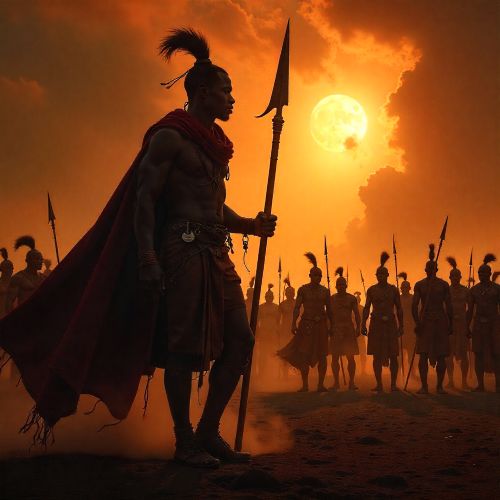
The Nyabinghi spiritual movement emerged as both a religious and socio-political force. Spirit mediums, often women, claimed possession by Nyabinghi and delivered prophecies, healing rituals, and directives that challenged established rulers and later colonial authorities. Over time, Nyabinghi evolved from a regional spirit of abundance into a symbol of resistance and spiritual sovereignty. Her legacy would eventually travel across the Atlantic, influencing the spiritual vocabulary of the Rastafari movement in Jamaica.
Physical Traits
Nyabinghi does not have a fixed physical description in traditional sources because she is primarily understood as a possessing spirit rather than a corporeal goddess. Unlike mythological figures from traditions with elaborate iconography, Nyabinghi’s presence is experienced through trance, voice, and ritual performance.
Historical accounts from the late nineteenth century describe her mediums, known in some regions as bagirwa, entering altered states during ceremonies. These mediums sometimes wore veils of barkcloth and spoke in heightened or stylized tones believed to be the voice of Nyabinghi herself. Observers described trembling movements, prophetic speech, and an atmosphere charged with sacred authority. Her “appearance,” therefore, is symbolic rather than anatomical. She manifests through charisma, command, and spiritual force rather than through a defined body.
This absence of a fixed physical form reinforces her identity as an omnipresent ancestral power. She is envisioned less as a statue or idol and more as an energy that inhabits chosen individuals, especially women, though male mediums later emerged as well.
Family
Nyabinghi is not part of a structured divine family tree in the way deities are in Greek or Norse traditions. Instead, she is associated with royal and ancestral lineages of the Great Lakes region. Some oral traditions link her to an 18th-century queen connected with Karagwe or Mpororo. In certain narratives, she was married to a ruler named Ruhinda or Murari, and her violent death transformed her into a vengeful and protective spirit.
Other traditions describe her as a daughter of a regional king who assumed power and was later assassinated. After her death, misfortunes and political unrest were attributed to her spirit. These accounts blend history and myth, suggesting that Nyabinghi may represent the spiritualization of a powerful female political figure.
Her true “family” is better understood as a lineage of mediums and devotees. Through ritual induction, spiritual authority passed from one generation to another. This continuity gave the Nyabinghi movement structure and resilience, especially during periods of political upheaval.
Other names
Nyabinghi appears in historical and ethnographic records under several spellings, including Nyabingi and Nyabyinshi. Variations reflect differences in local languages and colonial transcription practices. In Rastafari contexts, the spelling “Nyahbinghi” is also common.
She is sometimes described with titles that emphasize sovereignty and abundance, such as “Queen Nyabinghi” or “Mother of Plenty.” These names reinforce her identity as a spirit associated with wealth, fertility, and political legitimacy.
Powers and Abilities
Nyabinghi is traditionally associated with abundance, fertility, health, and material prosperity. Communities invoked her spirit to ensure successful harvests, livestock growth, and communal well-being. As a possessing spirit, she was believed to communicate directly through mediums, offering guidance, warnings, and blessings.
Her influence extended beyond agriculture and health. During the late nineteenth and early twentieth centuries, the Nyabinghi cult became intertwined with anti-colonial resistance. In parts of Uganda and Rwanda, mediums inspired uprisings against both local rulers and European colonial administrations. British colonial authorities in East Africa viewed the movement as politically dangerous and sought to suppress it, recognizing its capacity to mobilize communities.
Nyabinghi was also credited with protective and retaliatory powers. Oral accounts suggest that those who wronged her followers could suffer misfortune or disaster. Whether interpreted literally or symbolically, these beliefs reinforced social cohesion and resistance to domination. Her power was spiritual, economic, and political at once.
Modern Day Influence
Although colonial authorities weakened the Nyabinghi movement in East Africa during the early twentieth century, her name resurfaced powerfully in Jamaica in the 1930s. Reports of African resistance inspired early Rastafari communities, who adopted “Nyabinghi” as a symbol of sacred assembly, spiritual defiance, and loyalty to African identity. The Nyabinghi Order became the oldest mansion within Rastafari, emphasizing biblical devotion, reverence for Emperor Haile Selassie I, and rejection of oppressive systems referred to as “Babylon.” Gatherings known as groundations center on drumming, chanting, scripture, and collective reasoning.
Within Rastafari, Nyabinghi represents unity and spiritual continuity with Africa. Ceremonies often last for days, sustained by rhythmic drumming and the blending of biblical psalms with Rasta hymns that proclaim liberation and divine justice. These gatherings are not simply musical expressions but communal affirmations of resistance, memory, and identity, linking the Caribbean diaspora to African ancestral heritage.
Nyabinghi drumming also reshaped Jamaican music. The traditional ensemble of bass drum, funde, and repeater created a heartbeat rhythm that influenced ska, rocksteady, and reggae. Musicians such as Count Ossie introduced ceremonial rhythms into popular music, and later Bob Marley carried Nyabinghi influences into global consciousness through songs like “Rastaman Chant.” Today, Nyabinghi remains central to Rastafari spirituality and continues to shape roots reggae worldwide.
Related Images





Source
Hopkins, E. (1970). The Nyabingi cult of southwestern Uganda. In R. I. Rotberg & A. A. Mazrui (Eds.), Protest and power in Black Africa (pp. 258–336). Oxford University Press.
Rwanda Cultural Heritage Academy. (2025). Imigani migufi y’Ikinyarwanda isobanuye. Rwanda National Library.
Freedman, J. (n.d.). Ritual and history: The case of Nyabingi. Scribd. https://fr.scribd.com/document/393212713/Ritual-and-History-the-Case-of-Nyabingi
Wikipedia. (2024). Nyabinghi. https://en.wikipedia.org/wiki/Nyabinghi
Suppressed Histories. (n.d.). History of Nyabinghi, shamanic priestesses of East Africa. Rastafari.tv.
https://rastafari.tv/history-nyabinghi-shamanic-priestesses-east-africa/
Amateka. (2019). The Nyabingi cult. https://uk.amateka.net/the-nyabingi-cult/
Gorilla Highlands. (2021). Why did Rwanda’s fiercest woman die teaching black magic in Kampala? https://experts.gorillahighlands.com/daily-dose/2021/04/08/muhumuza/
Original People. (2022). Queen Muhumuza of Rwanda. https://originalpeople.org/queen-muhumuza-of-rwanda/
Frequently Asked Questions
What is Nyabinghi in African tradition?
Nyabinghi is a female spirit figure from East Africa associated with abundance, fertility, and anti-colonial resistance movements in Rwanda and Uganda.
Was Nyabinghi a real queen?
Some oral traditions link Nyabinghi to an 18th-century queen, but historians generally view her as a deified ancestral spirit whose cult gained political influence.
How is Nyabinghi connected to Rastafari?
The Rastafari movement adopted the term Nyabinghi for sacred gatherings and drumming ceremonies symbolizing resistance and African identity.
What is Nyabinghi drumming?
Nyabinghi drumming is a sacred Rastafari musical tradition using bass, funde, and repeater drums to create a heartbeat-like rhythm.
Is Nyabinghi considered a goddess?
She is often described as a spirit or deified ancestral figure rather than a formal goddess within a structured pantheon.



Bobo bless
ilike this page