


Napolo : The Serpent Spirit of Storms and Landslides in Chewa Tradition
Listen
At a glance
| Description | |
|---|---|
| Origin | Chewa Mythology |
| Classification | Spirits |
| Family Members | N/A |
| Region | Malawi |
| Associated With | Rain, Floods, Landslides, Earthquakes, Storms |
The Mythlok Perspective
In Mythlok’s Perspective, Napolo represents a powerful example of how cultures personify natural disasters to understand unpredictable landscapes. The serpent’s link to floods and landslides mirrors geological processes that were invisible to early communities but deeply felt through their consequences. Serpent spirits associated with water appear across many cultures. Napolo shares similarities with the rain-bringing Nāga spirits of Indian tradition and the destructive water dragons of Chinese folklore. In each case, serpentine beings embody the immense power of rivers, storms, and seasonal rainfall, reminding societies that nature’s life-giving forces are inseparable from its destructive potential.
Napolo
Introduction
Napolo is one of the most intriguing mythological figures in the oral traditions of southern Africa, particularly among the Chewa people of Malawi, Zambia, and parts of Mozambique. In Chewa belief systems, Napolo is described as a massive serpent-like spirit associated with water, rain, and destructive natural events such as floods and landslides. The myth serves as a cultural explanation for catastrophic weather events, reflecting how communities historically interpreted powerful environmental forces before modern scientific understanding.
Stories about Napolo are deeply connected to the geography of Malawi. The spirit is believed to dwell beneath mountains or within deep water sources such as sacred pools, rivers, and lakes. According to folklore, Napolo occasionally travels between mountain pools and larger water bodies, particularly Lake Chilwa in southern Malawi. During these journeys, violent storms and floods occur, devastating villages and reshaping landscapes.
The legend also reflects the symbolic importance of snakes in Chewa culture. The python, often linked with rivers and rain, appears frequently in art, storytelling, and ritual symbolism. Because of this association, Napolo is commonly imagined as a gigantic python spirit whose movements disturb the earth and unleash torrents of water.
Rather than simply portraying destruction, the myth reveals the Chewa understanding of nature as both powerful and unpredictable. Rain is essential for agriculture and survival, yet excessive rainfall can bring devastation. Napolo therefore represents the delicate balance between life-giving water and catastrophic floods.
Even today, the legend continues to circulate in oral traditions, literature, and cultural discussions in Malawi. The myth remains a powerful example of how indigenous knowledge systems interpret environmental phenomena and embed them within spiritual narratives.
Physical Traits
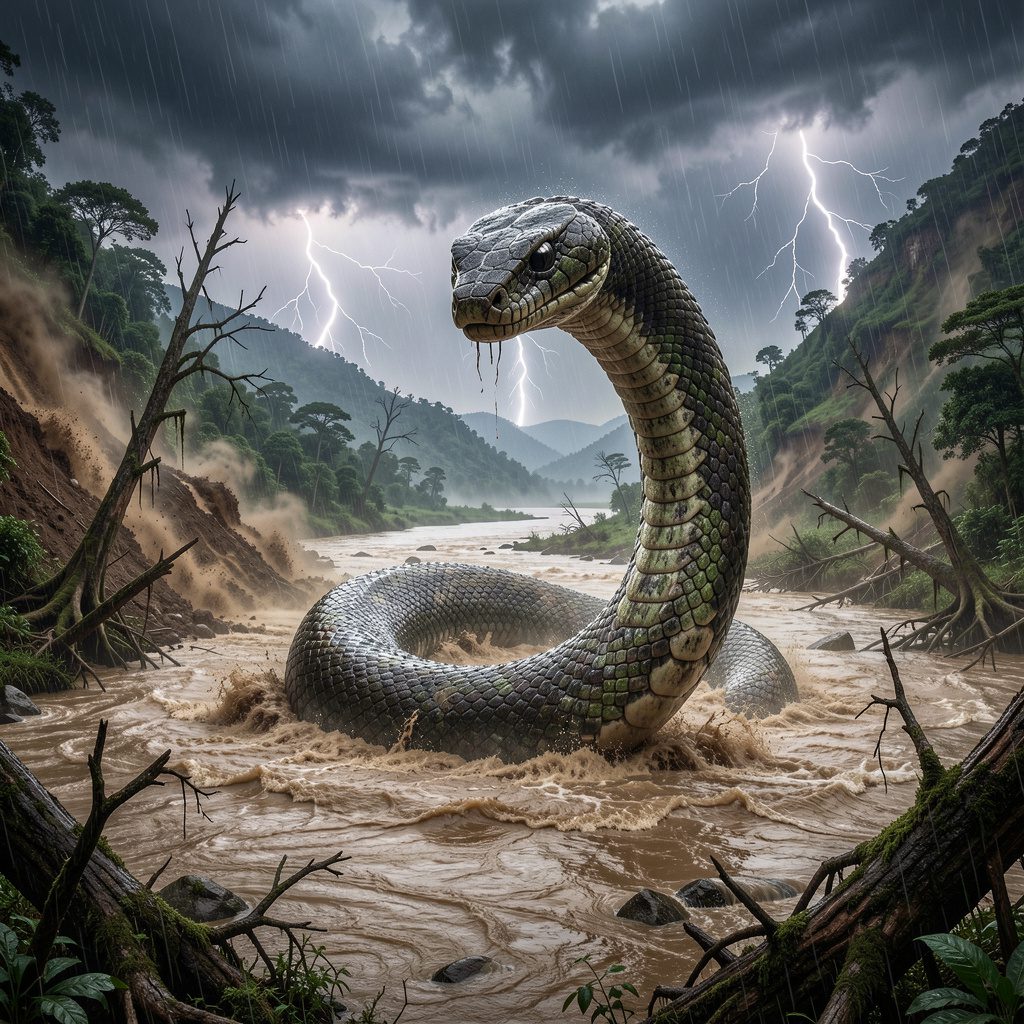
Napolo is typically described as a colossal serpent or dragon-like entity that inhabits underground spaces and deep water bodies. Unlike many mythological creatures that interact openly with humans, Napolo is usually invisible, revealing its presence only through the destruction it causes.
In Chewa storytelling, the creature resembles a gigantic python, reinforcing the cultural link between serpents and water. The python is already an important symbolic animal in the region, associated with rivers, rainfall, and fertility. By portraying Napolo in this form, the myth ties the spirit directly to the natural cycles of water.
Napolo’s immense size allows it to move beneath mountains and across landscapes. When it shifts underground or emerges from hidden pools, the earth trembles and large quantities of water surge across the land. Trees are uprooted, soil breaks loose from mountain slopes, and rocks tumble downward in destructive landslides.
Because the creature is considered supernatural, seeing Napolo directly is believed to be fatal. In many oral accounts, those who encounter it do not survive to tell the story. This belief reinforces the idea that Napolo belongs to a realm beyond human perception and should not be approached or disturbed. Rather than functioning as a physical monster that people hunt or fight, Napolo behaves more like an embodiment of natural forces. Its invisible presence mirrors the hidden processes beneath the earth that lead to floods and landslides.
Family
Unlike many mythological beings that belong to elaborate divine genealogies, Napolo has no clearly defined family relationships in Chewa tradition. The stories rarely mention parents, siblings, or offspring, and the spirit is not part of a structured pantheon of gods. Instead, Napolo is treated as a solitary elemental force connected to the landscape itself. Its existence is linked to mountains, water sources, and sacred locations where ancestral spirits are believed to dwell.
In some interpretations, Napolo may be indirectly connected to ancestral spirits that guard particular natural sites, but these associations remain symbolic rather than genealogical. The myth emphasizes the creature’s independence and its role as a manifestation of environmental power rather than a member of a divine lineage. This absence of family connections distinguishes Napolo from many mythological figures found in other traditions, where gods and spirits often exist within complex family trees.
Other names
Napolo is generally known by this single name within Chewa tradition. Unlike many mythological beings that possess numerous epithets or regional titles, the name Napolo remains remarkably consistent across oral accounts.
However, descriptive phrases sometimes accompany the name in storytelling. The creature may be referred to as a rain serpent, an earthquake serpent, or a destructive snake spirit. These expressions do not represent alternative names but instead highlight the natural phenomena associated with the spirit’s presence. The stability of the name across different communities suggests the myth has maintained a strong and recognizable identity within Malawian folklore.
Powers and Abilities
Napolo is primarily associated with the control of water and the violent forces that accompany heavy rainfall. Its most prominent ability is the power to unleash torrential storms when it moves between underground pools and lakes. As the serpent travels, rivers overflow and floodwaters rush through valleys. These floods can destroy homes, bridges, and farmland, leaving behind widespread devastation. In traditional explanations, such disasters occur because Napolo has been disturbed or has begun a journey through the landscape.
The creature is also believed to cause landslides by loosening soil and rocks from mountain slopes. When Napolo moves beneath the earth, the ground becomes unstable and entire hillsides may collapse. These events were historically interpreted as the physical path of the serpent moving underground. Earth tremors and violent storms are also linked to Napolo’s activity. In folklore, thunder, lightning, and heavy winds often accompany the serpent’s emergence from hidden water sources.
Despite its destructive nature, Napolo also has a life-giving dimension. Rain is essential for agriculture in Malawi, and the serpent’s connection to rainfall reflects the dual nature of water. It can nourish crops and sustain communities, but it can also overwhelm them when it arrives in excess. In this way, Napolo represents the unpredictable power of the natural world, capable of both sustaining life and bringing sudden destruction.
Modern Day Influence
The legend of Napolo continues to influence Malawian cultural memory and literature. Historical disasters have often been interpreted through the lens of this myth, particularly before scientific explanations became widespread. For example, devastating floods in the Zomba region in 1946 were attributed by local communities to Napolo moving from the mountains toward Lake Chilwa. Similar interpretations emerged after the catastrophic Phalombe floods of 1991 near Mulanje Mountain, which caused massive landslides and loss of life.
Beyond oral storytelling, the myth has also inspired modern literature. Malawian poet and writer Steve Chimombo explored the legend extensively in his work. His collection Napolo Poems (1987) and the novel The Wrath of Napolo (2000) reinterpret the myth as a metaphor for political turmoil and social upheaval in Malawi.
Through these works, Napolo evolves from a purely mythological figure into a symbolic representation of uncontrolled power and national struggle. The serpent becomes both a natural force and a political allegory. Today the legend remains part of Malawi’s cultural identity. It appears in storytelling, academic discussions, and artistic interpretations that examine the relationship between traditional beliefs and environmental realities.
Related Images


Source
Chimombo, S. (2000). The wrath of Napolo. Wasi Publications.
Chimombo, S. (1987). Napolo poems. Malawi Writers Series.
Explore Malawi. (2012, March 20). Chewa story of Napolo the ancient rain serpent. Malawian Explorer. http://exploremalawi.blogspot.com/2012/03/chewa-story-of-napolo-ancient-rain.html
Lattin-Rawstrone, R. (2014, May 16). The wrath of Napolo by Steve Chimombo. Rebekah Lattin-Rawstrone.
https://lattin-rawstrone.com/2014/05/16/the-wrath-of-napolo-by-steve-chimombo/
Msiska, O. (n.d.). Landscape and national memory in Steve Chimombo’s Napolo poems. Transformation, 44.
https://pdfproc.lib.msu.edu/?file=%2FDMC%2FAfrican+Journals%2Fpdfs%2Ftransformation%2Ftran044%2Ftran044007.pdf
Phiri, K. M. (1984). Chewa history in central and northern Malawi. Longman Malawi.
Wikipedia contributors. (2024). Chewa people. Wikipedia. https://en.wikipedia.org/wiki/Chewa_people
ACU MWK. (2024, February 1). The legend of Napolo: Malawi’s ancient giant snake.
https://www.acumwk.com/the-legend-of-napolo-malawis-ancient-giant-snake/
Frequently Asked Questions
Who is Kamohoaliʻi in Hawaiian belief?
Kamohoaliʻi is a revered shark god associated with ocean navigation, protection, and ancestral guardianship.
Is Kamohoaliʻi related to Pele?
Yes, he is traditionally regarded as Pele’s elder brother and often serves as her protector during ocean journeys.
Why are sharks considered sacred in Hawaiʻi?
Sharks are viewed as aumakua, or family guardians, a belief strongly connected to deities like Kamohoaliʻi.
Did Hawaiians worship Kamohoaliʻi?
Rather than worship in a distant sense, Hawaiians honored him through rituals and respect for the ocean.
Does Kamohoaliʻi still influence Hawaiian culture today?
Yes, his legacy continues through cultural practices, storytelling, and marine conservation values.
