


Nagaasan : The Supreme Being Who Provides for the Twa
At a glance
| Description | |
|---|---|
| Origin | Twa Mythology |
| Classification | Gods |
| Family Members | N/A |
| Region | Uganda |
| Associated With | Creation, Wealth, Food, Protection |
The Mythlok Perspective
In Mythlok’s Perspective, Nagaasan can be compared with Dyaus Pita of ancient Vedic tradition, as both represent supreme divine authority connected with the foundations of life. But while Dyaus Pita is primarily associated with the sky, Nagaasan’s documented role centres on food, wealth, protection and children. This makes Nagaasan a distinctly community-focused creator, closely connected to the needs of Twa life and its relationship with the natural world.
Nagaasan
Introduction
Nagaasan is the supreme being of traditional Twa, or Batwa, belief, regarded as a creator and a source of the essential blessings that sustain the community. In accounts of Batwa spirituality from Uganda, Nagaasan is also known as Imaana and is associated with wealth, food, protection and children. These qualities place Nagaasan at the centre of a religious worldview closely connected to the forest and to the traditional life of the Twa people.
The Twa are Indigenous communities of the Great Lakes region of Central Africa, with Batwa communities found across countries including Uganda, Rwanda and the Democratic Republic of the Congo. Historically, many Twa communities maintained close relationships with forest environments through hunting, gathering and the collection of forest products. Their spiritual traditions developed within this environment, making the forest an important setting for religious life as well as everyday survival.
Nagaasan’s role reflects this connection. Food and wealth were not abstract blessings in a forest-based society. Successful hunting and access to the resources of the forest were directly connected to the wellbeing of families and communities. Children represented the continuation of the community, while protection provided security in an environment where people depended heavily on their knowledge of the natural world.
Traditional Batwa religious practices included prayers and offerings connected with hunting and thanksgiving. Accounts of Batwa spirituality also describe the chameleon as sacred because it could climb to the highest point of a tree and was therefore believed to come closest to God. Nagaasan is consequently best understood as a supreme creator and provider whose importance is expressed through the fundamental needs of Twa life: nourishment, prosperity, protection and family continuity.
Physical Traits
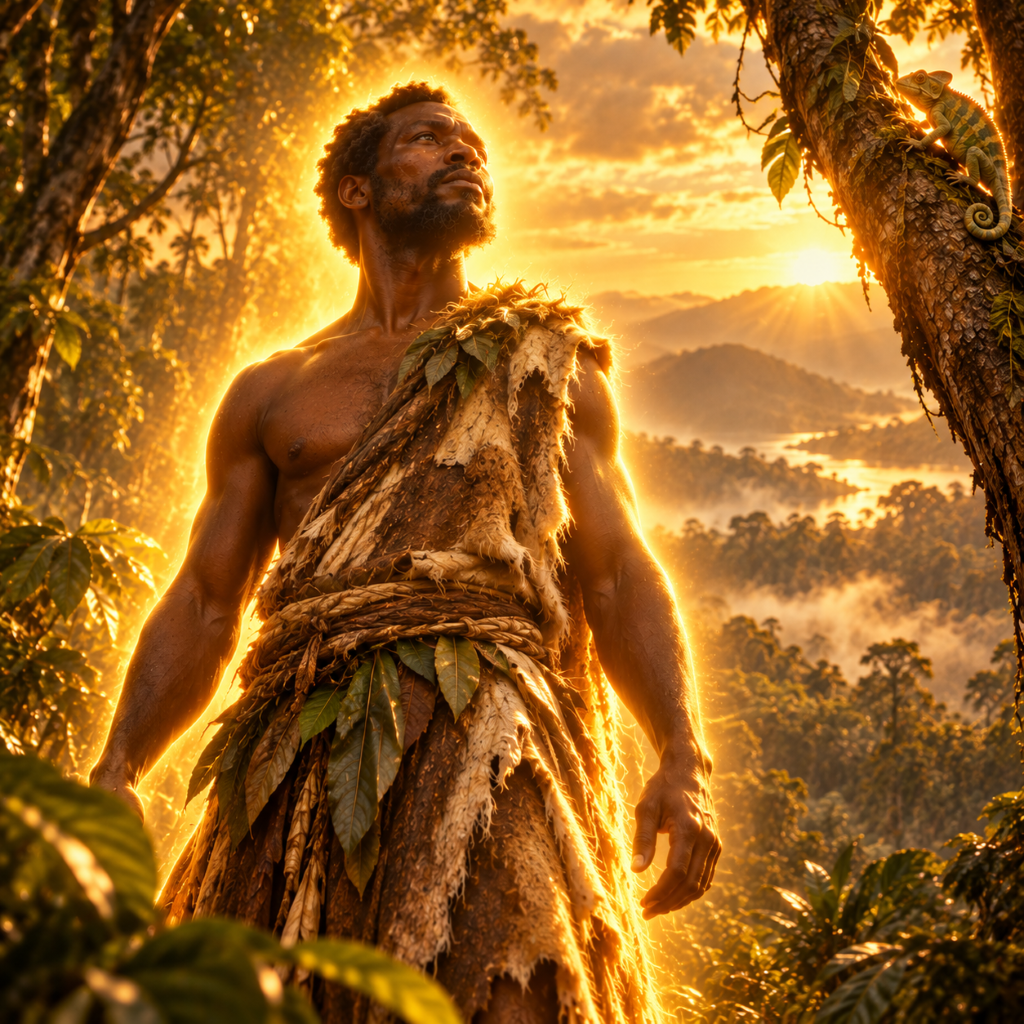
Nagaasan is presented in Batwa tradition as a supreme spiritual being rather than through a defined physical appearance. The traditions that identify Nagaasan or Imaana focus on the deity’s position as the supreme being and provider, rather than describing a particular human or animal form. The absence of a fixed physical image is particularly appropriate to the way Nagaasan is represented in these accounts. His importance lies in what he provides and represents rather than in a distinctive body, weapon or costume.
The sacred chameleon has an important place within this spiritual landscape. Batwa accounts describe the chameleon as sacred because it climbs higher than other animals and was consequently believed to come closest to God. This association gives the chameleon a meaningful connection to the divine without making it a physical representation of Nagaasan.
Nagaasan should also not be confused with the naga beings found in South and Southeast Asian religious traditions. Despite the similarity in sound, those traditions belong to entirely different cultural and religious contexts. The Batwa Nagaasan is documented as a supreme being and provider, not as a serpent deity.
Family
Nagaasan occupies the position of supreme being and creator in the Batwa accounts that identify him. His relationship with the Twa community is therefore more prominent than a divine genealogy involving spouses, parents or children.
The central descriptions of Nagaasan present him as the source of children, food, protection and wealth. The granting of children is particularly important because it connects Nagaasan with the continuation of families and the future of the community. Unlike traditions in which supreme gods belong to extensive divine families, the recorded descriptions of Nagaasan focus on his relationship with people and the blessings he provides. No spouse or named offspring forms part of the commonly recorded Nagaasan tradition.
The name Imaana is closely associated with Nagaasan in Batwa cultural descriptions. Sources describing Batwa spirituality identify the two as names for the supreme being, with Imaana or Nagaasan described as the creator who provides children, food and protection. This makes Nagaasan a distinctly community-centred supreme being. His significance is measured through the wellbeing of the people rather than through relationships within a divine household.
Other names
Imaana is the principal alternate name associated with Nagaasan in descriptions of traditional Batwa religion. Accounts of Batwa spirituality in Uganda explicitly describe the supreme being as Nagaasan or Imaana, while other cultural accounts refer to Imaana (Nagaasan) as the Supreme Being and Creator. Both names therefore appear together in descriptions of Batwa belief rather than representing two separate gods within a larger pantheon.
The name Imaana also appears in the wider religious traditions of the Great Lakes region, where it has been associated with concepts of a supreme being and creation. Its use among the Batwa belongs within this broader regional religious context, while the specific Batwa accounts connect Imaana directly with Nagaasan.
Powers and Abilities
Nagaasan’s powers are expressed primarily through provision and protection. Batwa accounts specifically associate the supreme being with wealth, food, protection and children. Other descriptions identify Imaana or Nagaasan as the Supreme Being and Creator who gives children, food and protection.
Food is particularly important within this tradition. Traditional Twa communities depended heavily on forest resources, including hunting and gathering. Successful hunting was accompanied by spiritual practices, including prayers and offerings. Accounts describe elders conducting prayers before hunting and offering meat to the gods following successful hunts.
The connection between Nagaasan and food therefore reflects the importance of provision within Twa spiritual life. Wealth represents another aspect of the deity’s role, while protection expresses Nagaasan’s position as a guardian of the community. Children form the fourth major element of Nagaasan’s documented powers. The supreme being is believed to provide children, linking divine blessing with family and community continuity.
The sacred chameleon also provides an important window into this religious worldview. Because it could climb to the highest branches of trees, the Twa regarded it as being especially close to God. Rather than a deity defined by battles or spectacular supernatural feats, Nagaasan is therefore characterised through the things that sustain life: nourishment, prosperity, safety and children.
Modern Day Influence
The modern story of Nagaasan is closely connected to the changing circumstances of the Twa people. Traditional Batwa spirituality was deeply connected to the forest, but displacement from ancestral forest territories transformed the relationship between many Batwa communities and the environments that had traditionally supported their way of life.
In Uganda, Batwa communities were displaced from ancestral forest areas when forests including Bwindi and Mgahinga were gazetted as national parks in the early 1990s. The loss of access to these territories disrupted traditional livelihoods as well as cultural practices associated with the forest. The International Work Group for Indigenous Affairs notes that Batwa communities were dispossessed of ancestral land following the creation of these protected areas.
This history matters when considering Nagaasan because traditional Batwa spirituality was closely connected to the forest. Religious practices included sacred places, hunting-related rituals, offerings and relationships with spiritual beings. A Ugandan government publication also records that Batwa worship, sacrifice and appeasement practices took place at special places in the forest and that displacement interfered with these cultural practices.
Christianity has also become influential among Batwa communities. Contemporary accounts note that many Batwa now follow Christianity, while some continue to maintain elements of traditional religious practice. Nagaasan therefore remains important as part of the documented religious heritage of the Twa people. The name preserves a worldview in which the supreme being was associated with the things most essential to community life: food, wealth, protection and children.
The surviving descriptions of Nagaasan are concise, but they reveal a clear religious concept. Nagaasan is the supreme creator and provider, while the forest forms the setting through which many of the community’s material and spiritual relationships were experienced. His tradition illustrates how mythology can be embedded not only in stories about gods but also in a people’s understanding of survival, family and their relationship with the natural world.
Related Images

Source
African Wilderness Tours. (2023, January 8). The Batwa culture. https://www.africanwildernesstours.com/the-batwa-culture/
All Uganda Safaris. (2025, September 30). Batwa people; All about the Twa or Batwa Pygmies of Uganda. https://www.allugandasafaris.com/batwa-people/
Beyond Travel Africa. (2021). The culture of Batwa people. https://beyondtravel.africa/safaris/the-culture-of-batwa-people
Bwindi Forest National Park Uganda. (2022, October 4). Batwa experience in Uganda | Bwindi Uganda Batwa Pygmies. https://www.bwindiforestnationalparkuganda.com/batwa-experience-in-uganda/
Gorilla Highlands. (n.d.). Gorilla Highlands info pack [PDF]. https://www.gorillahighlands.com/infopack/Gorilla_Highlands_2.2.pdf
Nakra Safaris Uganda. (2025, July 1). The Batwa cultural heritage. https://nakrasafarisuganda.com/batwa-cultural-heritage-trail/
New Vision. (2020, April 3). Batwa culture lost to modernity. https://www.newvision.co.ug/news/1517481/batwa-culture-lost-modernity
WorldMark Encyclopedia of Cultures and Daily Life. (n.d.). Twa. In Encyclopedia.com.
https://www.encyclopedia.com/humanities/encyclopedias-almanacs-transcripts-and-maps/twa
Frequently Asked Questions
Who is Nagaasan in Twa mythology?
Nagaasan is the supreme being and creator in traditional Twa belief, associated with providing food, wealth, protection and children to the Twa people.
What is Nagaasan also called?
Nagaasan is also known as Imaana in accounts of traditional Twa religion, where both names identify the supreme creator and provider.
What is Nagaasan the god of?
Nagaasan is associated with food, wealth, protection, children and creation, reflecting his role as the supreme provider in Twa religious belief.
What animal is sacred to Nagaasan?
The chameleon is sacred in Twa belief because it climbs to the highest points of trees and was believed to come closest to God.
Is Nagaasan a serpent god?
No. Nagaasan is the Twa supreme being and creator. The name should not be confused with serpent beings called nagas in South Asian traditions.


