Tokoloshe (1965) : African Folklore and the Fear of the Night Spirit
| Description | |
|---|---|
| Country of Origin | South Africa |
| Language | English, Zulu |
| Genre | Horror |
| Cast | Sidney James, Saul Pelle, Cy Sacks |
| Directed by | Peter Prowse |
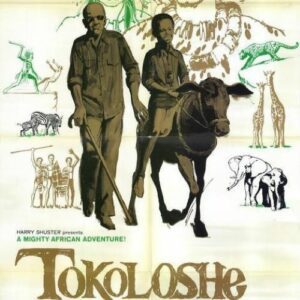
Tokoloshe
The 1965 South African film Tokoloshe is an early cinematic encounter with one of Southern Africa’s most enduring supernatural figures. Directed and written by Peter Prowse, the film centres on Risimati, a young African boy who is rescued from a witchdoctor’s death curse before travelling to the city, where a blind white man becomes his protector. While Tokoloshe does not appear to retell a specific traditional folktale, it draws upon a much older cultural belief in the tokoloshe and the supernatural forces associated with witchcraft, making the film particularly interesting as a piece of folklore-inspired cinema.
The tokoloshe occupies a complicated place in Southern African traditions. Descriptions vary between communities, but it is commonly portrayed as a small, supernatural being associated with the night, misfortune and harmful magic. In some traditions, the tokoloshe is believed to be invisible or difficult to perceive, while its effects are recognised through the misfortune it leaves behind. Research among AmaXhosa communities, for example, records beliefs in the tokoloshe as an evil supernatural agent associated with witchcraft and capable of causing harm at the direction of a witch.
This connection between the tokoloshe and witchcraft is particularly important when viewing the 1965 film. The story begins not with an abstract monster hunt but with a curse. Risimati’s danger is rooted in a supernatural act attributed to a witchdoctor, placing the film within a worldview where unseen forces can have very real consequences. The supernatural therefore functions less as an exotic creature feature and more as a mechanism through which danger, vulnerability and protection are understood.
The tokoloshe is also important because it represents the way folklore can transform invisible fears into recognisable supernatural forms. In Southern African belief systems, witchcraft has historically provided explanations for otherwise difficult-to-understand misfortune, illness and death. The tokoloshe can function within that worldview as an agent through which malicious intentions become supernatural action. Tokoloshe takes this cultural idea and translates it into a fictional cinematic narrative, allowing an audience to encounter a traditional supernatural concept through the conventions of popular storytelling.
There is also an important distinction between the tokoloshe of folklore and the tokoloshe of cinema. The traditional figure does not have one universally fixed appearance or role. Different Southern African communities have described it in different ways, and its relationship with witchcraft, traditional healing, misfortune and protection varies across contexts. Scholars have specifically cautioned against treating the tokoloshe as a single, uniform “African” creature divorced from the diverse traditions in which the belief exists.
That makes the 1965 film historically valuable. It captures a moment when an indigenous supernatural concept was being transferred from oral and cultural traditions into commercial cinema. The process inevitably changes the mythology. Folklore that can exist in stories, beliefs and community practices becomes something with characters, a narrative structure and a visual language. Yet the underlying idea remains recognisable: supernatural harm can originate through human intention and manifest through forces that ordinary people cannot easily see or control.
The film is particularly interesting when placed within the longer history of the tokoloshe in popular culture. Later representations have increasingly turned the creature into a conventional horror monster, sometimes separating it from the cultural beliefs that gave it meaning. The 2018 South African film The Tokoloshe, for example, reimagines the figure as a predatory supernatural presence while deliberately engaging with and departing from traditional understandings of the creature.
The 1965 Tokoloshe therefore deserves attention not simply because it features a famous supernatural creature, but because it represents an early attempt to bring Southern African folklore into cinematic storytelling. Its significance lies in that transition: from cultural belief to film, from an unseen supernatural presence to a character within a fictional narrative.
For students of mythology and folklore, the film offers an intriguing historical snapshot of how indigenous supernatural traditions were interpreted for the screen. It should not necessarily be regarded as a faithful recording of tokoloshe tradition, nor as the cinematic adaptation of one specific folktale. Instead, it is better understood as a fictional story built around an established supernatural belief — an early example of cinema transforming living folklore into popular narrative.
In that sense, Tokoloshe is more than a film about a supernatural creature. It is a document of how mythology travels: from belief to story, from story to popular culture, and eventually from folklore into the visual language of cinema.