

Hwjn (2024) : A Modern Arabic Fantasy Rooted in Djinn Lore
| Description | |
|---|---|
| Country of Origin | Saudi Arabia |
| Language | Arabic |
| Genre | Fantasy |
| Cast | Baraa Alem, Naif Aldaferi, Nour Alkhadra, Alanoud Saud, Mohsen Bin Mansour |
| Directed by | Yasir Alyasiri |
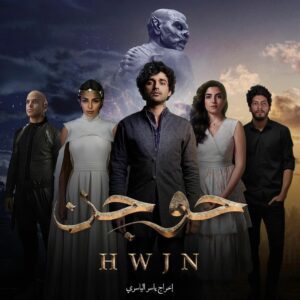
Hwjn
The 2024 Arabic film Hwjn stands out as one of the rare modern Middle Eastern fantasy films that fully embraces regional folklore instead of borrowing heavily from Western fantasy traditions. Adapted from the bestselling Saudi novel by Ibrahim Abbas, the movie explores the hidden world of the djinn through the story of Hwjn, a young djinn who becomes emotionally connected to a human woman. While the film carries elements of romance, mystery, and supernatural drama, its greatest strength lies in how naturally it integrates Arabic mythological concepts into a contemporary cinematic framework.
Unlike Hollywood portrayals that often reduce djinn to monstrous wish-granting spirits, Hwjn presents them closer to their traditional roots within Arabian and Islamic folklore. The djinn here are not simply evil or magical beings. They are portrayed as an ancient parallel civilization with their own emotions, conflicts, hierarchies, and moral ambiguities. This layered depiction immediately gives the film a mythological depth rarely seen in mainstream fantasy cinema. The movie treats the unseen world not as spectacle alone, but as a hidden extension of human existence.
Hwjn himself becomes an interesting mythological figure because he reflects the classic folkloric idea of beings existing between fire and shadow. His emotional vulnerability contrasts with the dangerous aura traditionally associated with djinn lore. The film repeatedly explores the tension between the human world and the unseen realm, echoing old Arabic stories where contact between humans and supernatural beings often leads to forbidden knowledge, obsession, or tragedy. In many ways, Hwjn feels less like a modern superhero fantasy and more like a contemporary folktale retold through cinema.
Visually, the movie succeeds in creating a mystical atmosphere rooted in Arabian aesthetics rather than generic fantasy imagery. The glowing desert landscapes, dim interiors, and supernatural transitions give the film a dreamlike quality that aligns well with the ancient oral traditions surrounding djinn encounters. The filmmakers avoid excessive CGI overload and instead focus on mood, shadows, whispers, and subtle supernatural tension. This approach makes the mythological elements feel believable within the world of the film.
The romance at the center of Hwjn also carries mythological symbolism. Across many cultures, stories involving mortals and supernatural beings often symbolize the crossing of forbidden boundaries. Similar themes appear in Celtic fairy lore, Japanese spirit romances, and Indian yaksha legends. In Hwjn, the relationship becomes a metaphor for curiosity toward the unknown world. The emotional connection between the characters is not merely romantic but existential, questioning whether two fundamentally different beings can truly understand one another.
One of the most compelling aspects of Hwjn is how confidently it embraces Arabic cultural identity. The film does not attempt to Westernize its mythology for broader appeal. Instead, it trusts the audience to enter its mythological framework on its own terms. This authenticity gives the story far greater impact. The lore surrounding the djinn, the spiritual undertones, and the constant sense of unseen presence all feel culturally grounded rather than artificially constructed.
At times, the pacing slows under the weight of its atmospheric storytelling, and some viewers expecting fast-paced horror or action may find the film more introspective than anticipated. However, this slower rhythm actually benefits the mythological dimension of the narrative. Ancient folklore was rarely about constant spectacle. It was about mystery, unease, temptation, and the fear of crossing invisible lines. Hwjn captures much of that energy surprisingly well.
Hwjn succeeds because it treats mythology as living culture rather than decorative fantasy. The film respects Arabic djinn traditions while reshaping them for a modern audience that rarely sees Middle Eastern folklore explored with this level of seriousness. Hwjn himself feels closer to spirit figures from ancient oral traditions than modern fantasy heroes. Similar parallels can be seen in the seductive yet dangerous fairy beings of Celtic lore or the emotionally conflicted yakshas of Indian tradition. Across cultures, these stories reflect humanity’s fascination with the unseen world and the risks of stepping beyond ordinary reality.