
Maria Cacao : The Golden Goddess of Cebu’s Cacao Legends
At a glance
| Description | |
|---|---|
| Origin | Philippine Mythology |
| Classification | Gods |
| Family Members | Mangao (Husband) |
| Region | Philippines |
| Associated With | Cacao, Abundance, Trade, Rivers, Wealth |
The Mythlok Perspective
Kamohoaliʻi represents a departure from the traditional humanised deity. Within the Mythlok framework, he is understood less as a god who governs the sea and more as the ocean itself choosing to be known. Unlike Mediterranean deities such as Poseidon or Neptune, shaped in the human image to be bargained with, Kamohoaliʻi remains fundamentally elemental. While he shares the predatory divinity of the Fijian shark god Dakuwaqa, he is defined by his sacred role as a navigator, marking the limits of human dominion.
Maria Cacao
Introduction
Maria Cacao is one of the most fascinating diwata figures in Philippine folklore, deeply rooted in the traditions of Cebu, particularly around Mount Lantoy in Argao. She represents a unique blend of indigenous belief systems and colonial reinterpretation, making her story both ancient and evolving. As a mountain goddess, she belongs to the same archetype as Maria Makiling and Maria Sinukuan, guardians of nature tied to specific landscapes.
Her name itself reflects layers of history. The term “Maria” was introduced during Spanish colonization, often used to align indigenous deities with Catholic imagery, while “Cacao” refers to the crop that defines her legend. Cacao was introduced to the Philippines through global trade routes, and over time, it became central to her identity.
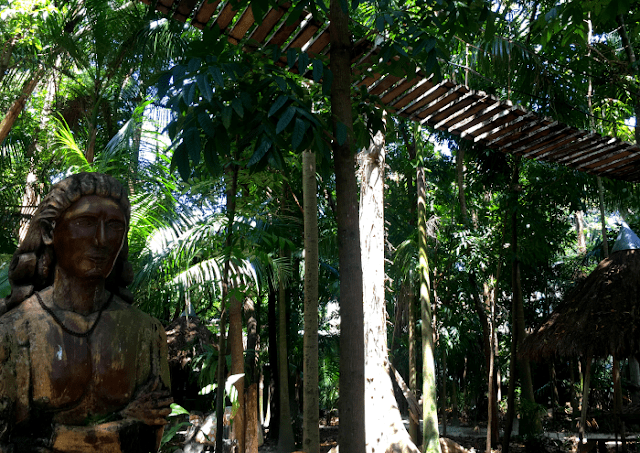
Maria Cacao is believed to dwell in a cave within Mount Lantoy, overseeing vast cacao plantations. She was once known for her generosity, lending valuable items like chinaware and silverware to villagers for important occasions. These objects were said to come from distant lands, hinting at her connection to trade and travel. However, when people failed to return what they borrowed, her kindness turned into distance, reinforcing a moral theme common in folklore: respect, honesty, and reciprocity.
Physical Traits
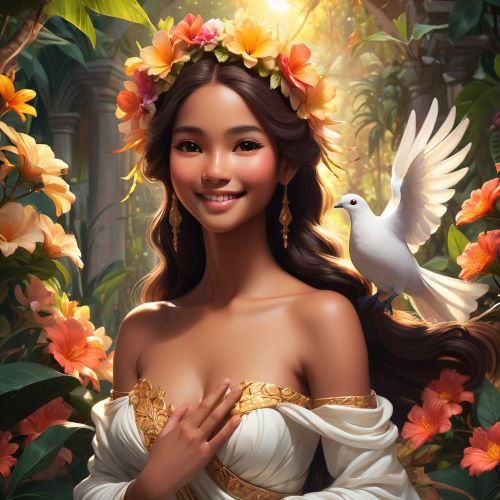
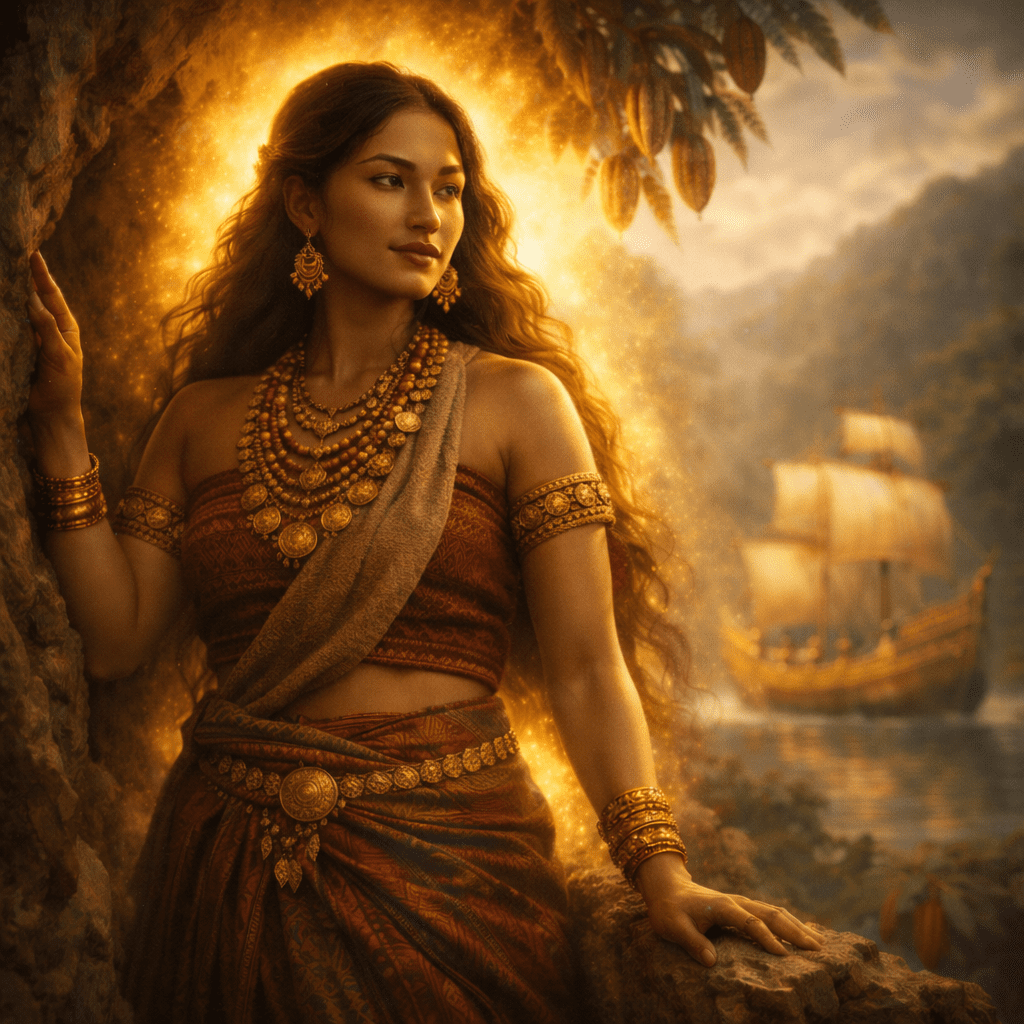
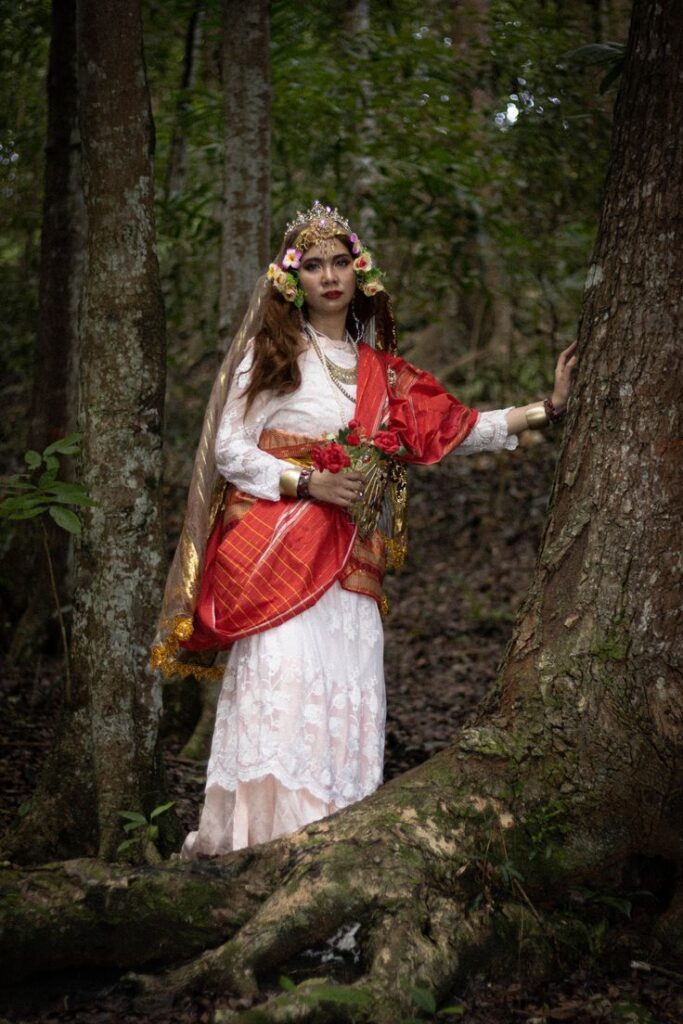
Maria Cacao’s appearance shifts depending on the storyteller, reflecting the fluid nature of oral traditions. She is most often described as extraordinarily beautiful, with long flowing hair and a calm yet powerful presence. Her features are sometimes portrayed with a mestiza influence, a result of colonial reinterpretation, though earlier versions likely imagined her as distinctly indigenous.
In some accounts, she appears as a youthful and radiant woman, especially during full moons when she reveals herself to mortals. In others, she takes on the role of an older enchantress, commanding respect and authority among the unseen beings of the mountains.
Her presence is often accompanied by a subtle golden glow, symbolizing both her connection to wealth and the richness of cacao. This luminous quality reinforces her identity as a being who exists between the natural and supernatural worlds.
Family
Maria Cacao’s story occasionally includes a companion named Mangao, sometimes described as her husband and other times as her brother. Mangao is associated with the same mountainous domain and is believed to assist her in managing their cacao trade.
Together, they are said to travel using a golden vessel, transporting cacao and other goods across rivers and seas. Their partnership reflects a balance between nature and commerce, suggesting that their influence extends beyond the mountain into wider economic and cultural exchanges.
Beyond Mangao, there are no consistent accounts of parents or children. The absence of a defined family structure emphasizes her role as an independent diwata, tied more to place and function than lineage.
Other names
Maria Cacao is sometimes referred to simply as Kakaw, directly linking her identity to the cacao plant. Variations such as Maria de Cacao appear in later retellings influenced by colonial language.
Her original pre-colonial name has been lost over time, a common occurrence among indigenous figures whose identities were reshaped during colonization. In some narratives, she is not given a formal name at all, instead being described as a powerful enchantress or diwata of the mountain.
Powers and Abilities
Maria Cacao’s abilities are closely tied to nature, wealth, and the unseen forces that govern both. Her most iconic power is her control over a golden ship or galleon, which she uses to transport cacao. This vessel is said to travel through rivers, and its passage is often linked to sudden floods or damaged bridges. These stories likely emerged as mythological explanations for natural disasters.
She also possesses the ability to provide material abundance. Villagers would visit her cave to request items for special occasions, and these would mysteriously appear at their homes. This act of lending reflects her role as a provider, but also introduces a moral condition: what is borrowed must be returned.
In later versions of the legend, her powers take on a darker tone. She is sometimes believed to punish dishonesty by taking individuals into her realm or enslaving them. This transformation highlights how folklore evolves to reflect changing social values and fears.
Her domain over cacao is equally significant. Her plantations are described as endlessly fertile, symbolizing prosperity and the deep connection between land and livelihood. She also has the ability to appear and disappear at will, reinforcing her identity as a being who exists beyond ordinary perception.
Modern Day Influence
Maria Cacao continues to shape cultural identity in Cebu and beyond. Argao, in particular, is known for its rich cacao traditions, especially the production of tableya used to make sikwate, a traditional hot chocolate drink. Her legend is often invoked as a symbolic origin of this thriving cacao culture.
She also appears in literature, most notably in children’s stories that aim to preserve Philippine folklore for younger generations. Scholars have studied her legend to understand how indigenous beliefs adapt under colonial and modern influences.
Among migrant communities, her story serves as a powerful link to home. Retelling her legend allows people to maintain a shared cultural memory, connecting them to specific places and experiences tied to Cebu. Today, Maria Cacao stands as both a mythological figure and a cultural symbol. She represents abundance, mystery, and the enduring relationship between people and the land they inhabit.
Related Images

Source
Alburo, E. K. (1980). A study of two Cebuano legends: The lost lender and Maria Cacao. Philippine Quarterly of Culture and Society, 8(1), 44–59. https://www.jstor.org/stable/29791666
Eugenio, D. L. (2007). Philippine folk literature: An anthology. University of the Philippines Press.
Mojares, R. B. (2006). Waiting for Mariang Makiling: Essays in Philippine cultural history. Ateneo de Manila University Press.
Seki, K. (2012). Rethinking Maria Cacao: Legend-making in the Visayan context. Philippine Studies: Historical and Ethnographic Viewpoints, 49(4), 560–583. https://archium.ateneo.edu/phstudies/vol49/iss4/5
Villanueva, R. O. (2002). Maria Cacao, ang diwata ng Cebu. Lampara Publishing House.
Maria Cacao. (n.d.). In Wikipedia. Retrieved April 16, 2026, from https://en.wikipedia.org/wiki/Maria_Cacao
Sailing the golden ship with Maria Cacao, the diwata of Filipino cacao culture. (2022, July 28). Auro Chocolate. https://aurochocolate.com/blogs/community-programs/sailing-the-golden-ship-with-maria-cacao-the-diwata-of-filipino-cacao-culture
The mysterious Maria Cacao and her golden ship. (2023, July 30). HubPages. https://discover.hubpages.com/religion-philosophy/The-Enchantress-Maria-Cacao-and-Her-Golden-Ghost-ShipThe-Mountain-Goddesses-of
Frequently Asked Questions
Who is Maria Cacao in Philippine mythology?
Maria Cacao is a Cebuano diwata linked to Mount Lantoy, known for her cacao plantations, golden ship, and role as a guardian of abundance.
What is Maria Cacao famous for?
She is famous for her golden galleon, lending magical items to villagers, and her connection to cacao and prosperity.
Where does Maria Cacao live?
She is believed to reside in a cave on Mount Lantoy in Argao, Cebu, surrounded by enchanted cacao plantations.
Is Maria Cacao a benevolent or dangerous spirit?
She is both. Early stories show her as generous, but later versions portray her as punishing dishonesty.
What does Maria Cacao symbolize?
She symbolizes wealth from nature, moral responsibility, and the balance between generosity and consequence.