


Lado : The Forgotten God of Love in Slavic Folklore
At a glance
| Description | |
|---|---|
| Origin | Slavic Mythology |
| Classification | Gods |
| Family Members | Lada (Wife/Sibling) |
| Region | Poland, Ukraine, Russia, Croatia, and Serbia |
| Associated With | Love, Fertility, Harmony, Marriage |
The Mythlok Perspective
In Mythlok’s Perspective, Lado represents the fragile boundary between mythology and folklore. Unlike powerful sky gods or underworld rulers, his existence survives through songs, festivals, and communal memory rather than grand legends. This makes him one of the most human figures in Slavic tradition, embodying joy, marriage, and seasonal renewal instead of conquest or destruction. His uncertain identity also reveals how oral cultures can blur the line between deity, ritual phrase, and symbolic archetype over centuries. Similar figures can be seen in other traditions, such as the paired fertility symbolism of Freyr and Freyja in Norse belief or the seasonal love deities connected with spring festivals across Europe. Lado ultimately survives not because of mythic battles, but because communities continued singing his name long after the old religions faded.
Lado
Introduction
Lado is one of the most mysterious figures connected to Slavic mythology and folklore. Unlike major Slavic deities such as Perun or Veles, Lado survives mainly through ritual songs, seasonal celebrations, and scattered medieval references rather than detailed myths. He is traditionally associated with love, fertility, marriage, harmony, and the renewal of nature. His name frequently appears beside Lada, a female figure connected with beauty and fertility, leading many scholars to view them as divine counterparts representing masculine and feminine balance.
The earliest written mentions of Lado appear in Christian sermons from the 15th century. Church authorities condemned rural communities for invoking names like Lado and Lada during pagan-inspired festivities. These references are important because they suggest that the names held cultural significance among Slavic populations long after Christianization. However, historians continue to debate whether Lado was truly worshipped as a deity or whether the name originated from ritual refrains used in folk songs.
In many Eastern and Southern Slavic traditions, Lado became associated with spring festivals, weddings, harvest celebrations, and midsummer ceremonies. Songs invoking his name often focused on joy, courtship, and the unity of families and communities. Because of this, Lado is commonly viewed as a symbolic figure tied to fertility and social harmony rather than a warrior god or cosmic ruler.
Modern scholars remain divided on his historicity. Some believe Lado was a genuine pre-Christian Slavic deity whose cult faded over time, while others argue that medieval chroniclers misunderstood repetitive words in ceremonial songs and mistakenly transformed them into the name of a god. Despite this uncertainty, Lado continues to occupy a fascinating place in Slavic cultural memory.
Physical Traits
Very little is known about Lado’s appearance because surviving Slavic sources do not provide detailed visual descriptions. Unlike figures from Greek or Norse mythology, many Slavic deities were preserved through oral tradition rather than written mythology, leaving large gaps in their iconography. As a result, Lado’s image remains vague and symbolic.
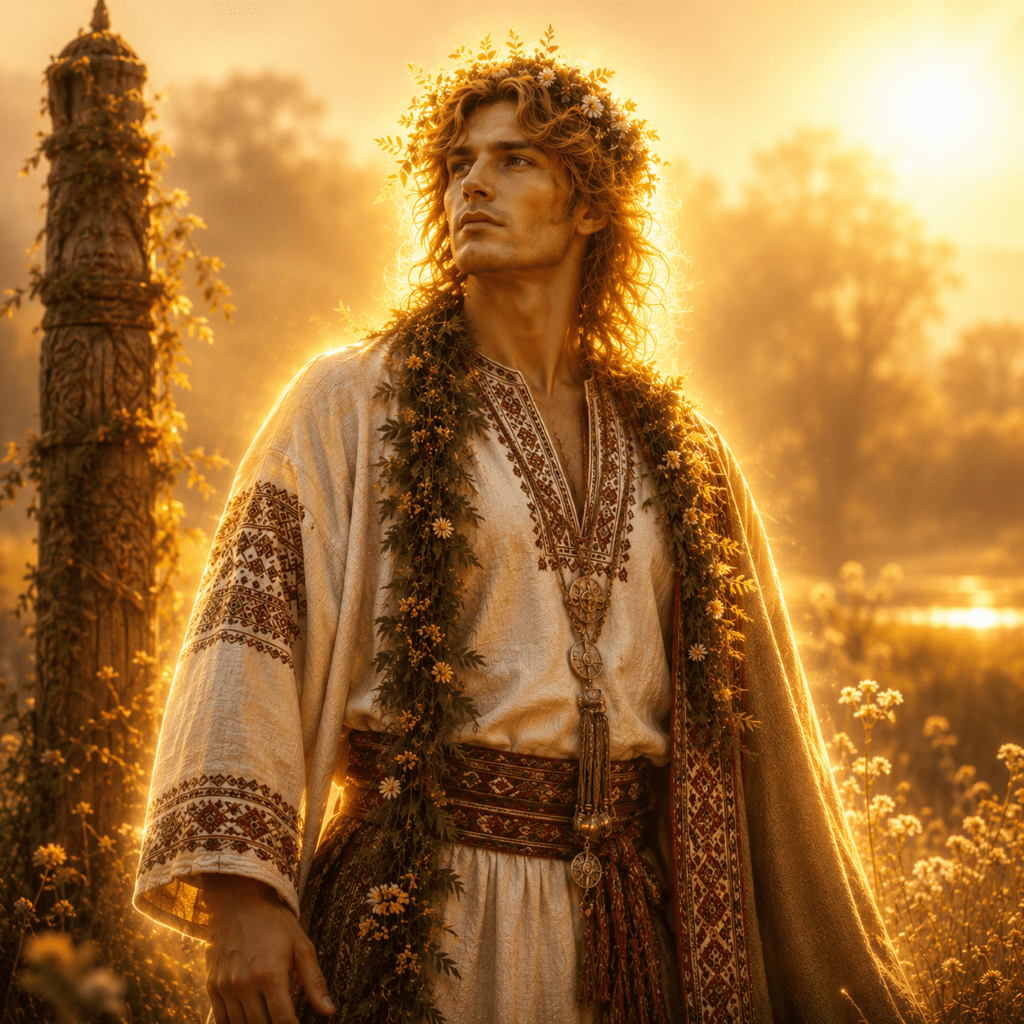
Some later folk interpretations portray him as a youthful and energetic male figure representing vitality, romance, and seasonal renewal. In these depictions, he often appears during spring or summer festivals surrounded by flowers, greenery, and dancing communities. These artistic interpretations emphasize his connection to fertility and the rebirth of nature after winter.
Other traditions avoid describing him physically at all. Instead, Lado exists more as a spiritual presence invoked during rituals and songs. In wedding chants and midsummer celebrations, his name symbolized joy, balance, and emotional unity rather than an anthropomorphic deity with a fixed appearance.
Modern artistic representations sometimes depict Lado with traditional Slavic clothing, wreaths, or solar imagery. However, these portrayals are largely speculative because no confirmed ancient statues or descriptions of him survive. His undefined appearance contributes to the mystery surrounding his role in Slavic belief systems.
Family
Lado is most closely connected with Lada, a figure associated with beauty, fertility, love, and marriage in Slavic folklore. Depending on the region and interpretation, Lada is described as his consort, twin, sister, or feminine counterpart. Together, the pair represent harmony between masculine and feminine forces within nature and society.
Some traditions present Lado and Lada as divine twins similar to fertility pairs seen in other Indo-European cultures. In these interpretations, they embody balance, seasonal renewal, and the sacred union between earth and life-giving forces. Their association with weddings and communal rituals reinforces this symbolic partnership.
Certain folk traditions and later interpretations also connect Lado with figures such as Lel or Ljeljo, youthful beings linked with romance and springtime celebrations. However, these relationships are inconsistent across Slavic regions, making it difficult to establish a definitive mythological genealogy.
Unlike many mythological pantheons, Slavic folklore surrounding Lado does not provide extensive family trees or stories involving parents and siblings. His importance comes more from ritual symbolism than narrative mythology.
Other names
The name Lado appears in several forms across Slavic regions and historical texts. Variations often emerged because oral traditions differed between communities and because medieval writers recorded names inconsistently.
One notable variation is Lyada, mentioned by the Polish chronicler Jan Długosz. He compared Lado to the Roman god Mars, interpreting the figure as a war deity. This comparison likely reflects the medieval practice of interpretatio Romana, where foreign gods were equated with Roman counterparts. Modern scholars generally question this interpretation because most folk traditions associate Lado with fertility and harmony rather than warfare.
The names Lado and Lada are sometimes used interchangeably in ritual songs. This has created centuries of confusion regarding whether they were separate deities, aspects of the same figure, or merely ceremonial refrains repeated during celebrations.
In some South Slavic traditions, names such as Lel, Ljeljo, Dido, or Dida appear in related ceremonial contexts. Linguistically, the root “lad” is associated with harmony, peace, and order in several Slavic languages, reinforcing Lado’s symbolic role as a figure of balance and communal unity.
Powers and Abilities
Lado’s powers are closely tied to fertility, emotional harmony, and seasonal renewal. He was believed to preside over weddings, communal celebrations, and rituals connected to agricultural abundance. His presence in folk songs suggests that people invoked his name to encourage prosperity, love, and healthy family relationships.
One of his primary associations is with fertility. During spring and summer festivals, communities celebrated nature’s renewal through dancing, singing, and matchmaking rituals. Lado symbolized the vitality of the earth and the continuation of life through successful harvests and marriage.
He is also linked with harmony and social unity. In Slavic traditions, balance within the household and village was considered essential for survival and prosperity. Lado represented emotional peace, joyful celebration, and cooperation among communities.
Some medieval accounts attributed martial characteristics to Lado after comparing him with Mars. However, this interpretation is generally viewed as a later misunderstanding rather than evidence of an original war god identity.
Lado additionally carried symbolic connections to seasonal cycles. His invocation during midsummer and spring ceremonies reflected the transition from winter hardship to warmth, abundance, and human connection. In this sense, he embodied the returning energy of nature itself.
Modern Day Influence
Although Lado remains obscure compared to major mythological figures, his cultural legacy survives in Slavic folklore and seasonal traditions. References to his name continue to appear in folk songs across Poland, Ukraine, Croatia, Serbia, and Russia, particularly in ceremonies celebrating love, marriage, and midsummer festivities.
Kupala Night celebrations preserve elements associated with Lado and Lada traditions. These festivals involve dancing, singing, fire rituals, and matchmaking customs connected to fertility and renewal. Even when participants no longer recognize Lado as a mythological figure, echoes of the old traditions remain embedded in the ceremonies.
Lado also appears in academic discussions about Slavic paganism and the reconstruction of pre-Christian belief systems. Scholars frequently debate whether he was an authentic deity or a misunderstanding created by medieval chroniclers interpreting ritual refrains as divine names. This debate has made Lado an important example in studies of folklore preservation and historical interpretation.
In modern Slavic neopagan movements, some practitioners have revived Lado as a symbolic fertility and harmony deity. Artistic works, fantasy literature, and cultural festivals occasionally reference him as part of a broader revival of Slavic heritage. Despite the uncertainty surrounding his origins, Lado continues to represent the enduring connection between folklore, seasonal rituals, and cultural identity across the Slavic world.
Related Images

Source
Ivanits, L. J. (1989). Russian folk belief. M.E. Sharpe.
Machal, J. (1911). Slavic mythology. In The Mythology of All Races (Vol. 3). Marshall Jones Company.
Nodermann, K. (2012). Lada and Ljeljo in the folklore of Croats and Slavic context. Zbornik za narodnu umjetnost i kulturno baštinenstvo, 46, 65-88. https://hrcak.srce.hr/en/clanak/200921
Słownik starożytności słowiańskich. (1960). Encyclopedic dictionary of Slavic antiquities (Vol. 4). Wrocław: Zakład Narodowy im. Ossolińskich.
Warner, E. (1975). Russian myths. British Library.
Zielińska, J. (2006). Lada in Baltic and Slavic mythology. Acta Baltico-Slavica, 30, 597-609. https://web.archive.org/web/20110718090057/http:/cejsh.icm.edu.pl/cejsh/cgi-bin/getdoc.cgi?07PLAAAA02134512
Slovanski Bogovi. (2018). Lada. https://slovanskibogovi.wordpress.com/2018/01/16/lada/
Encyclopedia of Ukraine. (n.d.). Lada. https://www.encyclopediaofukraine.com/display.asp?linkpath=pages%5CL%5CA%5CLada.htm
Frequently Asked Questions
Who is Lado in Slavic mythology?
Lado is a mysterious Slavic figure associated with love, fertility, harmony, and seasonal celebrations, often linked with the goddess Lada.
Was Lado a real Slavic god?
Scholars debate this heavily. Some believe he was a genuine deity, while others think the name came from ritual song refrains.
What powers did Lado have?
Lado was connected with fertility, marriage, harmony, communal joy, and the renewal of nature during spring and summer festivals.
What is the connection between Lado and Lada?
Lado is commonly viewed as Lada’s masculine counterpart, consort, or symbolic twin representing balance and union.
Is Lado still remembered today?
Yes. His name survives in Slavic folk songs, midsummer rituals, cultural festivals, and modern neopagan interpretations.
