

Ilat : The Kalenjin God of Lightning and Justice
At a glance
| Description | |
|---|---|
| Origin | Kalenjin Mythology |
| Classification | Gods |
| Family Members | Asis/Tororut (Father) , Arawa (Sister), Kokel (Children) |
| Region | Kenya |
| Associated With | Thunder, Lightning, Rain, Storms, Justice, Morality, Nature, Fertility |
The Mythlok Perspective
In Mythlok’s Perspective, Ilat represents one of the most fascinating examples of how African spiritual traditions connected morality directly to the environment. Thunder was not merely weather in Kalenjin thought. It was a living force capable of rewarding honesty and punishing imbalance. This gives Ilat a philosophical depth similar to storm deities in many ancient cultures. Ilat also shares similarities with Thor from Norse tradition and Shango from Yoruba belief systems, as all three are associated with thunder and divine justice. However, Ilat differs because his mythology places stronger emphasis on ecological balance and the dual nature of rainfall as both creator and destroyer.
Ilat
Introduction
Ilat, also known as Ilet or Toiyoi, is one of the most important spiritual figures in the traditional beliefs of the Kalenjin people of Kenya. Deeply connected to thunder, lightning, rain, and divine justice, Ilat represents the unpredictable power of nature and the moral order that governs human life. In Kalenjin cosmology, weather was never viewed as random. Storms, droughts, and rainfall were understood as expressions of spiritual forces, and Ilat stood at the center of those forces.
The Kalenjin communities of the Rift Valley depended heavily on rainfall for survival. Because of this, rain was not simply a seasonal event but a sacred blessing linked to divine approval. Ilat became the spiritual authority behind these natural cycles, capable of bringing life-giving rain to nourish crops or unleashing destructive storms when communities violated moral or social laws.
Unlike many mythological gods portrayed in human form, Ilat exists more as a supernatural force woven into the environment itself. Thunder rolling across the hills, flashes of lightning in the night sky, and rain pouring over valleys were all considered manifestations of his presence. Waterfalls, rivers, and deep pools were believed to be sacred places where Ilat dwelled on earth.
Kalenjin oral traditions describe Ilat as a being with a dual nature. He could be protective and generous, but he could also be terrifying and destructive. This balance reflected the Kalenjin understanding of nature itself. Rain sustains life, but storms can also destroy homes, crops, and lives. Through Ilat, these realities became part of a larger spiritual philosophy that emphasized respect for nature, honesty, and communal harmony.
Physical Traits
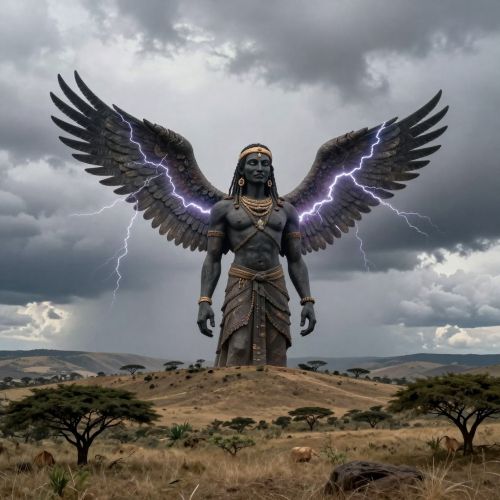
Unlike mythological figures with clearly defined human appearances, Ilat is mostly represented through natural phenomena. His presence is seen in lightning strikes, heard in thunderclaps, and felt in violent storms or nourishing rainfall. This makes him less of a physical being and more of a living embodiment of atmospheric power.
Some oral traditions describe Ilat as a supernatural creature with wings, huge talons, and a frightening appearance. Other stories compare him to a giant bird or cock-like entity descending from the sky during storms. These descriptions likely evolved from attempts to visualize the terrifying speed and force of lightning. Even when given physical characteristics, Ilat never fully loses his connection to the natural world.
One of the most poetic elements in Kalenjin belief is the idea that rainbows are the discarded garments of Ilat. After storms pass and sunlight returns, the appearance of a rainbow symbolized the deity’s lingering presence. This imagery transforms an ordinary natural phenomenon into a sacred reminder of divine activity.
Water is another major part of Ilat’s identity. He is associated with waterfalls, rivers, deep pools, and storm clouds. These places were often viewed with reverence because they connected the earthly world to spiritual forces. In many stories, approaching such locations carelessly could invite supernatural consequences.
The Nandi subgroup of the Kalenjin people also divided Ilat into two spiritual expressions. Ilet ne-mie represented the benevolent side associated with distant thunder and beneficial rain, while Ilet ne-ya symbolized destructive lightning and deadly storms. This division reinforced the belief that nature contains both protective and dangerous forces.
Family
The family connections of Ilat vary across Kalenjin traditions, but he is consistently linked to the supreme celestial powers. In several accounts, Ilat is considered the son of Asis, the great sun deity associated with creation, light, and divine authority. Other traditions identify him as the son of Tororut, another creator figure connected to the heavens.
These differing versions reflect the diversity of oral traditions among Kalenjin subgroups. Since mythology was passed down through storytelling rather than written scripture, variations naturally developed across regions and generations.
Some traditions mention Arawa, the moon spirit, as Ilat’s sibling. Together, these celestial figures represented different forces governing the natural world. Asis controlled the sun and order, while Ilat governed storms and rainfall. This cosmic structure created a balanced understanding of nature where different spiritual powers worked together to maintain life.
Certain Suk and Pokot traditions also identify the Kokel, spirits associated with death or stars, as children of Ilat. This connection gave Ilat influence beyond weather, linking him to mortality and the spiritual world. In these beliefs, storms and lightning were reminders that divine forces could both sustain and end life.
Although details differ, Ilat always occupies a central role within Kalenjin cosmology. Whether viewed as a son, servant, or divine agent, he remains one of the strongest spiritual powers in the traditional belief system.
Other names
Ilat is known by several names throughout Kalenjin-speaking communities. The most common alternative spelling is Ilet, which appears frequently in oral narratives and academic studies. Pronunciation differences among regional groups contributed to these variations over time. Another important name connected to Ilat is Toiyoi, a term associated with thunder and rain. This title highlights his role as a living force of storms rather than merely a distant deity.
The Nandi people further divided Ilat into two identities. Ilet ne-mie translates to “Good Lightning” and refers to the benevolent aspect that brings rainfall, protection, and fertility. Ilet ne-ya means “Bad Lightning” and represents destructive storms, dangerous thunder, and divine punishment.
In some traditions, Ilat is also described as a god of justice. This title comes from the belief that lightning strikes were not accidental but expressions of divine judgment. People who lied, violated sacred oaths, or threatened communal harmony risked attracting his wrath.
These different names and titles reveal how deeply Ilat was integrated into everyday life. He was not simply a distant god worshipped in rituals but a constant presence visible in the skies above the Rift Valley.
Powers and Abilities
Ilat’s greatest power lies in his control over thunder, rain, and lightning. For agricultural communities dependent on seasonal rainfall, this authority made him one of the most influential divine beings in Kalenjin belief.
Rain represented survival. Without it, crops failed, animals died, and famine spread. Through Ilat, rainfall became a sacred gift rather than a natural accident. Communities prayed for his favor during dry seasons and feared his anger during violent storms.
Lightning was viewed as both a weapon and a form of divine justice. According to oral traditions, Ilat used lightning to punish criminals, liars, and oath-breakers. Some communities even believed disputed land boundaries could be settled spiritually through his judgment. If someone falsely claimed ownership, Ilat’s wrath might strike them through lightning or misfortune.
His powers also extend into cosmic symbolism. In some creation stories, Ilat participates in struggles involving humanity, animals, and spiritual beings. These myths explain the origins of social order and humanity’s relationship with nature.
Another important aspect of Ilat’s power is duality. As Ilet ne-mie, he nourishes the land and protects communities. As Ilet ne-ya, he destroys through storms and lightning. This balance reflects a worldview where creation and destruction are inseparable forces within nature itself. Rituals were historically performed to appease Ilat after lightning strikes or severe storms. These ceremonies sought to restore harmony between humans and the spiritual world.
Modern Day Influence
Although Christianity became dominant in Kenya during and after colonial rule, the cultural memory of Ilat remains strong among the Kalenjin people. His stories continue to survive through oral traditions, folklore, songs, and cultural discussions.
In many rural communities, thunderstorms are still viewed with spiritual respect. Even among Christian families, older beliefs about lightning and divine justice sometimes coexist alongside modern religious practices. Sacred natural locations linked to Ilat also continue to hold cultural importance.
Kalenjin musicians, storytellers, and cultural historians frequently reference Ilat when discussing heritage and identity. His mythology serves as a reminder of the deep relationship between humans and the natural environment.
Modern scholars have also revisited Ilat as part of indigenous ecological philosophy. His myths emphasize respect for nature, balance within the environment, and the consequences of human wrongdoing. In an age of climate change and ecological disruption, these themes have gained renewed relevance. Today, Ilat remains more than a mythological figure. He stands as a symbol of the Kalenjin understanding of nature’s beauty, danger, and spiritual meaning.
Related Images



Source
Chesaina, C. (1991). Oral literature of the Kalenjin. East African Publishers.
Fish, B. C. (1995). The Kalenjiin heritage. Africa Gospel Church, World Gospel Mission.
Hollingsworth, L. (n.d.). Nandi (Kalenjiin), their language and folklore. Academia.edu.
Snell, G. S. (1954). Nandi customary law. Macmillan.
Wikipedia contributors. (2024). Kalenjin folklore. Wikipedia. https://en.wikipedia.org/wiki/Kalenjin_folklore
Wikipedia contributors. (2024). Kalenjin mythology. Wikipedia. https://en.wikipedia.org/wiki/Kalenjin_mythology
Lebarty. (2024). Kalenjin mythology. https://lebarty.bongchong.com/kalenjin-mythology/
Ehret, C. (1998). The civilizations of Africa: A history to 1800. University Press of Virginia.
Kipkorir, B. E. (1983). The Marakwet of Kenya: A preliminary ethnographic account. East African Literature Bureau.
Sang, J. K. (2002). Kalenjin religion and culture. Moi University Press.
Sambu, K. (2007). The Kalenjin heritage: Traditional religious beliefs and practices. Nairobi: Kalenjin Cultural Association.
Frequently Asked Questions
Who is Ilat in Kalenjin tradition?
Ilat is the Kalenjin deity associated with thunder, lightning, rain, storms, and divine justice.
What does Ilet ne-mie mean?
Ilet ne-mie refers to the benevolent aspect of Ilat connected to protective thunder and life-giving rain.
Is Ilat considered a god or spirit?
Ilat is generally viewed as a powerful deity or nature spirit within Kalenjin cosmology.
What natural phenomena are linked to Ilat?
Thunderstorms, lightning strikes, rainfall, waterfalls, and rainbows are all associated with Ilat.
Is Ilat still important today?
Yes. Ilat remains culturally significant in Kalenjin oral traditions, folklore, and environmental symbolism.