


Gesar : The Divine Warrior-King of Tibetan Tradition
At a glance
| Description | |
|---|---|
| Origin | Bhutanese Mythology |
| Classification | Mortals |
| Family Members | Sengblon (Father), Gogza Lhamo (Mother), Todong (Uncle), Brugmo (Wife) |
| Region | Bhutan, Tibet |
| Associated With | Divine kingship, Demon-slaying |
The Mythlok Perspective
In Mythlok’s Perspective, Gesar represents the archetype of the sacred warrior whose battles restore balance rather than expand empire. His narrative reflects the Tibetan plateau’s spiritual ecology, where human survival depends on harmony with seen and unseen forces. Unlike purely martial heroes, Gesar combines shamanic transformation with royal authority. He parallels figures such as King Arthur in Britain and the Mongolian Geser Khan, yet his cosmic mission aligns him closer to culture heroes like Rama in Indian tradition. Where Arthur defends a realm and Rama upholds dharma, Gesar restores equilibrium between heaven and earth. His legend reminds us that leadership, in many cultures, is not political power alone but a sacred responsibility.
Geser
Introduction
Epic of King Geser stands among the longest and most remarkable oral epics in human history. At its heart is Gesar, the legendary king of Ling, a culture hero whose story has echoed across Tibet, Bhutan, Mongolia, Buryatia, and Himalayan communities for over a millennium. Passed down through bardic recitation rather than fixed manuscripts, the epic blends indigenous Tibetan beliefs, shamanic elements, and later Buddhist symbolism into a sweeping saga of divine mission and heroic conquest.
Gesar is not merely a warrior. He is a divinely sent protector who descends to earth during an age of chaos. His purpose is clear: defeat oppressive demon-kings, restore moral order, and unify fractured tribes. Though versions differ across regions, the narrative consistently presents Gesar as both a celestial emissary and a deeply human ruler whose trials reflect the spiritual and political tensions of the Tibetan plateau.
In 2009, UNESCO inscribed the Gesar epic tradition on the Representative List of the Intangible Cultural Heritage of Humanity, recognizing its immense cultural value. Even today, singers in Kham, Amdo, Mongolia, and Bhutan continue to perform vast portions of the epic from memory, sometimes over several days.
Physical Traits
Descriptions of Gesar’s appearance vary depending on the regional version of the epic. In many early narratives, he does not begin life as a shining hero. Instead, he appears wild, unruly, and even unattractive as a child. Living in exile with his mother, he grows up among herders on the windswept Tibetan plateau, clothed in animal skins and embodying raw, untamed energy. This early portrayal emphasizes his liminal nature: part divine, part outsider.
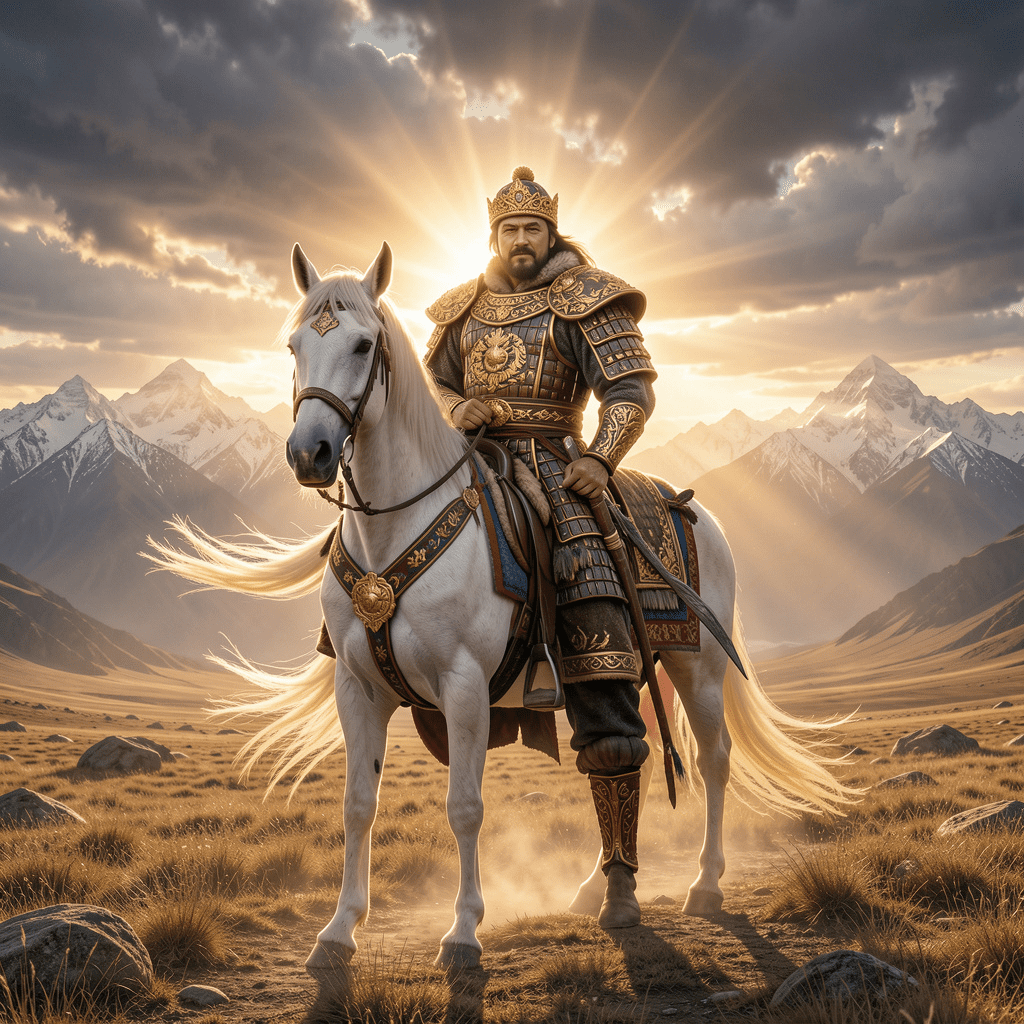
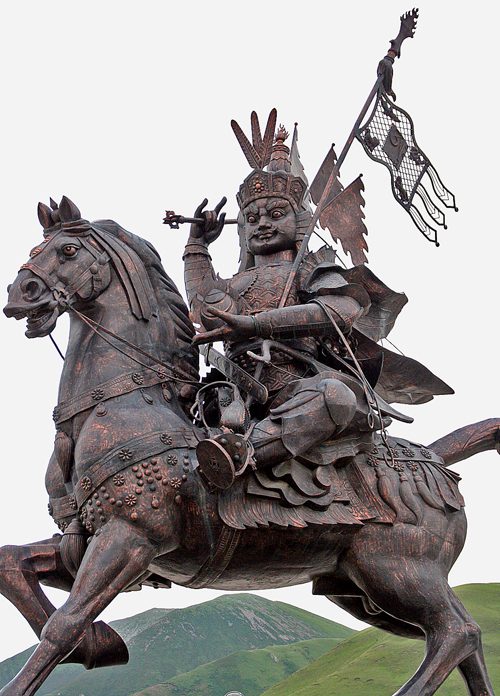
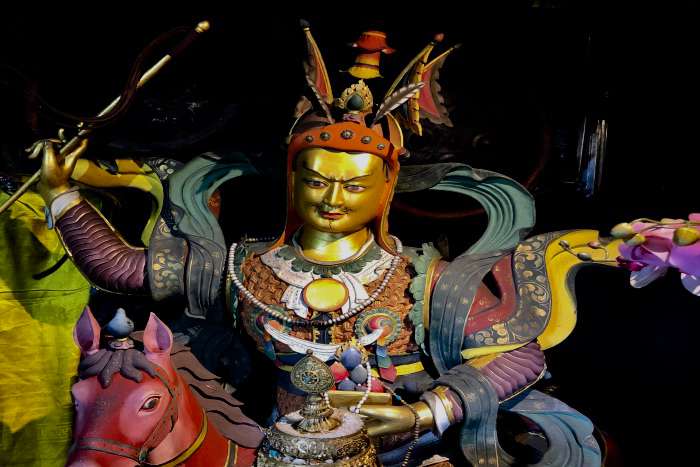
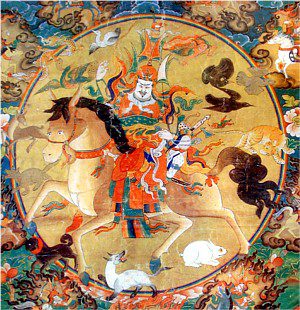
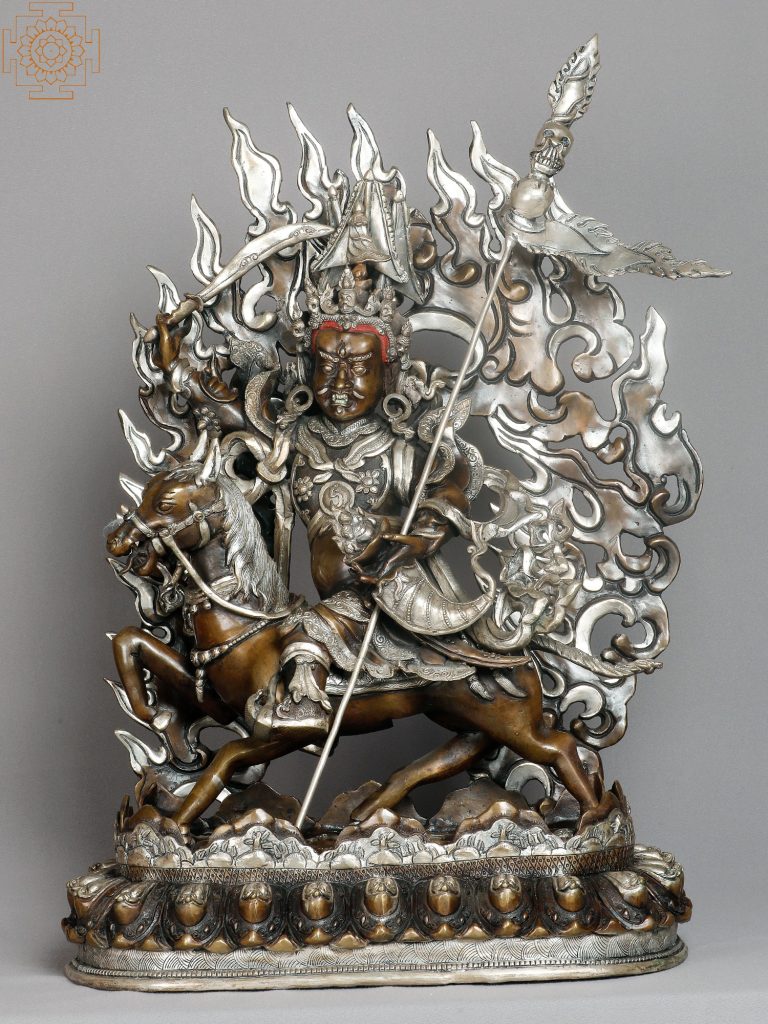
As he matures and claims his destiny, his image transforms. Later artistic depictions show Gesar as a radiant warrior clad in armor, mounted on a powerful horse, often white or chestnut. He carries a bow, sword, or magical weapons gifted from heavenly realms. Murals, thangka paintings, and statues present him with commanding posture and fierce expression, symbolizing divine authority and invincibility rather than ornamental beauty.
Family
Gesar’s lineage blends myth and theology. In many Tibetan versions, he is born to Sengblon (or Senglon), a noble elder of the kingdom of Ling, and Gogza Lhamo, sometimes described as a naga-associated princess or noblewoman. His birth is no ordinary event. Celestial beings send him to earth to combat demonic forces overwhelming humanity.
Some Buddhist-influenced accounts interpret him as an emanation connected to enlightened beings such as Padmasambhava or under the compassionate guidance of Avalokiteshvara. These interpretations elevate Gesar from tribal hero to sacred protector aligned with Buddhist cosmology.
A key antagonist in his early life is his jealous uncle, Todong (or Trothung), who repeatedly attempts to harm or exile him. This conflict sets the stage for Gesar’s eventual triumph in a decisive horse race that wins him the throne of Ling at a young age.
Gesar’s principal wife is widely known as Brugmo (often rendered as Sechan Dugmo in some versions). Her abduction by rival kingdoms becomes a major narrative arc, driving Gesar into campaigns of vengeance and rescue. In Mongolian traditions, variations appear in the names and relationships, but the emotional core remains: loyalty, betrayal, exile, and restoration.
Other names
Across Central Asia, Gesar’s name adapts to linguistic and cultural contexts. In Tibetan he is often called Ling Gesar, emphasizing his sovereignty over the kingdom of Ling. In Mongolian traditions, he appears as Geser Khan. Some texts and transcriptions render his name as Kesar or Gesa’er.
These variations reflect the epic’s remarkable diffusion across Tibet, Mongolia, Buryatia, and Himalayan regions. Despite differences in pronunciation and embellishment, the central identity remains constant: a divinely empowered warrior-king destined to confront chaos.
Powers and Abilities
Gesar’s powers define his mythic stature. From childhood he demonstrates supernatural traits, including prophetic insight and extraordinary physical resilience. As an adult king, he commands abilities that blur the boundary between shaman and deity.
He can summon storms, command wind and rain, and wield weapons imbued with celestial force. In several episodes, he shape-shifts or uses magical transformation to outwit enemies. One famous tale recounts his transformation into a tiny golden fish to infiltrate an enemy king’s body, later expanding into a destructive force that compels surrender. Such episodes highlight not brute strength alone, but cunning and adaptability.
Divine protection shields him in battle. Heavenly guardians intervene, ensuring that his campaigns against demon-kings succeed. His victories extend beyond physical warfare. He unites tribes, restores ethical order, and re-establishes harmony between human and spiritual realms.
In many versions, Gesar defeats the kings of the four directions and subdues monstrous beings linked to underworld forces. His battles are not random conquests; they symbolize the triumph of order over chaos, justice over tyranny.
Modern Day Influence
The Gesar tradition remains vibrantly alive. Bards in Tibetan regions, particularly in Kham and Amdo, continue to perform lengthy recitations, alternating prose and verse. Some performers are believed to receive the epic through visionary experience, reinforcing its sacred aura.
Cultural institutions in Tibet and China have collected hundreds of manuscript editions and thousands of hours of recordings since the late twentieth century. The epic is studied academically for insights into early Tibetan society, oral literature, and Central Asian intercultural exchange.
Gesar’s image appears in murals, woodblock prints, ritual performances, and festival reenactments. The Potala Palace houses representations of Gesar, underscoring his integration into Tibetan cultural memory.
Translations into English, Russian, German, and other languages have introduced Gesar to global audiences. Scholars consider the epic an invaluable resource for understanding Tibetan cosmology, ethics, and oral artistry.
Even today, passages from the epic are sung at significant life events. In some communities, verses describing Gesar’s descent to earth are recited during childbirth, symbolically invoking protection and courage for the newborn.
Related Images


Source
WindhorseTour. (2025, April 4). Epic of King Gesar – Tibet’s timeless heroic legend. https://windhorsetour.com/tibet-culture/king-gesar-epic
Tibet Vista. (2025, July 14). Tibetan heroic epic – King Gesar. https://www.tibettravel.org/tibetan-culture/king-gesar.html
Wikipedia. (2004, June 23). Epic of King Gesar. https://en.wikipedia.org/wiki/Epic_of_King_Gesar
Go to Tibet. (2018, March 29). King Gesar: Discovering Tibet’s legendary epic hero.
https://www.gototibet.com/tibetan-culture/king-gesar.html
Tulkus Tondup. (2025, January 22). Introduction: The warrior song of King Gesar. https://www.tulkuthondup.com/blog/introduction-the-warrior-song-of-king-gesar
White Rose ePrints. (2019, April 10). The Tibetan Gesar epic beyond its bards: An ecosystem of genres.
https://eprints.whiterose.ac.uk/id/eprint/132882/10/project_muse_721126.pdf
Druk Journal. (n.d.). Reflecting on the past to forge the future: What can modern Bhutan learn from Ling Gesar’s youthful bodhisattva qualities. http://drukjournal.bt/reflecting-on-the-past-to-forge-the-future-what-can-modern-bhutan-learn-from-ling-gesars-youthful-bodhisat
Frequently Asked Questions
Who was Gesar in Tibetan tradition?
Gesar was a legendary warrior-king of Ling, believed to be divinely sent to defeat demons and restore order across Tibet and Central Asia.
Is the Epic of King Gesar the longest epic in the world?
Yes, many scholars consider it the longest oral epic tradition in the world, with millions of words preserved through centuries of recitation.
Was Gesar considered a god?
Where is the Gesar epic still performed?
It is actively performed in Tibetan regions of China, Bhutan, Mongolia, and among Buryat communities in Russia.
When was the Gesar epic recognized by UNESCO?
The Gesar epic tradition was inscribed on UNESCO’s Representative List of the Intangible Cultural Heritage of Humanity in 2009.

dave
I WANT FOOD 🤤