


Geser Khan : The Buryat Sky Warrior of Siberia
Listen
At a glance
| Description | |
|---|---|
| Origin | Buryat Mythology |
| Classification | Demigods |
| Family Members | Khormusta Tengri (Father) |
| Region | Russia |
| Associated With | Protection, Kingship, Divine Blessing |
The Mythlok Perspective
In Mythlok’s Perspective, the Buryat Geser Khan represents the sky descending into human struggle. He is less a king and more a corrective force of the cosmos. Like the Vedic Indra battling Vritra or the Norse Thor confronting giants, Geser fights embodiments of elemental chaos. Across cultures, sky deities send champions when disorder spreads. The Buryat epic preserves this archetype in its purest Tengrist form, where heaven does not watch from afar but acts directly through a chosen warrior.
Gesar Khan
Introduction
The Epic of Gesar Khan is known across Central Asia, but its Buryat version carries a distinct identity rooted in Siberian shamanic cosmology. Among the Buryat people of southern Siberia, Geser Khan is not merely a king of Ling or a Buddhist hero. He is a celestial warrior sent directly by the sky gods, the Tengris, to save humanity from annihilation.
In Buryat tradition, the epic begins not on Earth but in the heavens. A cosmic conflict erupts between the western sky gods led by Khormusta Tengri and rival eastern celestial forces. When the defeated eastern deity Atai Ulaan is destroyed, fragments of his body fall to Earth and transform into monstrous beings. These demons bring plague, disaster, and chaos to humankind. Humanity stands on the brink of extinction. In response, the western Tengris decide to send a divine champion to Earth. That champion is Geser Khan, born among humans but carrying the authority of the sky.
Physical Traits
In the Buryat version, Geser’s physical form reflects transformation rather than immediate grandeur. As a child, he is known by an unflattering name, often translated as Nyukhata Sura. He appears dirty, unruly, and socially disruptive. His early ugliness is symbolic. The divine warrior is hidden beneath an unattractive exterior. The Buryat epic uses this contrast to emphasize spiritual concealment before revelation.
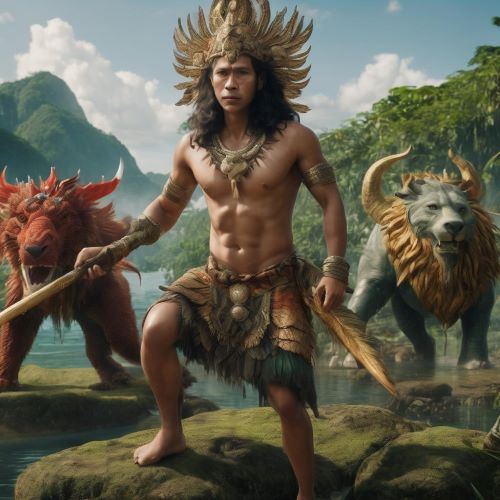
When Geser awakens to his true nature, his physical presence changes dramatically. He becomes Abai Geser Bogdo Khan, radiant and commanding. He rides a powerful horse suited for cosmic battle and carries weapons granted by the Tengris. His armor and sword are not decorative. They represent heavenly authority manifesting in human form. Unlike other heroic traditions that describe detailed facial features or stature, the Buryat narrative focuses on symbolic power. Geser’s body embodies celestial energy. His appearance becomes a visual declaration that heaven has intervened.
Family
The Buryat Geser Khan is deeply embedded within a sky-centered cosmology. He is the son of Khormusta Tengri, the ruler of the fifty-five western Tengris who inhabit the upper world. This lineage establishes Geser not as a mere mortal hero but as a divine emissary. The epic describes a structured heavenly order divided between benevolent western deities and hostile eastern forces. Geser’s descent to Earth is a deliberate act within this cosmic hierarchy. He is not born accidentally. He is dispatched with purpose.
In Buryat narratives, family ties reinforce celestial support. Some versions describe brothers or heavenly allies aiding him in battles against powerful demons such as Gal Dulme or other monstrous manifestations of Atai Ulaan’s remains. Marriage alliances also appear in certain branches of the epic, symbolizing integration with earthly society. However, in the Buryat version, family is primarily cosmic rather than domestic. Geser’s identity is defined by his relationship to the sky.
Other names
Within Buryat tradition, Geser carries titles that reflect reverence and transformation. He is often called Abai Geser Khubun or Abai Geser Bogdo Khan after revealing his divine nature. During his troubled youth, he bears names associated with disgrace or ridicule, reinforcing the motif of hidden greatness.
These names serve narrative functions. They track his journey from obscurity to revelation. While Tibetan and Mongolian versions expand his royal identity, the Buryat epic retains a stronger emphasis on his heavenly mission. In Siberian storytelling, he remains fundamentally a sky warrior rather than a political monarch.
Powers and Abilities
The Buryat Geser Khan is defined by combat against cosmic disorder. His enemies are not ordinary rivals. They are physical embodiments of celestial corruption. He slays monstrous beings that originated from the shattered body of Atai Ulaan. These include giant predators, fire demons, flood spirits, and multi-headed adversaries. Each battle symbolizes the restoration of balance between sky and Earth.
Geser demonstrates superhuman strength from an early age. As he matures, he receives divine weapons, enchanted armor, and a celestial mount. His power extends beyond brute force. He can traverse realms, withstand magical transformations, and recover from enchantments through heavenly intervention.
Shamanic elements permeate his abilities. He interacts with spirits, channels sky power, and operates within a three-tiered cosmos of upper world, middle world, and underworld. Unlike purely martial heroes, Geser functions as a cosmic mediator. His victories are not personal triumphs. They are acts of universal correction.
Modern Day Influence
Among the Buryat people of Siberia, Geser Khan remains the most celebrated epic hero. Oral bards have preserved the narrative for centuries, transmitting it across generations. Written versions such as the Ekhirit-Bulagat variant were recorded in the early twentieth century, ensuring its survival during periods of political upheaval.
In 1995, the ethnographic park “Land of Geser” opened in Buryatia to commemorate the long-standing epic tradition. During the Soviet era, the story also functioned as a cultural anchor, reinforcing Buryat identity amid ideological pressures. Today, scholars analyze the Buryat Geser epic for its Tengrist cosmology, shamanic symbolism, and linguistic richness. Artists, sculptors, and cultural institutions continue to reinterpret Geser as a symbol of resilience and spiritual heritage. For the Buryats, Geser Khan is not distant mythology. He is ancestral memory personified.
Related Images


Source
Bazarsad, J., & Chimeddorzh, R. (2021). The epic of Geser: Local features of Buryat versions reviewed. Kigiran. https://kigiran.elpub.ru/jour/article/view/3285?locale=en_US
Epic of King Gesar. (2024). In Wikipedia. https://en.wikipedia.org/wiki/Epic_of_King_Gesar
Imegenov, M. (2008). Abai Geser: The first branch. Buryat Mongol. https://buryatmongol.org/abai-geser-the-first-branch/
Potanin, G. N. (1883). The Mongolian legend about Geser Khan. https://e-history.kz/en/news/show/33834
Quijada, J. (2013). The Buryat epopee of Geser: General characteristics. Abai Geser Blog. https://abaigeser.blogspot.com/2013/06/the-buryat-epopee-of-geser-general.html
Zhamtsarano, Ts. (1930-1931). The Ekhirit-Bulagat version of the Buryat epic “Geser”
Frequently Asked Questions
Who is Geser Khan in Buryat mythology?
Geser Khan is a divine warrior sent by the sky god Khormusta Tengri to defeat demons and restore balance to the world.
Is the Buryat Geser different from the Tibetan Gesar?
Yes. The Buryat version emphasizes Tengrist sky cosmology and shamanic elements, while Tibetan versions integrate Buddhist symbolism.
What are the Tengris in the Geser epic?
The Tengris are sky gods in Mongolian and Buryat belief systems. Geser is the son of one of the highest Tengris.
Why was Geser sent to Earth?
He was dispatched after cosmic conflict created demons that threatened humanity’s survival.
Is the Buryat Geser epic still performed?
Yes. Oral storytelling traditions continue in Buryatia, and written variants preserve the epic for modern study.

rome
This is the myth of Geser Khan, a legend of Central Asia encompassing Mongolia, Kazakhstan, Kyrgyzstan, Uzbekistan, Turkmenistan, and Türkiye. The Buryat people are of Mongolic descent, as they are the descendants of the soldiers stationed during the conquest of Russia and Siberia by the Great Mongol Empire—the world’s strongest empire that conquered the world. Therefore, in Mongolian mythology, Geser Khan is the god of the world’s strongest soldier-emperor, the god of war, the god of world conquest, and the deity of war horses, war dogs, and the steel sword.”