


Fenghuang : The Chinese Celestial Bird of Harmony
At a glance
| Description | |
|---|---|
| Origin | Chinese Mythology |
| Classification | Animals |
| Family Members | N/A |
| Region | China |
| Associated With | Rebirth, Renewal, Harmony |
Mythlok Perspective
In Mythlok’s Perspective, the Fenghuang represents a different kind of mythological power—one expressed through harmony rather than conquest. Its connection with virtue, righteous leadership and prosperity makes it comparable to the Garuda of Hindu tradition, another magnificent sacred bird associated with divine authority. Yet where Garuda embodies strength and freedom, the Fenghuang reflects balance, grace and social harmony, making it a particularly elegant symbol of an ideal world shaped by moral order.
Fenghuang
Introduction
The Fenghuang is one of the most revered mythological birds in Chinese tradition, associated with virtue, harmony, prosperity and benevolent rule. Often translated into English as the “Chinese Phoenix,” the Fenghuang occupies a distinctive place in Chinese mythology as an auspicious creature whose appearance signifies a harmonious and well-ordered world.
The Fenghuang is traditionally associated with periods of peace and the reign of virtuous rulers. Its presence was regarded as an extraordinary omen, suggesting that the natural and human worlds were in balance. Because of this association, the bird became closely connected with ideals of good governance, moral excellence and prosperity.
The name Fenghuang brings together two terms, feng and huang, which were historically associated with male and female phoenix-like birds. Over time, these complementary figures became understood as a unified mythological creature. This development contributed to the Fenghuang’s association with harmony between complementary forces and later with feminine authority.
The Fenghuang eventually became particularly important in imperial culture. Alongside the dragon, it formed one of the most recognisable symbolic pairings in Chinese art. The dragon was associated with the emperor, while the Fenghuang became closely associated with the empress. Together, they expressed balance, partnership and harmonious authority.
Although the origins of phoenix-like imagery in China are extremely ancient, surviving classical descriptions provide the clearest foundation for understanding the Fenghuang. Texts such as the Shan Hai Jing preserve traditions concerning its appearance, virtues and auspicious significance, while later literature and art expanded its symbolism across Chinese history.
Physical Traits
The Fenghuang is described in classical Chinese tradition as a remarkable composite bird, combining characteristics associated with several animals. Different texts and artistic periods provide varying descriptions, giving the creature an appearance that developed considerably over time.
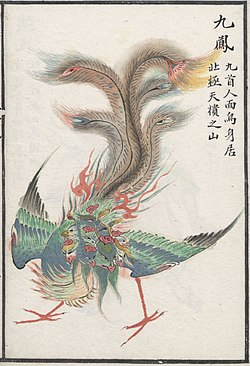
Classical descriptions associate different parts of the Fenghuang with animals including the rooster, swallow, goose, tortoise and stag. Later artistic traditions gave greater prominence to elegant birds such as the pheasant and peacock, particularly in representations of the bird’s elaborate crest and magnificent tail.
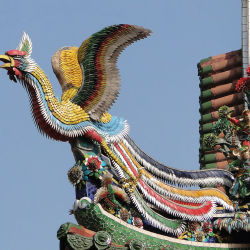
Its plumage is traditionally associated with five colours, reflecting the importance of the Five Phases in Chinese cosmology. These colours are commonly represented as red, yellow, blue or green, white and black. Their presence gives the Fenghuang a complete and harmonious appearance and connects the bird with the ordering principles of the natural world.
The body of the Fenghuang also carries moral symbolism. Classical traditions associate different parts of the bird with qualities including virtue, righteousness, propriety, benevolence and trustworthiness. Its physical beauty therefore reflects an ethical ideal, presenting the creature as a living embodiment of qualities valued in an ordered society.
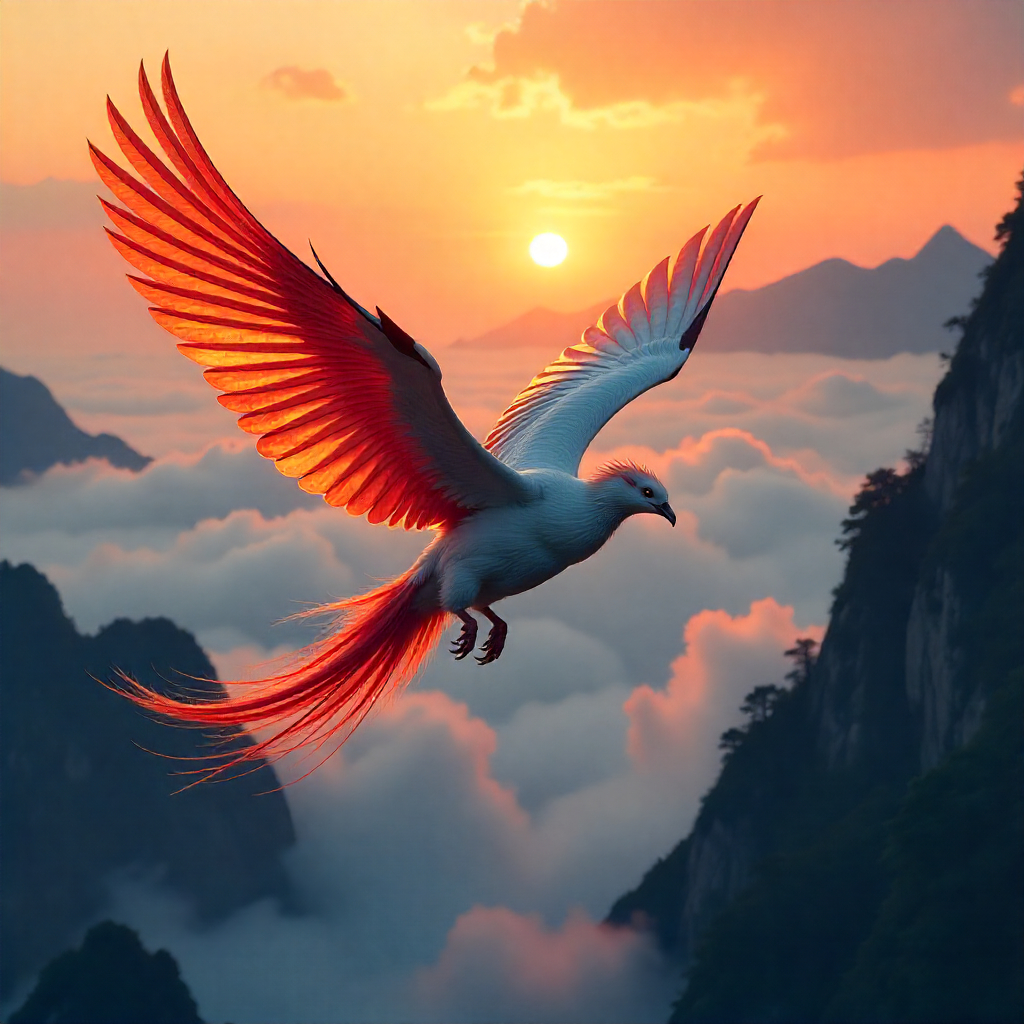
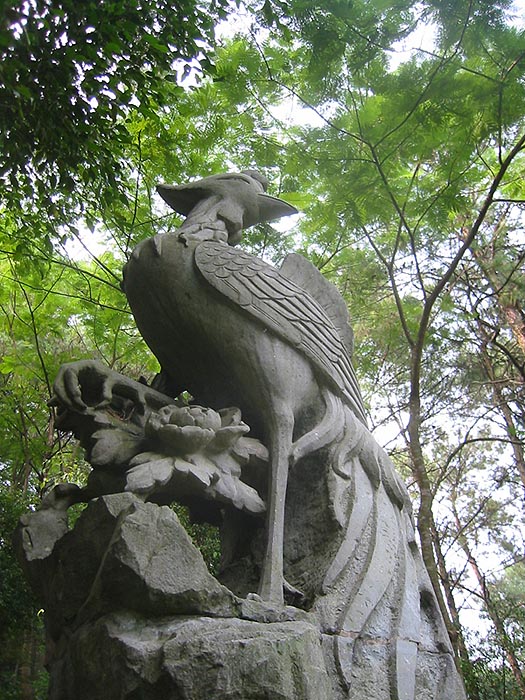
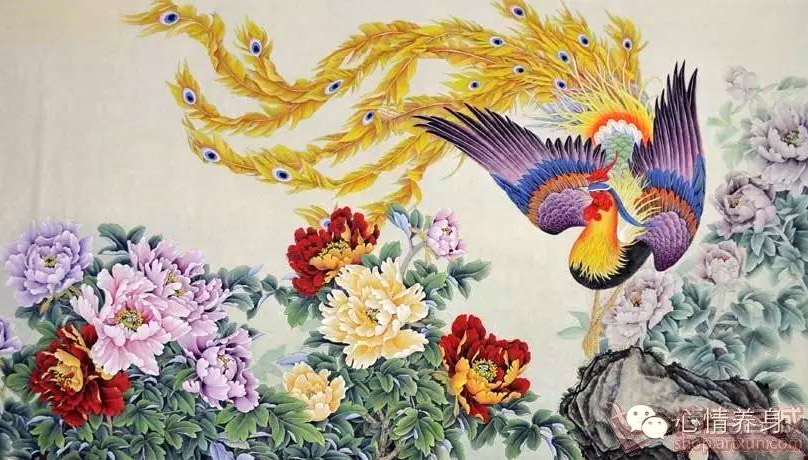
The Fenghuang is usually portrayed with an elegant body, an elaborate head crest, expansive wings and long ornamental tail feathers. Its posture tends to convey dignity and serenity. In Chinese art, it may appear among clouds, flowers, mountains or other auspicious natural surroundings, reinforcing its connection with prosperity and celestial harmony. Its elaborate appearance is central to its identity. Every element contributes to the impression of a creature that brings together different aspects of the natural world into a single harmonious form.
Family
The earliest traditions surrounding the Fenghuang include the complementary figures of Feng and Huang. Feng was associated with the male bird and Huang with the female, creating a symbolic pairing that represented complementarity and harmony. As Chinese mythology and symbolism developed, the two names became combined into Fenghuang, referring to the unified mythological bird. The idea of two complementary beings becoming represented through a single name contributed to the creature’s enduring association with balance and harmonious relationships.
The Fenghuang’s most important symbolic relationship is with the Chinese dragon. Their pairing became particularly prominent in imperial culture, where the dragon represented the emperor and the Fenghuang represented the empress. This association transformed the two creatures into powerful symbols of complementary authority.
The dragon and Fenghuang also became associated with marriage and marital harmony. Their paired imagery appears extensively in Chinese decorative traditions, particularly in wedding objects, clothing, jewellery and ceremonial art. The combination expresses the idea that harmony emerges when complementary forces exist together in balance.
The feminine associations of the Fenghuang became especially strong through its connection with the empress. Over time, the bird came to represent qualities such as grace, dignity, compassion and moral authority, creating a symbolic counterpart to the dragon’s imperial strength.
Other Names
Fenghuang (鳳凰) is the traditional Chinese name of the mythological bird. The name combines the characters feng and huang, reflecting the older distinction between male and female phoenix-like birds. The creature is commonly called the Chinese Phoenix in English-language writing. This translation has helped introduce the Fenghuang to audiences outside China and is now widely recognised.
Another traditional description is King of Birds, reflecting the Fenghuang’s exceptional status among birds in Chinese mythology. Its position represents moral and symbolic authority rather than simply physical dominance. The Fenghuang also has related traditions across East Asia. In Japanese mythology and culture it is known as Hō-ō, while Korean tradition uses Bonghwang and Vietnamese tradition has phượng hoàng. These forms developed through centuries of cultural exchange and adapted the phoenix tradition to their respective societies.
The Fenghuang and the Vermilion Bird (Zhuque) belong to different symbolic traditions within Chinese mythology. The Zhuque is one of the Four Symbols associated with the southern direction and summer, while the Fenghuang is primarily connected with virtue, harmony and auspicious rule.
Powers and Abilities
The Fenghuang’s supernatural power is expressed through its auspicious presence and connection with cosmic harmony. Its appearance traditionally signifies an era of peace, prosperity and virtuous government. The bird therefore functions as an extraordinary omen whose arrival reflects the moral condition of the world around it.
One of its defining qualities is its embodiment of virtue. Classical descriptions connect the Fenghuang with moral principles such as benevolence, righteousness, propriety, wisdom and trustworthiness. These qualities make the bird an ideal representation of righteous leadership and social harmony.
The Fenghuang is also associated with peace and prosperity. Its appearance indicates that society has reached a state of stability in which people, nature and government exist in proper relationship. For this reason, the bird became particularly important in traditions surrounding exemplary rulers.
Music is another important aspect of the Fenghuang’s supernatural character. Classical traditions associate the bird with beautiful sounds, song and dance. Its presence contributes to an atmosphere of harmony, linking its voice with the ordered rhythms of nature and the ideal of peaceful existence.
The Fenghuang’s symbolic authority extends across the natural and moral worlds. Its extraordinary form brings together characteristics of different creatures, while its five-coloured appearance connects it with the cosmological structure of the universe. Through these qualities, the Fenghuang represents an ideal state of existence in which virtue produces harmony and harmony produces prosperity.
Modern Day Influences
The Fenghuang remains a powerful cultural symbol in contemporary Chinese society. Its distinctive image continues to appear in painting, embroidery, ceramics, jewellery, architecture and decorative arts, where it represents beauty, prosperity, dignity and auspiciousness. Its relationship with the dragon remains particularly important. Dragon-and-Fenghuang designs are widely recognised as symbols of partnership and marital harmony and continue to appear in wedding decorations, garments, jewellery and ceremonial objects.
The bird is also prominent in traditional Chinese craftsmanship. Elaborate Fenghuang motifs can be found in textiles and decorative objects, where artists use its sweeping tail feathers and colourful plumage to create intricate patterns. Its visual elegance has made it one of the most enduring subjects in Chinese decorative art. Modern literature, cinema, television, animation and video games have further expanded the Fenghuang’s reach. Contemporary storytellers frequently reinterpret its traditional associations with virtue, celestial power and transformation, adapting the creature for new audiences while retaining its recognisable form.
The Fenghuang has also become an important symbol internationally. Its striking appearance and association with harmony have made it a familiar figure in fantasy art, popular culture and modern interpretations of Chinese mythology. The name is additionally associated with Fenghuang County in Hunan Province, a historic settlement known for its preserved architecture and cultural heritage. While the town and mythological bird represent separate subjects, the shared name has contributed to the global familiarity of the word Fenghuang.
Across centuries of Chinese culture, the Fenghuang has remained a symbol of an ideal world shaped by virtue, balance, peace and prosperity. Its enduring appeal comes from more than its extraordinary appearance: the bird represents the belief that when moral order and cosmic harmony are achieved, prosperity naturally follows.
Related Images


Source
Britannica. (2025). Fenghuang | Phoenix, Bird-Woman & Immortality. Retrieved October 2, 2025, from https://www.britannica.com/topic/fenghuang
Wikipedia. (2003). Fenghuang. Retrieved from https://en.wikipedia.org/wiki/Fenghuang
Study.com. (2020). The Phoenix vs. Fenghuang Bird | Mythology & Meaning. Retrieved October 21, 2020, from https://study.com/learn/lesson/fenghuang-vs-phoenix-meaning-in-chinese-m
MythologyCrafts. (2022). The History of Fenghuang and DIY Chinese Phoenix. Retrieved January 30, 2022, from https://mythologycrafts.com/the-history-of-fenghuang/
Life as Myth. (2006). The Chinese Phoenix. Retrieved December 31, 2006, from https://lifeasmyth.com/chinesephoenix
IJLLL. (n.d.). Fenghuang and Phoenix: Translation of Culture. International Journal of Law, Language & Literature, 11(3). Retrieved from https://ijlll.org/fenghuang-and-phoenix-translation
Yang, L. (2005). Handbook of Chinese Mythology. Oxford University Press.
Birrell, A. (1993). Chinese Mythology: An Introduction. Johns Hopkins University Press.
Wu, K. C. (1982). The Chinese Heritage. Crown Publishers.
Eberhard, W. (1986). A Dictionary of Chinese Symbols: Hidden Symbols in Chinese Life and Thought. Routledge.
Schafer, E. H. (1963). The Golden Peaches of Samarkand: A Study of T’ang Exotics. University of California Press.
Frequently Asked Questions
What is the Fenghuang in Chinese mythology?
The Fenghuang is a mythological bird symbolizing virtue, balance, and auspicious rule, often associated with the empress and cosmic harmony.
How is the Fenghuang different from the Western phoenix?
Unlike the phoenix, which symbolizes rebirth through fire, the Fenghuang represents peace, moral purity, and the balance of yin and yang.
What does the Fenghuang look like?
It is described as a composite bird with features of several animals and feathers in five sacred colors representing Confucian virtues.
What powers does the Fenghuang have?
The Fenghuang is believed to bring prosperity, dispel evil, and appear only under righteous and prosperous rule.
Is the Fenghuang still important today?
Yes, it remains a major cultural symbol in art, fashion, architecture, weddings, and modern media across East Asia.


