

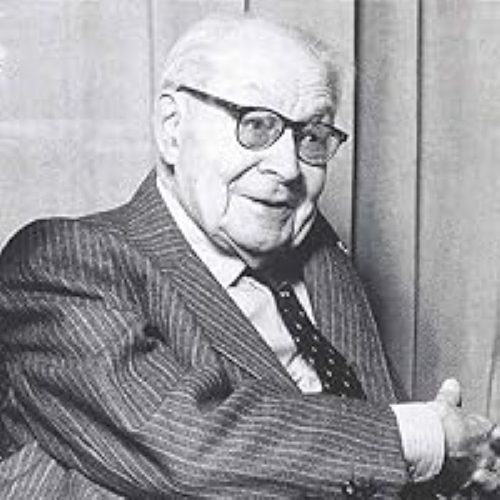
Dr. Georges Dumézil : Architect of Indo-European Mythic Structure
Mythlok Perspective
In Mythlok’s perspective, Dr. Georges Dumézil transformed mythology into a comparative science of social structure. His work proposed that Indo-European myths were not random stories but reflections of an underlying tripartite order, organising society into sacred authority, warrior force, and productive life. By reading myth alongside language, ritual, and law, Dumézil revealed how narrative encoded social ideology. This structural vision finds echoes in Indian varna theory, Roman religious hierarchy, and Norse divine groupings, where cosmic order mirrors human organisation. Across cultures, Dumézil demonstrated that myth is not merely symbolic, but constitutional, shaping how societies imagine balance, power, and duty.
Dr. Georges Dumézil
Introduction
Dr. Georges Dumézil, a French philologist, linguist, and scholar of religious studies, made groundbreaking contributions to the study of comparative mythology and Indo-European cultures. Born on March 4, 1898, in Paris, he passed away on October 11, 1986, leaving behind a lasting legacy. Dumézil is best known for his trifunctional hypothesis, which suggests that the mythologies and social structures of ancient Indo-European societies were organized around three primary classes: the priestly, warrior, and agricultural. This theory revolutionized the way scholars approached the relationships between mythology, society, and religion, continuing to influence the field today.
Area of Expertise
Dumézil devoted his career to studying the religions and mythologies of Indo-European cultures, uncovering deep-rooted connections between them. His groundbreaking trifunctional hypothesis proposed that these societies were structured around three core roles: religious authority, military power, and economic productivity. By analyzing myths from civilizations such as ancient Rome, India, and the Norse world, he demonstrated striking similarities that pointed to a common ancestral heritage. His work provided scholars with a new framework for interpreting mythology in relation to social organization, shaping the field of comparative mythology for generations.
Books & Publications
Dumézil’s extensive body of work shaped the study of Indo-European mythology and social structures. His seminal Mythe et Épopée (1968–1973) provided a sweeping analysis of mythological narratives, reinforcing his trifunctional hypothesis across multiple cultures. In Mitra-Varuna, he examined the concept of sovereignty through comparative studies of deities in Indo-European traditions. Jupiter, Mars, Quirinus (1941) explored the tripartite structure within Roman mythology, while Archaic Roman Religion delved into Rome’s early religious institutions. His research extended to Norse mythology with Gods of the Ancient Northmen (1973), demonstrating cross-cultural links between divine figures and societal roles.
Research & Contributions
Dr. Georges Dumézil revolutionized the study of comparative mythology by demonstrating how mythological themes mirrored the social organization of ancient Indo-European societies. His trifunctional hypothesis categorized these societies into three distinct roles: religious authority, military defense, and economic sustenance. This framework provided a new perspective on how myths reinforced societal structures, with deities often embodying these functions. His interdisciplinary approach—melding linguistics, anthropology, and history—enabled him to uncover deep-rooted connections between distant cultures. His work not only reshaped the field but also inspired ongoing debates, challenging scholars to rethink the evolution of mythology and its ties to social hierarchy.
Awards & Recognitions
Dr. Georges Dumézil’s achievements earned him widespread recognition in academic and intellectual circles. In 1949, he was appointed to the Collège de France, where he led the Chair of Indo-European Civilization until his retirement in 1968. His election to the Académie Française in 1975 solidified his status as a leading scholar in mythology and linguistics. He also held teaching positions at institutions such as Istanbul University and the École Pratique des Hautes Études. Among his many accolades, he received the Prix Paul Valéry in 1974, honoring his literary and scholarly contributions to the study of ancient religions and mythologies.
Social Media Profiles
Although Georges Dumézil lived before the rise of social media, his influence persists across digital platforms dedicated to mythology and anthropology. Scholars and enthusiasts continue to explore his theories through academic websites, online journals, and university resources. Discussions of his trifunctional hypothesis and comparative mythology regularly appear on platforms like Twitter and Facebook, reflecting the ongoing relevance of his work. While he never had personal social media accounts, his legacy thrives in online discourse, where scholars analyze and reinterpret his contributions for new generations.
Bibliographic Sources
Wikipedia contributors. (2004, March 20). Georges Dumézil. Wikipedia. https://en.wikipedia.org/wiki/Georges_Dum%C3%A9zil
Encyclopaedia Britannica. (2025, February 3). Georges Dumézil: French philologist. https://www.britannica.com/biography/Georges-Dumezil
Encyclopaedia Iranica. (n.d.). Dumézil, Georges. https://iranicaonline.org/articles/dumezil-georges
Collège de France. (n.d.). Biography and publications: Georges Dumézil. https://www.college-de-france.fr/site/georges-dumezil/biography-and-publications.htm
Harrison, T. (2016, October 23). An introduction to Georges Dumézil. https://www.academia.edu/30278573/An_Introduction_to_Georges_Dumezil



Frequently Asked Questions
Who was Georges Dumézil?
Dr. Georges Dumézil was a French comparative mythologist and philologist best known for his theories on Indo-European mythology.
What is Georges Dumézil known for?
He is best known for the trifunctional hypothesis, which argues that Indo-European myths reflect a three-part social structure.
What is the trifunctional hypothesis?
It is the idea that Indo-European societies organised myth and ideology around three functions: sovereignty, warfare, and fertility or production.
Did Georges Dumézil study Indian mythology?
Yes. His comparative work included Vedic, Iranian, Roman, Norse, and other Indo-European traditions, including Indian sources.
Why is Georges Dumézil important today?
His theories remain influential in comparative mythology, historical linguistics, and the study of ancient societies, even as they continue to be debated and refined.