


Empusa : The Donkey Footed Spirit of Greek Mythology
At a glance
| Description | |
|---|---|
| Origin | Greek Mythology |
| Classification | Spirits |
| Family Members | N/A |
| Region | Greece |
| Associated With | Shape shifting, Deception, Fear, Night, Seduction |
The Mythlok Perspective
In Mythlok’s Perspective, Empusa is more intriguing as a creature of uncertainty than as an ancient Greek version of a vampire. Compared with Lamia, who became more directly associated with the predation of children and young men, Empusa is defined more strongly by transformation, deception, and her connection to Hecate. Her strange bronze and donkey-like legs make her unlike the elegant monsters of later folklore, reminding us that Greek supernatural beings were often deliberately bizarre rather than conventionally beautiful or terrifying.
Empusa
Introduction
Empusa, also spelled Empousa, is a strange and frightening supernatural figure from Greek mythology. Unlike the Olympian gods, Empusa belongs to the world of ghosts, spirits, monsters, and other beings that existed at the edges of the human world. Ancient sources portray her as a shape-shifting apparition associated with Hecate, the goddess whose domains included night, magic, crossroads, and the realm of the dead. The surviving traditions do not present one completely consistent version of Empusa, which makes her more interesting than a straightforward monster with a fixed biography.
Her earliest literary appearances are particularly important for understanding the original character. In Aristophanes’ Frogs, written in the fifth century BCE, Empusa appears as a terrifying supernatural presence capable of changing form. The encounter is deliberately comic as well as frightening, reflecting the ancient Greek tradition of the bogey or frightening supernatural figure used to unsettle audiences. Later lexicographical traditions describe Empusa as a daemonic ghost associated with Hecate and note that she could assume different forms.
Empusa therefore should not simply be described as a Greek vampire. The familiar image of a beautiful supernatural woman who seduces young men and consumes their blood and flesh developed through later literary traditions and through her association with related figures such as Lamia. Philostratus’ Life of Apollonius of Tyana, written centuries after Aristophanes, describes an empousa in a story about a supernatural woman who disguises herself as a beautiful bride and intends to consume the young man she has ensnared. This later tradition helped connect Empusa with the broader literary archetype of the seductive female monster.
Physical Traits
Empusa’s appearance is deliberately unnatural. One of her most distinctive features is her mismatched legs. Ancient traditions describe one leg as metallic, generally identified as bronze or brass, while the other is associated with a donkey. Some ancient explanations are even stranger, describing the second leg in terms connected with donkey or cow dung. This bizarre combination is one reason Empusa stands apart from more familiar Greek monsters.
The name Empusa itself became associated in later explanations with unusual movement, including the idea that the creature moved on one leg. Other descriptions connect her with the epithet Onokole or Onoskelis, terms referring to a donkey-like or donkey-footed feature. These names reinforce the importance of her strange legs within the tradition.
Her appearance was not limited to one fixed body, however. Shape-shifting is fundamental to Empusa’s identity. Aristophanes presents her as changing between different forms, including animal and human shapes. Ancient descriptions associate her with forms resembling a large beast, a child, a mule, a woman, and a dog, while her face could appear fiery or terrifying.
This variability matters because Empusa was not necessarily imagined as having one permanent monstrous appearance. Her ability to become different creatures was itself part of what made her frightening. A traveler could encounter something apparently ordinary only to discover that it was a supernatural being.
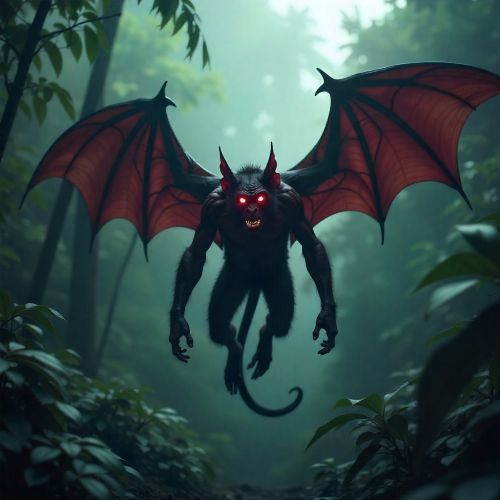
Modern depictions often add features such as fangs, wings, glowing eyes, corpse-like skin, or dramatic fiery effects. These elements can work well in contemporary fantasy, but they should be distinguished from the ancient evidence. The strongest classical descriptions emphasize transformation, mismatched legs, supernatural appearance, and fear rather than the standardized vampire appearance common in modern media.
Family
Onoskelis, terms referring to a donkey-like or donkey-footed feature. These names reinforce the importance of her strange legs within the tradition.
Her appearance was not limited to one fixed body, however. Shape-shifting is fundamental to Empusa’s identity. Aristophanes presents her as changing between different forms, including animal and human shapes. Ancient descriptions associate her with forms resembling a large beast, a child, a mule, a woman, and a dog, while her face could appear fiery or terrifying.
This variability matters because Empusa was not necessarily imagined as having one permanent monstrous appearance. Her ability to become different creatures was itself part of what made her frightening. A traveler could encounter something apparently ordinary only to discover that it was a supernatural being.
Modern depictions often add features such as fangs, wings, glowing eyes, corpse-like skin, or dramatic fiery effects. These elements can work well in contemporary fantasy, but they should be distinguished from the ancient evidence. The strongest classical descriptions emphasize transformation, mismatched legs, supernatural appearance, and fear rather than the standardized vampire appearance common in modern media.
Family
Empusa does not possess a clearly established family tree comparable to the Olympian gods. Her most consistent supernatural relationship is with Hecate. Ancient and later sources connect Empusa with Hecate’s sphere and describe her as a being associated with the goddess’s retinue.
This relationship is significant because Hecate herself occupies a liminal position within Greek religious tradition. She is associated with crossroads, night, magic, ghosts, and the boundaries between different realms. A supernatural creature such as Empusa naturally belongs within this environment. Rather than functioning as an independent goddess with her own cult and genealogy, Empusa is better understood as a supernatural being operating within a broader network of chthonic and nocturnal imagery.
Some later sources and modern retellings describe Empusa as a daughter of Hecate, sometimes giving Mormo as her other parent. This genealogy is frequently repeated online, but it should not be presented as a firmly established feature of ancient Greek mythology. The surviving classical evidence does not provide a universally accepted parentage for Empusa.
Empusa is also sometimes grouped with Lamia, Mormo, and other frightening female supernatural figures. Such comparisons are useful because these beings share themes of fear, transformation, sexuality, predation, and the dangers faced by children or travelers. However, they are not simply different names for one creature. Ancient traditions gave each figure distinct characteristics, and their identities became increasingly blurred in later literature.
Other names
The most common alternative spelling is Empousa, which more closely reflects the transliteration of the ancient Greek name Ἔμπουσα. Both Empusa and Empousa are widely used in modern scholarship and mythology writing. Empusa is also associated with names such as Onokole and Onoskelis, which refer to her unusual donkey-like leg. These names reflect ancient attempts to explain or characterize the creature through her most memorable physical feature.
Ancient and later sources also connect Empusa with the broader category of supernatural female bogeys. Terms associated with ghosts, phantoms, and daemons are particularly relevant because Empusa does not fit neatly into the modern category of a monster. She occupies an intermediate space between spirit, apparition, demon-like being, and shape-shifting creature.
Her association with Lamia and Mormo is especially important in later interpretations. Philostratus’ account of the supernatural seductress in Corinth uses empousa for a type of supernatural being while also explaining that ordinary people might call such creatures lamiai or similar names. This illustrates why later writers sometimes treated these figures as closely related even though their earlier traditions were distinct.
Powers and Abilities
Shape-shifting is Empusa’s defining supernatural ability. She can assume different forms, allowing her to frighten, confuse, or approach humans without immediately revealing her identity. In Aristophanes, her changing appearance is central to the encounter, demonstrating that the creature cannot be understood simply by observing her outward form.
Empusa’s ability to appear as an attractive woman becomes particularly important in later traditions. In Philostratus’ Life of Apollonius of Tyana, a supernatural woman attempts to lure the young Menippus by presenting herself as beautiful, wealthy, and romantically interested in him. The apparent luxury surrounding her is revealed to be an illusion, and the supernatural being ultimately confesses that she intends to consume him.
This later story is one of the main reasons Empusa is associated with vampiric behavior today. The creature feeds on young human bodies and their blood, creating a striking parallel with later European vampire traditions. However, it is more accurate to describe this as a later literary development of the Empusa tradition than to claim that ancient Greek Empusa was simply a vampire in the modern sense.
Fear and deception are therefore as important to Empusa as physical violence. Her transformations make it difficult for humans to recognize her, while her association with darkness and supernatural spaces reinforces the danger of encountering her outside ordinary society.
Ancient tradition also preserves a surprisingly unusual weakness. In Philostratus’ account of an empousa encountered during travel, Apollonius advises his companions to insult the apparition. They do so, and the creature flees while shrieking. This episode reflects the strange logic of ancient supernatural folklore, where ridicule, recognition, or refusal to fear a spirit could sometimes break its power.
Modern Day Influence
Empusa’s modern reputation is strongly shaped by the later evolution of the female supernatural predator. Her combination of beauty, deception, transformation, and consumption makes her particularly relevant to the history of vampire and demon imagery. Modern writers frequently describe her as an ancient Greek precursor to the female vampire, although this interpretation combines several different strands of Greek and later Greco-Roman tradition.
Her influence can also be seen in literary treatments of supernatural women. Writers working with classical mythology have repeatedly returned to figures such as Empusa, Lamia, and related female spirits to explore themes of desire, danger, death, and illusion. The ancient idea of a supernatural woman who uses beauty as a disguise became particularly influential in later European literature.
Empusa has also entered modern fantasy and popular culture. Rick Riordan’s Percy Jackson universe features Empousai as supernatural creatures associated with Hecate, drawing heavily on the ancient motifs of shape-shifting, monstrous legs, and predatory behavior. Video games, tabletop role-playing games, fantasy novels, and mythology-inspired fiction similarly use Empusa as a recognizable monster.
Yet the ancient Empusa remains stranger than many of these modern versions. She was not simply a winged vampire or a Greek equivalent of a modern horror character. She was a shape-shifting supernatural apparition whose identity developed across centuries of Greek and Roman storytelling. Her mismatched legs, shifting forms, connection with Hecate, and later association with seductive predation reveal how Greek ideas about ghosts and supernatural danger could evolve into one of the most recognizable female monster archetypes in later mythology-inspired fiction.
Related Images



Source
Aristophanes. (1998). The Frogs (K. J. Dover, Ed.). Oxford University Press.
Gantz, T. (1993). Early Greek myth: A guide to literary and artistic sources. Johns Hopkins University Press.
Grimal, P. (1991). The dictionary of classical mythology (A. R. Maxwell-Hyslop, Trans.). Blackwell.
Ogden, D. (2013). Drakōn: Dragon myth and serpent cult in the Greek and Roman worlds. Oxford University Press.
Smith, W. (Ed.). (1844). A dictionary of Greek and Roman biography and mythology. John Murray. https://www.perseus.tufts.edu/hopper/text?doc=Perseus:text:1999.04.0104
Theoi Project. (n.d.). Lamia & Empusa (Empousa) – Vampiric monsters of Greek myth.
https://www.theoi.com/Phasma/Empousai.html
Wikipedia contributors. (2025). Empusa. In Wikipedia. https://en.wikipedia.org/wiki/Empusa
Timeless Myths. (2024, February 16). Empousa: The story of the first vampire in Greek mythology.
https://timelessmyths.com/stories/empousa-the-story-of-the-first-vampire-in-greek-mythology/
Frequently Asked Questions
Who was Empusa in Greek mythology?
What did Empusa look like in Greek mythology?
Empusa was described with mismatched legs, including a bronze or brass leg and a donkey-related leg, while other traditions emphasize her ability to change into different forms.
Was Empusa a vampire in Greek mythology?
Empusa is often called a Greek vampire today, but this reflects later traditions. Ancient and later sources portray her as a shape-shifting supernatural predator.
Was Empusa the daughter of Hecate?
Some later traditions describe Empusa as connected by birth to Hecate, but ancient sources more securely associate her with Hecate as a supernatural attendant or spirit.
What were Empusa's powers in Greek mythology?
Empusa was associated with shape-shifting, deception and supernatural appearances. Later traditions also describe her using beauty to lure and consume human victims.


