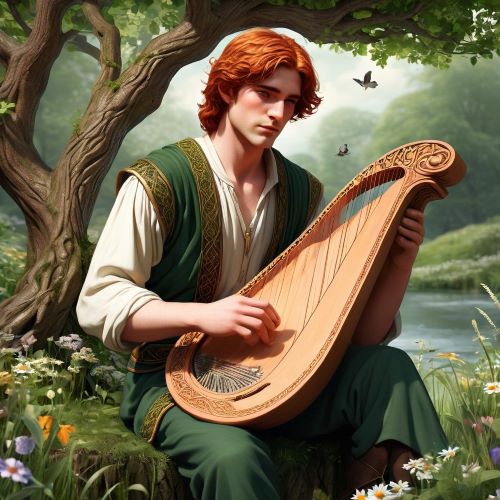


Deirdre : The Irish Tragic Heroine of the Ulster Cycle
Listen
At a glance
| Description | |
|---|---|
| Origin | Irish Mythology |
| Classification | Mortals |
| Family Members | Fedlimid mac Daill (Father), Leabharcham (Foster guardian), Naoise (Lover), Ainnle and Ardan (Brothers-in-law) |
| Region | Ireland |
| Associated With | Tragic love, Prophecy, Beauty, Exile, Loyalty, Fate |
The Mythlok Perspective
From the Mythlok perspective, Deirdre represents the elemental power of choice within a rigid social order. Unlike divine figures who impose fate, she reveals how fate often emerges from fear-driven control. Her story parallels figures such as Helen of Troy in Greek tradition and Sita in Indian epic narratives, women whose bodies become battlegrounds for political and masculine ambition. Yet Deirdre differs in one crucial way. She chooses exile over captivity, sorrow over submission. Across cultures, she stands as an enduring reminder that tragedy is not always caused by destiny itself, but by how societies respond to the fear of it.
Deirdre
Introduction
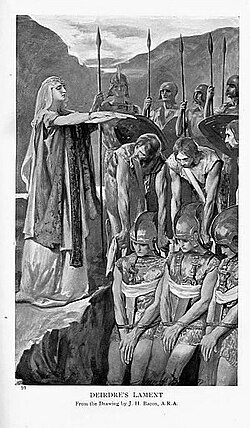
Deirdre stands at the emotional heart of the Ulster Cycle, remembered not for conquest or magic, but for how a single human life can fracture an entire kingdom. Often called Deirdre of the Sorrows, her story is shaped by prophecy, desire, and irreversible choice. Before her birth, the druid Cathbad foretold that her beauty would bring exile, bloodshed, and grief to Ulster. Rather than preventing this fate, the prophecy becomes the force that defines her existence. Raised in isolation and claimed by King Conchobar mac Nessa as a future bride, Deirdre grows into the very catalyst the warning described. Her decision to flee with the warrior-poet Naoise transforms her from a guarded possession into an active agent of her own destiny, even though that choice leads to betrayal, death, and her own tragic end. In Irish tradition, her tale is counted among the “Three Sorrows of Storytelling,” a reminder that the deepest tragedies are often born from human emotion rather than divine wrath.
Physical Traits
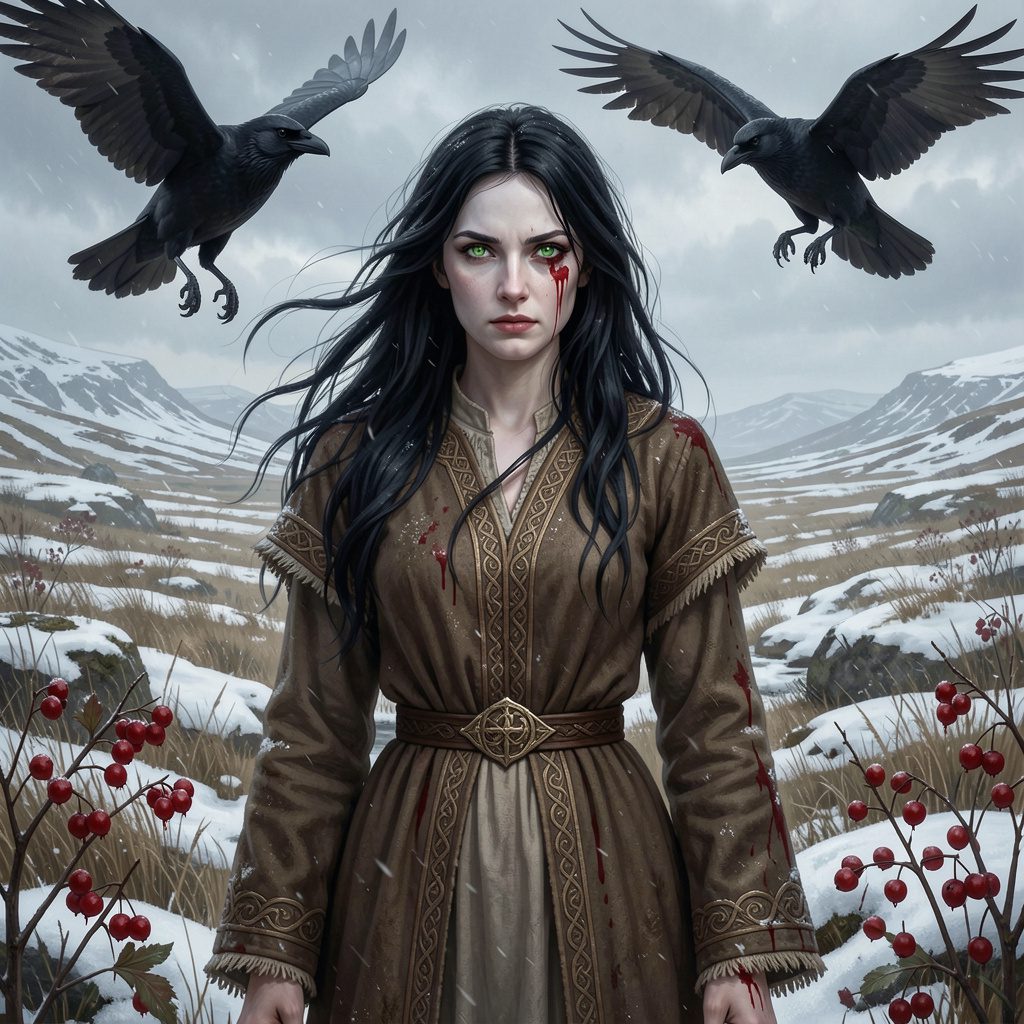
Deirdre’s beauty is not decorative detail but narrative gravity. Ancient sources describe her appearance as extraordinary to the point of inevitability, a beauty capable of unsettling kings and undoing loyalties. One of the most famous moments associated with her appearance occurs when she sees a raven drinking blood on snow. From this image she imagines her ideal lover, a man with hair as black as the raven, skin as white as snow, and cheeks as red as blood. This vision leads her to Naoise, who embodies those very traits. Other traditions describe her with clear green eyes, red lips, and flowing hair, sometimes golden, sometimes dark, depending on the manuscript tradition. Her physical presence becomes symbolic rather than anatomical, representing irresistible desire and the danger of possession. Even when hidden away, her beauty matures rather than fades, reinforcing the sense that fate itself is unfolding through her body.
Family
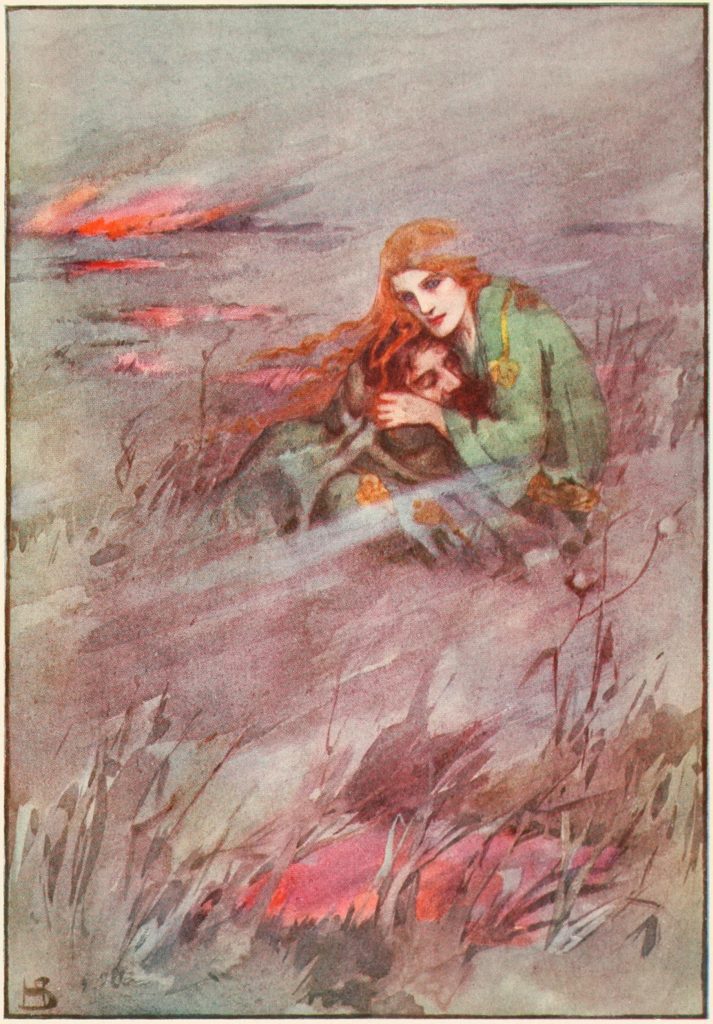
Deirdre was born to Fedlimid mac Daill, a bard and storyteller at the court of King Conchobar. Her mother remains unnamed in surviving sources, a common silence in early Irish narrative where lineage often serves political function rather than domestic detail. After Cathbad’s prophecy, Deirdre is taken from her family and raised in seclusion under the care of Leabharcham, a wise woman and poet who acts as both guardian and quiet rebel. Leabharcham ultimately enables Deirdre’s meeting with Naoise, recognizing that isolation cannot erase destiny. Naoise, son of Uisneach, is not only her lover but her chosen family, and his brothers Ainnle and Ardan share in their exile. Together they flee to Scotland, forming a fragile household defined by loyalty rather than blood. Some later versions mention children born to Deirdre and Naoise, fostered by Manannán mac Lir, but these details sit at the margins of the core tradition.
Other names
Deirdre is most widely known by the epithet Deirdre of the Sorrows, rendered in Irish as Deirdre an Bhróin. This title encapsulates both her personal suffering and the grief her story brings to others. In Old Irish texts, her name appears as Derdriu, especially in medieval manuscripts such as Longes mac n-Uislenn. Over time, anglicised spellings like Deidre or Deidra appear in literary adaptations, but the sorrow-bound epithet remains inseparable from her identity. Unlike heroic epithets that celebrate victory or power, Deirdre’s title frames her as a living lament.
Powers and Abilities
Deirdre possesses no supernatural powers in the conventional sense. She is not a goddess, enchantress, or warrior, and she wields no magic. Her influence lies instead in emotional force and moral weight. In some versions, she places a geis upon Naoise, a binding obligation that compels him to act despite the danger. This act shows her capacity to shape fate through cultural law rather than spellcraft. She is also sometimes credited with prophetic intuition, sensing disaster before it unfolds, such as visions of blood or ominous signs surrounding their return to Ulster. These moments do not elevate her to the supernatural but emphasize her tragic awareness. Deirdre’s power is human, rooted in choice, loyalty, and the refusal to submit quietly to an imposed future.
Modern Day Influence
Deirdre’s story has exerted a remarkable influence on modern literature, theatre, and cultural identity. During the Irish Literary Revival, she emerged as a symbol of resistance against authoritarian control and colonial power. Plays such as J. M. Synge’s Deirdre of the Sorrows and W. B. Yeats’ Deirdre reframed her as a defiant figure whose tragedy exposes the moral rot of kingship built on possession rather than consent. Novelists including James Stephens, Morgan Llywelyn, and Jules Watson retold her story for new generations, often emphasizing her inner voice and emotional agency. Beyond literature, her name has been carried into music, opera, and even modern media, appearing in video games and television adaptations inspired by Celtic legend. Her continued relevance lies in how easily her narrative speaks to themes of autonomy, exile, and the cost of love under power.
Related Images


Source
Wikipedia. (n.d.). Deirdre. https://en.wikipedia.org/wiki/Deirdre
Meyer, K. (Ed. & Trans.). (n.d.). Longes mac n-Uislenn background. University College Cork. https://iso.ucc.ie/Longes-mac/Longes-mac-background.html
Murray, K. (Ed.). (2023). Oidhedh Chloinne hUisneach: Reassessments. Irish Texts Society.
Synge, J. M. (1910). Deirdre of the Sorrows. In The Cambridge companion to J. M. Synge. Cambridge University Press.
Yeats, W. B. (1907). Deirdre. A. H. Bullen.
Russell, G. W. (1902). Deirdre. https://en.wikipedia.org/wiki/Deirdre
Keating, G. (c. 1634). The history of Ireland (Vol. 2, pp. 191-197).
Stokes, W. (Ed. & Trans.). (1890). Irische Texte (Ser. II.2). Longes mac nUislenn.
Frequently Asked Questions
Who was Deirdre in Irish legend?
Deirdre was a mortal woman in the Ulster Cycle whose beauty and tragic fate led to exile, betrayal, and sorrow across Ulster.
Why is Deirdre called Deirdre of the Sorrows?
The epithet reflects the grief she endured and caused, making her story one of the three great sorrows of Irish storytelling.
Did Deirdre have supernatural powers?
No, Deirdre is a mortal figure whose influence comes from emotional strength, prophecy, and cultural bonds rather than magic.
What role does Naoise play in Deirdre’s story?
Naoise is Deirdre’s lover and chosen companion, whose death at Conchobar’s command marks the central tragedy of her tale.
Why is Deirdre still relevant today?
Her story explores timeless themes of autonomy, control, exile, and the human cost of power, making her resonate across cultures and eras.