


Skogtroll : The Mysterious Forest Trolls of Norse Folklore
At a glance
| Description | |
|---|---|
| Origin | Norse Mythology |
| Classification | Hybrids |
| Family Members | N/A |
| Region | Norway, Sweden |
| Associated With | Forests, Protection |
Mythlok Perspective
In Mythlok’s Perspective, the Skogtroll represents the mysterious boundary between human civilisation and the untamed wilderness. Its association with Scandinavian forests invites comparison with the Leshy of Slavic folklore, a woodland spirit known for its connection to forest life and its ability to mislead travellers. While the Leshy embodies the living spirit of the forest, the Skogtroll reflects the broader Scandinavian tradition of imagining trolls within remote and unfamiliar landscapes.
Skogtroll
Introduction
The Skogtroll is a forest-dwelling troll associated with the mysterious woodlands of Scandinavian folklore. In the traditional imagination of Norway and Sweden, forests were places of extraordinary beauty and uncertainty, where familiar paths could disappear beneath thick vegetation and unfamiliar sounds echoed through the trees. Such landscapes became natural settings for stories about supernatural beings, including trolls believed to inhabit places beyond the reach of ordinary human settlements.
Trolls occupy a prominent position in Scandinavian folklore, appearing in tales about encounters between humans and the supernatural. Their characteristics vary across regional traditions, but they are frequently associated with remote landscapes, extraordinary physical forms, and lives separated from human society. The Skogtroll embodies this connection between trolls and the forest, representing the mysterious presence of supernatural life within the wilderness.
The figure also occupies a distinctive place in Scandinavian art and storytelling. Artists have portrayed forest trolls as imposing inhabitants of ancient woodlands, drawing inspiration from traditional tales and the atmospheric landscapes of northern Europe. Through folklore, illustration, and modern fantasy, the Skogtroll continues to represent the enduring fascination with the hidden world of the forest.
Physical Description
The appearance of a Skogtroll reflects the diversity of Scandinavian troll traditions. Trolls are portrayed in different forms, ranging from enormous, monstrous creatures to beings with surprisingly human features. Their appearance depends on the particular story or artistic interpretation, allowing the forest troll to assume forms that reflect the character of its woodland surroundings.
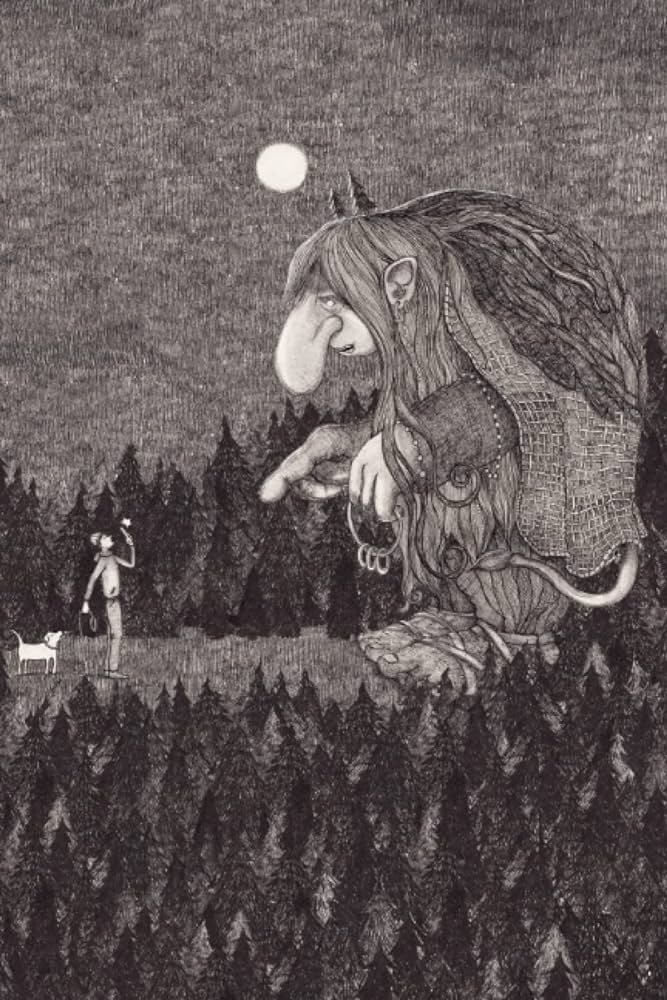
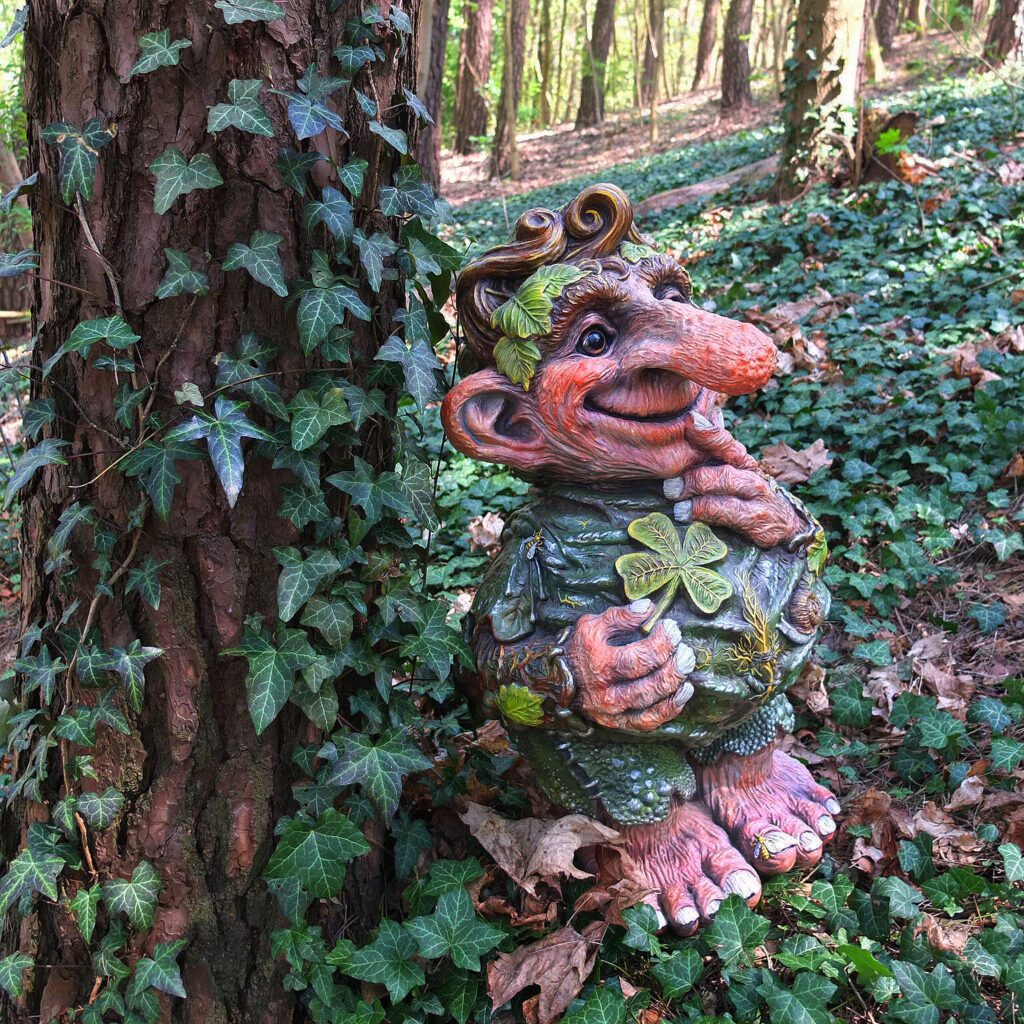
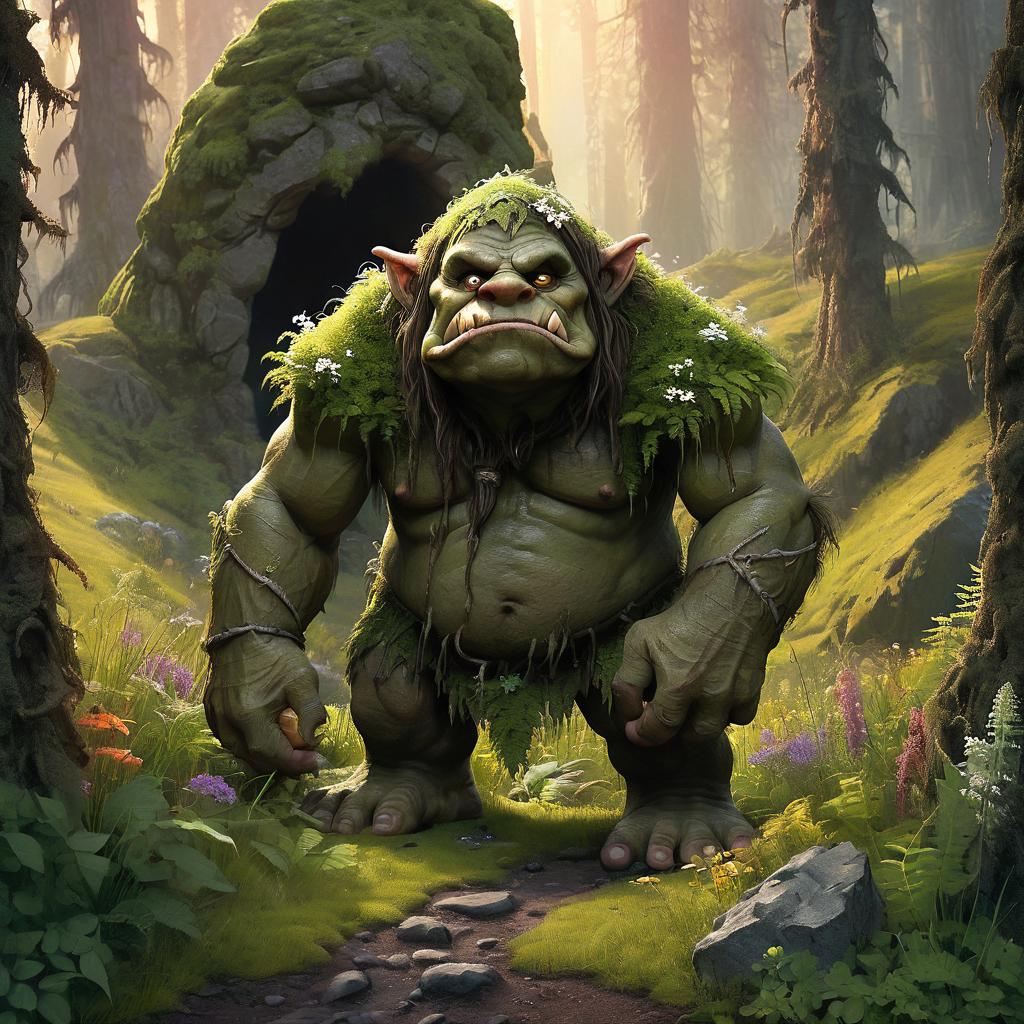
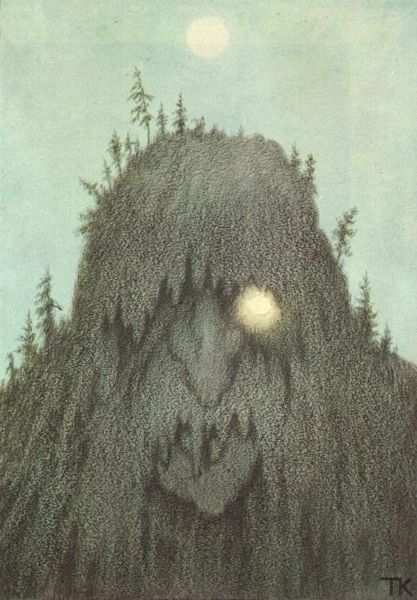
In visual representations, forest trolls are often imagined as large, imposing figures with heavy bodies, rough features, tangled hair, and an earthy appearance. Some modern interpretations incorporate bark-like skin, moss, roots, or other natural elements into their designs, creating a visual connection between the creature and the forest it inhabits. These features are especially effective in art because they blur the boundary between living beings and the surrounding landscape.
The forest itself contributes to the Skogtroll’s identity. Dark trees, rocky clearings, thick undergrowth, and ancient roots provide the setting for its imagined existence. Such surroundings reinforce the impression of a creature that belongs to a world beyond ordinary human experience. The resulting image is both imposing and mysterious. Whether portrayed as a hulking figure emerging from the trees or a strange silhouette concealed within the undergrowth, the Skogtroll captures the sense that the Scandinavian wilderness contains more than meets the eye.
Mythological Context
Trolls appear in medieval Norse literature and the later folklore of Scandinavia, occupying a broad category of supernatural beings whose characteristics differ between traditions. They are associated with extraordinary strength, unusual appearances, remote habitats, and encounters with humans. Their stories frequently take place beyond the boundaries of familiar settlements, where ordinary rules and expectations give way to the supernatural.
The Skogtroll belongs to the wider tradition of forest-associated trolls. Its woodland setting distinguishes it thematically from trolls connected with mountains, caves, and other landscapes. Forests provide a particularly compelling environment for such beings because they combine natural beauty with isolation, uncertainty, and the possibility of encountering something unfamiliar.
In Scandinavian storytelling, the forest often functions as a threshold between the familiar human world and the unknown. Travellers who leave established paths enter environments where their knowledge and assumptions may no longer serve them. Trolls inhabiting these places give supernatural form to the mysteries of the wilderness. The Skogtroll consequently belongs to a rich cultural tradition in which landscapes and supernatural beings are closely connected. Its identity emerges from the wider Scandinavian understanding of trolls and the enduring imaginative power of the forest.
Origins
The origins of Scandinavian troll traditions extend across centuries of oral storytelling, medieval literature, and regional folklore. Stories about supernatural beings developed within communities whose lives were closely connected to forests, mountains, and other natural environments. These landscapes shaped both the settings of traditional tales and the creatures imagined to inhabit them.
The Skogtroll’s association with the forest reflects this relationship between folklore and the natural world. Woodlands provided resources, shelter, and routes between settlements, but they could also be difficult to navigate. Dense vegetation, unfamiliar sounds, and changing weather made remote forests places of uncertainty. Stories about supernatural inhabitants gave imaginative form to these experiences.
Over time, Scandinavian folklore was collected, recorded, and reinterpreted by writers and artists. The nineteenth century witnessed growing interest in traditional stories and national cultural identity, encouraging artists to draw upon folklore for inspiration.
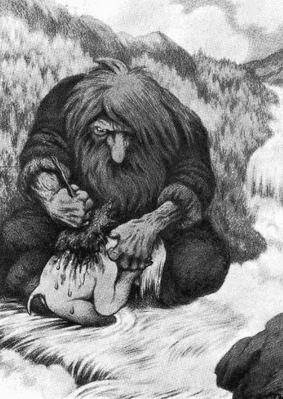
Norwegian artist Theodor Kittelsen became particularly influential in shaping modern images of trolls. His illustrations combined supernatural subjects with recognizably Norwegian landscapes, creating an atmosphere in which the natural world appeared alive with mysterious possibilities. His work helped establish the visual tradition through which many audiences continue to imagine Scandinavian trolls.
The Skogtroll thus belongs to an evolving tradition shaped by oral narratives, literary interpretation, and artistic imagination. Its enduring appeal comes from the close relationship between supernatural storytelling and the forests that inspired it.
Notable Members
The Skogtroll is best understood as a category of forest-associated troll rather than a single mythological individual with an established biography. Unlike Odin, Thor, or Loki, it does not possess a widely recognized place within a pantheon of named supernatural figures.
Trolls in Scandinavian folktales frequently appear as individual characters whose identities are defined by their actions and encounters with humans. A troll might inhabit a remote location, challenge a traveller, threaten a settlement, or become an opponent whom a clever protagonist must outwit. Such characters reflect the variety of stories within the broader troll tradition.
Theodor Kittelsen’s artistic work provides one of the most recognizable cultural references associated with the Skogtroll. His illustration Skogtroll presents the subject through the distinctive visual language of Norwegian folklore and landscape art. The work is particularly valuable for understanding how the forest troll became an enduring image in Scandinavian cultural imagination.
Although the Skogtroll lacks a universally established roster of named members, its broader folkloric tradition contains numerous memorable trolls. Their stories demonstrate the flexibility of the troll figure, which can represent a physical threat, a supernatural mystery, or an extraordinary inhabitant of the wilderness.
Relationship with Other Beings
Trolls inhabit a varied supernatural landscape in Scandinavian folklore, where their encounters with humans and other beings depend on the particular tradition. Stories frequently place them beyond the boundaries of human settlements, creating opportunities for conflict, deception, bargaining, and unexpected encounters.
Their relationship with humans is especially important. Trolls can appear as threatening opponents whose strength challenges human courage and ingenuity. In other narratives, encounters with trolls involve negotiation or cleverness, allowing human protagonists to overcome a seemingly more powerful adversary. These stories often emphasize intelligence and resourcefulness alongside physical strength.
The Skogtroll’s woodland environment also brings it into thematic proximity with other forest-associated beings. Among them is the Swedish skogsrå, a supernatural forest spirit traditionally connected with woodland animals and encounters with humans. Norwegian folklore features the huldra, a female supernatural being associated with the wilderness and often depicted as alluring or mysterious.
These figures belong to distinct Scandinavian folklore traditions, yet they share an association with landscapes that exist beyond ordinary human control. Together, they illustrate the richness of Scandinavian supernatural storytelling, where forests and remote places become settings for encounters between human beings and unfamiliar powers.
Similar Beings
Several supernatural figures from Scandinavian folklore share the Skogtroll’s connection with the wilderness, although each has its own identity and traditional characteristics. The broader category of Scandinavian trolls encompasses supernatural beings associated with extraordinary physical forms, remote habitats, and encounters with humans. Their appearance and behaviour vary across regional stories, providing the wider folkloric context for the Skogtroll.
The Skogsrå is a forest spirit particularly associated with Swedish folklore. Traditionally depicted as a female supernatural being, she is connected with woodland environments and the people who enter them. Her stories explore the forest as a place of both opportunity and danger. The Huldra is a female supernatural being prominent in Norwegian folklore and related Scandinavian traditions. Often portrayed as beautiful and mysterious, she is associated with encounters between humans and the supernatural world. Her woodland associations make her a useful point of comparison with the Skogtroll.
Trolls associated with mountains and rocky landscapes occupy an important place in Scandinavian folklore and art. Their habitats provide a contrast with the forest setting associated with the Skogtroll, while both reflect the tradition of placing supernatural beings within dramatic natural environments. These comparisons demonstrate how Scandinavian folklore connects different supernatural figures with particular landscapes. The forest troll, the forest spirit, and the mountain troll all express different possibilities within a cultural tradition shaped by the natural world.
Symbolism and Interpretations
The Skogtroll represents the mystery, power, and unpredictability associated with the Scandinavian wilderness. Forests can conceal what lies beyond immediate perception, transforming familiar surroundings into places of uncertainty. In folklore, supernatural inhabitants give this uncertainty a recognizable form, allowing storytellers to explore the relationship between humans and environments that resist easy understanding.
The forest troll also embodies the tension between civilization and the untamed world. Human settlements represent familiar routines, social structures, and shared knowledge, while the forest offers a space where these systems become less reliable. The Skogtroll belongs to this imagined wilderness, standing for forces that exist outside the boundaries of everyday life.
In artistic interpretations, the creature’s physical form can strengthen this symbolism. A troll covered in moss or resembling an ancient tree visually merges the supernatural with the natural landscape. Such imagery suggests that the forest is not merely a backdrop but an active presence within the story.
Contemporary interpretations sometimes portray forest trolls as guardians of nature, connecting them with environmental protection and the preservation of ancient woodlands. This reading reflects modern concerns about humanity’s relationship with the natural world. It also demonstrates how traditional supernatural figures can acquire new meanings as cultural attitudes change.
The Skogtroll’s symbolic significance ultimately rests on the relationship between the familiar and the unknown. It represents the possibility that the wilderness contains forms of life and power beyond ordinary human understanding.
Modern Influence
The Skogtroll continues to inspire contemporary interpretations of Scandinavian folklore, particularly through art, fantasy literature, and visual storytelling. Its association with ancient forests and mysterious landscapes makes it an appealing figure for creators exploring the relationship between the natural world and the supernatural.
The illustrations of Theodor Kittelsen remain an important part of this cultural legacy. By combining trolls with atmospheric Norwegian landscapes, Kittelsen developed an artistic style that made supernatural beings appear inseparable from their surroundings. His work continues to influence how Scandinavian folklore is visualized and understood.
Modern fantasy has expanded the possibilities for depicting trolls. Some portray them as enormous and dangerous creatures, while others imagine them as ancient inhabitants of the wilderness with distinctive cultures and personalities. Forest trolls can consequently appear as antagonists, mysterious neighbours, or beings whose existence challenges human assumptions about nature.
The Skogtroll also fits naturally into contemporary environmental storytelling. Its imagined connection with ancient woodlands provides a way to explore deforestation, ecological change, and the loss of natural habitats. Although these themes reflect modern interpretations rather than a single established traditional role, they demonstrate the adaptability of the forest troll as a cultural figure.
Ultimately, the Skogtroll remains compelling because it brings together two enduring elements of Scandinavian storytelling: the supernatural and the natural world. From folklore and nineteenth-century illustration to modern fantasy, the forest troll continues to embody the mystery of landscapes where familiar reality gives way to imagination.
Related Images



Sources
Caselli Gomes, A. (2021). Skogtroll: Brief analysis of Theodor Kittelsen’s illustration. Scandia: Journal of Medieval Norse Studies, 1(4). https://doi.org/10.22478/ufpb.2595-9107.2021v1n4.60862
Lindow, J. (2002). Norse mythology: A guide to the gods, heroes, rituals, and beliefs. Oxford University Press. https://academic.oup.com/book/48637
Lindow, J. (2014). Trolls: An unnatural history. Reaktion Books. https://reaktionbooks.co.uk/work/trolls
Lindow, J. (2021). Old Norse mythology. Oxford University Press. https://academic.oup.com/book/41179
Asbjørnsen, P. C., & Moe, J. (2019). The complete and original Norwegian folktales of Asbjørnsen and Moe (T. Nunnally, Trans.). University of Minnesota Press.
Institute for Language and Folklore. (n.d.). Skogsrå. Swedish Institute for Language and Folklore. https://www.isof.se/folkminnen/amnesomraden/folktro-och-forestallningsvarldar/lar-dig-mer-om-vasen-i-folktron/vasengalleriet/skogsra
Kvideland, R., & Sehmsdorf, H. K. (Eds.). (1988). Scandinavian folk belief and legend. University of Minnesota Press. https://www.jstor.org/stable/10.5749/j.ctttszpg
Frequently Asked Questions
What is a Skogtroll in Scandinavian folklore?
A Skogtroll is a forest troll associated with Scandinavian folklore. It represents the mysterious supernatural beings believed to inhabit remote woodlands and places beyond human settlements.
What does a Skogtroll look like?
Skogtrolls have no single traditional appearance. They are often imagined as large, strange, humanoid creatures, with modern illustrations sometimes depicting bark-like skin and tangled hair.
Where do Skogtrolls live?
Skogtrolls are associated with the forests of Scandinavia, particularly the mysterious woodlands of Norway and Sweden, where trolls feature prominently in regional folklore and supernatural tales.
Are Skogtrolls and Skogsrå the same?
No, Skogtrolls and Skogsrå are different figures in Scandinavian folklore. A Skogtroll is a forest-associated troll, while the Skogsrå is a female forest spirit in Swedish tradition.
What does the Skogtroll symbolise?
The Skogtroll can symbolise the mystery and unpredictability of the wilderness. In modern interpretations, it also represents humanity’s fascination with ancient forests and the supernatural.


