

Patuljci : The Hidden Dwarfs of Slavic Folklore
| Description | |
|---|---|
| Origin | Slavic Mythology |
| Nature | Benevolent |
| Notable Members | Dunavski vodeni duh, Household patuljci |
| Symbolism | Cleverness, Guardianship, Duality of nature |
| Epics | Folk tales, Household legends |
Mythlok Perspective
In Mythlok’s Perspective, Patuljci represent one of the clearest examples of how ancient cultures connected spirituality with the natural world. Unlike modern fantasy dwarves defined by warfare or mining alone, the Slavic Patuljci feel deeply rooted in the land itself. Their presence near hearths, forests, and underground spaces reflects a worldview where every corner of existence carried spiritual meaning. Their symbolism also mirrors other “little folk” traditions worldwide. Similar to Celtic leprechauns or Norse dwarves, Patuljci embody hidden wisdom and the mystery of unseen realms. Yet Slavic folklore gives them a more grounded and ancestral quality, tying them closely to family, survival, and respect for nature. This makes them less like fantasy races and more like living echoes of ancient spiritual beliefs.
Patuljci
Introduction
Among the many supernatural beings found in Slavic folklore, Patuljci hold a unique place as mysterious dwarf-like spirits connected to nature, homes, and underground realms. The word patuljak in several South Slavic languages simply means “dwarf,” but in mythology, Patuljci are far more than tiny humanoids. They embody ancient beliefs about hidden wisdom, unseen powers, and the delicate balance between humanity and nature.
Stories about Patuljci appear across Serbia, Croatia, Slovenia, and neighboring Slavic regions. Unlike giants, who are often portrayed as powerful yet foolish, Patuljci represent intelligence, adaptability, and magical knowledge. Their tales reflect the traditional Slavic belief that even the smallest beings can influence the world in profound ways.
In folklore, they are commonly linked to forests, mountains, mines, hearths, and thresholds of homes. Some legends describe them as protective household spirits similar to the Domovoi, while others portray them as underground guardians of treasure and natural wealth. These different interpretations reveal how deeply Patuljci were woven into the everyday spiritual imagination of Slavic communities.
Physical Description
Patuljci are usually described as miniature humans with aged and intelligent appearances. In many traditions, they stand no taller than a child’s hand or knee, though some regional stories make them slightly larger. Despite their small size, they are rarely weak. Folklore often presents them as surprisingly strong, capable of moving heavy stones, working underground, or performing magical tasks beyond human ability.
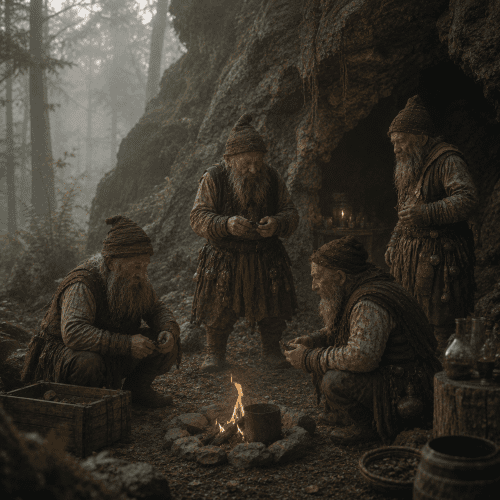
Their appearance varies between regions, but certain features remain consistent. Patuljci are frequently shown with long beards, wrinkled faces, crooked noses, and earthy clothing in shades of brown or green. Some Croatian and Serbian tales describe them with oversized heads and unusually sharp eyes, emphasizing their wisdom and supernatural awareness.
Another defining trait is their magical ability to disappear or blend into their surroundings. In some stories they become invisible, while in others they shapeshift into frogs or other small creatures. This connection to transformation reinforces their role as beings that exist between the visible and invisible worlds.
Unlike the armored dwarves of later fantasy literature, Slavic Patuljci feel deeply tied to nature. Their appearance reflects forests, caves, rivers, and soil rather than grand kingdoms or battlefields. They resemble ancient spirits of the land more than traditional fantasy warriors.
Mythological Context
Within Slavic cosmology, Patuljci belong to what folklorists often call the “lower mythology.” This category includes local spirits connected to households, forests, mountains, rivers, and underground places rather than the major gods of the Slavic pantheon. They are not worshipped like divine deities such as Perun or Veles, but they remain spiritually significant because they interact directly with human life.
Many traditions associate Patuljci with mines and hidden treasures. Polish folklore includes similar figures such as the Skarbnik, a mining spirit who protects underground riches and warns miners about danger. South Slavic legends similarly portray Patuljci as guardians of crystals, gemstones, and precious metals buried beneath the earth.
Other stories place them inside homes, especially near hearths or beneath thresholds. In these versions, they act as protective spirits that reward respectful families with prosperity and punish careless behavior with misfortune. This dual role as both domestic guardian and underground spirit reflects the Slavic view that the natural and human worlds were spiritually interconnected.
Some Serbian legends even describe Patuljci as an early creation of God and Saint Peter. According to these tales, they were considered too small and fragile for heavy labor, which led to the later creation of giants and eventually humans as a balance between strength and intelligence.
Origins
The origins of Patuljci likely emerge from very old pre-Christian beliefs tied to animism and ancestor worship. Ancient Slavic communities believed that forests, springs, mountains, and homes were inhabited by spiritual forces. Over time, these beliefs evolved into stories about small supernatural beings that protected specific places or families.
Some traditions viewed Patuljci as transformed ancestors. Spirits dwelling beneath a household threshold were sometimes believed to represent the first male founder of the family line. This idea connected the living household to its ancestral past and gave spiritual meaning to the home itself.
Scholars also note similarities between Patuljci and dwarf-like beings from broader Indo-European traditions. Germanic dwarves, Celtic earth spirits, and Greek pygmies all share themes of hidden wisdom, craftsmanship, and underground knowledge. These parallels suggest that stories about small magical beings may have deep roots stretching across ancient Eurasian cultures.
In later centuries, Christian influence changed how these beings were viewed. Some folk traditions continued to treat them as protective spirits, while others reinterpreted them as troublesome or even demonic creatures. Despite these changes, Patuljci survived in oral storytelling and regional folklore.
Notable Members
Unlike gods or legendary heroes, Patuljci are rarely individualized. Most folklore treats them as a collective race of supernatural beings rather than named personalities. However, several related figures from Slavic traditions share many of their characteristics.
One of the best-known examples is the Polish Skarbnik, also called Skarbnyk, a spirit associated with mines and hidden treasures. This being protects underground wealth and sometimes warns miners about accidents or cave-ins.
Belarusian folklore includes Dzedka, an elderly spirit connected with hidden riches and guidance. Croatian tales mention darker figures such as the Zli Patuljak, or “wicked dwarf,” who represents the more dangerous side of underground spirits. Although these beings differ regionally, they all preserve the image of the wise and mysterious dwarf spirit who exists close to the hidden powers of the earth.
Relationship with Other Beings
Patuljci maintain complex relationships with humans, spirits, and supernatural creatures. When respected, they often help people by protecting livestock, guiding travelers, or bringing luck to households. However, when insulted or ignored, they can become mischievous and disruptive.
Their relationship with giants is especially symbolic. In many stories, giants represent uncontrolled strength and arrogance, while Patuljci symbolize intelligence and adaptability. This contrast reflects a recurring theme in Slavic folklore where wisdom triumphs over brute force.
Patuljci also share similarities with other Slavic spirits such as the Domovoi, Leshy, and Rusalka. While Domovoi guard homes and Leshy rule forests, Patuljci often move between both spaces, acting as intermediaries between human civilization and untamed nature. Because of their magical nature, they are sometimes viewed as beings that exist between the earthly world and Nav, the Slavic realm of spirits and the dead.
Similar Beings
Patuljci share traits with many mythological beings across Europe. Germanic dwarves are perhaps the closest comparison. Both are associated with underground places, hidden treasures, and supernatural craftsmanship. However, Germanic dwarves are more heavily linked to smithing and weapon-making, while Patuljci maintain stronger ties to household protection and nature spirits.
Greek mythology also contains parallels through the pygmies and Dactyls, small magical beings associated with craftsmanship and mystery. Czech folklore includes Skřítek and Šotek, spirits that overlap with the role of Patuljci in protecting homes or causing harmless trouble.
These similarities reveal how widespread the archetype of the “little folk” became across Indo-European cultures. Despite regional differences, such beings often symbolize hidden knowledge, earth magic, and the unseen forces beneath ordinary life.
Symbolism and Interpretations
Patuljci symbolize far more than physical smallness. In Slavic folklore, they represent intelligence, survival, and harmony with nature. Their stories remind listeners that wisdom can overcome physical strength and that unseen forces deserve respect.
Their underground associations connect them to mystery, hidden wealth, and transformation. As guardians of mines and natural resources, they embody humanity’s complicated relationship with the earth. They can reward greed with disaster or reward humility with fortune.
Some modern interpretations view Patuljci as symbolic representations of marginalized wisdom or forgotten traditions suppressed during Christianization. Others interpret them psychologically as reflections of human anxieties about labor, wealth, and survival. Their dual nature, both protective and dangerous, reflects a broader Slavic understanding of the supernatural world as morally complex rather than purely good or evil.
Modern Influence
Patuljci continue to influence modern fantasy, literature, and popular culture. Contemporary Slavic authors often reinterpret them through darker or more realistic fantasy settings. Polish writer Andrzej Sapkowski drew heavily from Slavic folklore while creating the world of The Witcher, helping introduce many Eastern European mythological concepts to global audiences.
In modern media, Patuljci are frequently merged with global fantasy dwarf archetypes, though their original folklore identity remains distinct. Croatian and Serbian folklore art still portrays them as mystical earth spirits rather than battle-driven fantasy races.
Interest in Slavic pagan traditions and Rodnovery movements has also revived fascination with beings like Patuljci. Artists, writers, and game developers increasingly use them to reconnect with pre-Christian cultural heritage and regional mythology. Today, Patuljci remain enduring symbols of hidden wisdom, ancient landscapes, and the belief that the smallest beings can hold immense spiritual power.


Sources
Wikipedia contributors. (2002, October 4). Asura. Wikipedia. https://en.wikipedia.org/wiki/Asura
Temple Purohit. (2016, December 15). The untold story of Asuras – Hindu mythology. https://www.templepurohit.com/untold-story-of-asuras-hindu-mythology/
Wisdomlib.org. (2025, December 30). Asura: Significance and symbolism. https://www.wisdomlib.org/concept/asura
Dharmawiki.org. (2020, March 11). Asuras (असुराः). https://dharmawiki.org/index.php/Asuras_(%E0%A4%85%E0%A4%B8%E0%A5%81%E0%A4%B0%E0%A4%BE%E0%A4%83)[5]
Round Table India. (2023, March 19). Asura in postmodern times. https://www.roundtableindia.co.in/asura-in-postmodern-times/
Hindu Culture Hub. (2025, June 7). The resilient Asuras: Unraveling the layers of the mythical figures in Hindu texts. https://hinduculturehub.com/hindu-mythology/asuras/
Wisdomlib.org. (2025, October 9). Devas and Asuras: Significance and symbolism. https://www.wisdomlib.org/concept/devas-and-asuras
Hindupedia contributors. (2024, January 21). Asura. Hindupedia, the Hindu Encyclopedia.
https://www.hindupedia.com/en/Asura
Frequently Asked Questions
Who were the Asuras in Indian tradition?
Asuras were powerful beings associated with ambition, authority, and conflict, often portrayed as rivals to the Devas rather than embodiments of pure evil.
Were Asuras always considered evil?
No, early texts depict Asuras as divine or semi-divine beings, and later traditions present them as morally complex rather than uniformly evil.
What is the difference between Asuras and Devas?
Devas generally represent order and balance, while Asuras represent ambition and resistance, with both emerging from shared cosmic origins.
Is Ravana considered an Asura?
Yes, Ravana belongs to the Asura lineage and is portrayed as both a learned devotee and a ruler undone by pride.
Do Asuras have relevance today?
Asuras remain influential in festivals, literature, philosophy, and modern media, symbolizing inner conflict, power, and moral struggle.