


Baihu : The White Tiger Guardian of the West
Mythlok Perspective
In Mythlok’s Perspective, Baihu stands apart from many mythological beasts because its power comes less from individual legends and more from its place within a cosmic system. Like the Greek Griffin, it combines animal ferocity with guardianship, but Baihu is more deeply tied to astronomy, direction, season, and elemental symbolism. Its evolution from celestial emblem to protector and martial symbol demonstrates how Chinese mythology could transform the natural world into an ordered map of the universe.
Baihu
Introduction
Baihu (白虎), meaning White Tiger, is one of the Four Symbols (Sì Xiàng) of ancient Chinese cosmology. Representing the West, Baihu is associated with autumn, the element of Metal, and the colour white. Its origins are closely connected with ancient Chinese astronomy, where the Four Symbols correspond to four groups of seven lunar mansions in the Twenty-Eight Mansions of the sky. Over time, the White Tiger developed beyond an astronomical emblem into an important symbol of military authority, protection, strength, and cosmic order.
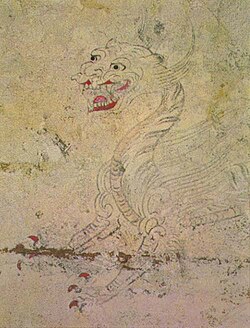
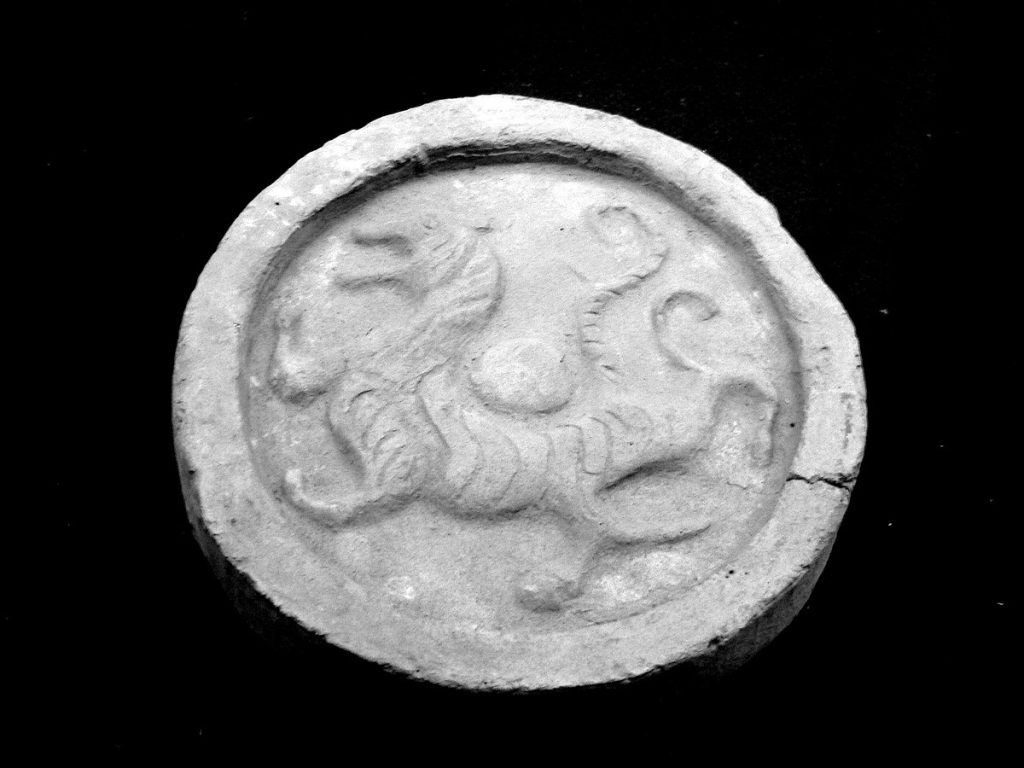
Baihu was especially significant in the Han period, when the Four Symbols became prominent in tomb art, ritual imagery, and ideas about the structure of the cosmos. The White Tiger could represent the western quarter of heaven and serve as a protective presence, particularly in funerary contexts. Its association with warfare also gave the creature an enduring connection with military power and martial authority. In Daoist traditions, Baihu later became one of the guardian figures associated with religious spaces and ritual protection.
Unlike many mythological beasts whose stories centre on adventures, battles, or genealogies, Baihu is primarily understood through its cosmological role. Its meaning comes from the relationship between direction, season, element, colour, astronomy, and ritual symbolism in traditional Chinese thought.
Physical Traits
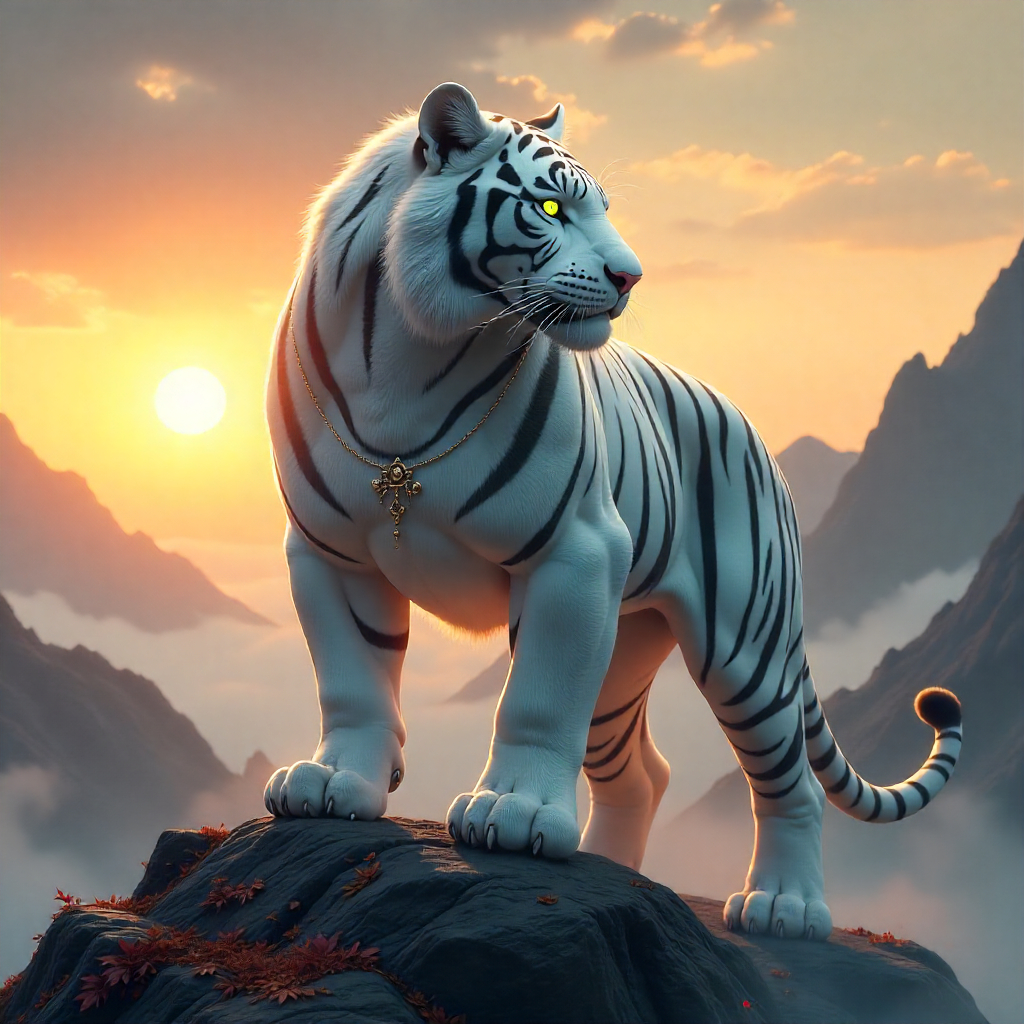
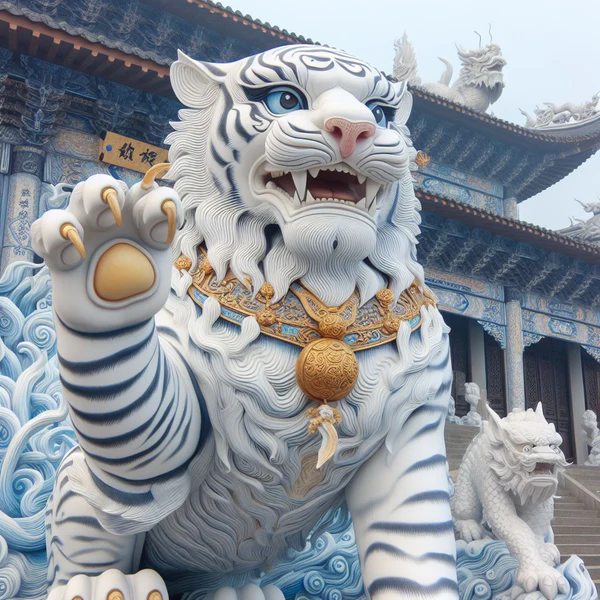
Baihu is traditionally depicted as a white tiger, retaining the recognizable form of the powerful striped tiger rather than appearing as a completely different supernatural animal. Artistic representations vary considerably according to period and context, but the creature is generally shown with a strong body, large paws, prominent claws, and an alert, imposing posture.
Its white colour is especially significant. In Chinese cosmology, white corresponds to the western direction and the Metal phase of the Five Phases (Wǔ Xíng). The colour therefore identifies Baihu as much as its tiger form does. Its black or dark markings usually remain visible in artistic representations, creating the familiar appearance of a white tiger rather than a featureless white animal.
There is no single classical description establishing Baihu as an enormous tiger with glowing eyes, supernatural flames, metallic fur, or a thunderous roar. Such features occur in later artistic and fictional interpretations rather than forming a consistent part of the ancient tradition. For this reason, Baihu is best understood visually as an idealized celestial tiger whose appearance communicates strength and authority.
The tiger itself was already associated with courage, ferocity, and military power in Chinese culture. Giving it a celestial identity connected these qualities with the western quadrant of the heavens and with the wider system of cosmic correspondences.
Family
Baihu does not have a conventional family tree in Chinese mythology. Its closest mythological relationships come from its position among the Four Symbols, which together organize the four principal directions of the celestial world. Baihu represents the West and stands alongside Qinglong, the Azure Dragon of the East; Zhuque, the Vermilion Bird of the South; and Xuanwu, the Black Tortoise or Dark Warrior of the North. Each corresponds to a direction and a group of stars, while later cosmological systems connect them with a season, colour, and element.
Baihu’s western association links it with autumn, white, and Metal. Qinglong’s eastern position corresponds to spring, green or blue-green, and Wood; Zhuque represents the South, summer, red, and Fire; while Xuanwu represents the North, winter, black, and Water. Together, these correspondences form part of a larger cosmological framework rather than a literal family.
Some later systems also introduce a fifth central figure, sometimes represented by the Yellow Dragon (Huanglong), in association with the centre and Earth. However, Huanglong should not be treated as Baihu’s established parent or progenitor. The Four Symbols are better understood as cosmological counterparts rather than a biological or divine family.
Other Names
The primary Chinese name Baihu (白虎) literally means “White Tiger.” It is also described as the White Tiger of the West, emphasizing its position within the Four Symbols and its connection with the western celestial quadrant. In Daoist traditions, Baihu is associated with Jianbing (监兵) or Jianbing Shenjun, a divine guardian figure connected with the protection provided by the White Tiger. This reflects the development of the Four Symbols from astronomical and cosmological emblems into figures with religious and protective functions.
Baihu also has closely related forms in other East Asian traditions. In Japan, it is known as Byakko (白虎), while in Korea it is called Baekho (백호). In Vietnam, the corresponding name is Bạch Hổ. These traditions inherited and adapted the Four Symbols within their own religious, artistic, astronomical, and cultural systems. Although names such as “Metal Tiger” or “Western Guardian” can be used descriptively to explain Baihu’s associations, they should not be treated as equivalent to its principal traditional name. Baihu, the White Tiger of the West, remains the clearest and most historically grounded identification.
Powers and Abilities
Baihu’s abilities are best understood through its cosmological and protective functions rather than through a fixed collection of magical powers. As the celestial representative of the West, Baihu occupies one quarter of the traditional Chinese conception of the heavens and forms part of the system that organizes the Four Symbols.
Its strongest symbolic association is with Metal, one of the Five Phases. Metal was connected with qualities such as firmness, severity, strength, and decisiveness. These associations helped reinforce Baihu’s connection with warfare and military authority. The tiger’s natural reputation for ferocity made it particularly appropriate as a celestial emblem of martial strength.
Baihu also became a protective figure. During the Han period, representations of the White Tiger appeared alongside the other directional creatures in tombs and funerary art. Their presence reflected beliefs about protection, the organization of the cosmos, and the journey beyond earthly life. The White Tiger could therefore function as a guardian of the western side of a sacred or funerary space.
Its connection with autumn adds another dimension to its symbolism. Autumn represented a period of completion, harvesting, decline, and transition within the cyclical understanding of nature. Baihu consequently became associated with the more severe and concluding aspects of the cosmic cycle rather than with creation and renewal alone.
Baihu also had an important military role. Historical Chinese sources associate the White Tiger with military formations, banners, and martial symbolism. Its image communicated courage, authority, and the disciplined application of force. In later Daoist traditions, Baihu developed further as a guardian deity, reinforcing its reputation as a defender against harmful forces.
These associations explain why Baihu became more than an astronomical symbol. The White Tiger represented the strength and protective severity of the western quarter of the cosmos, bringing together astronomy, seasonal change, Metal, warfare, and ritual protection.
Modern Day Influence
Baihu remains one of the most recognizable figures from traditional Chinese cosmology. Its image continues to appear in Chinese art, religious imagery, martial symbolism, literature, television, animation, manga, and video games, where the White Tiger is frequently portrayed as a powerful guardian or celestial beast.
Its influence is particularly visible in the continuing popularity of the Four Symbols as a group. Qinglong, Baihu, Zhuque, and Xuanwu are regularly reinterpreted in contemporary fantasy and popular culture, often appearing as four powerful beings representing different directions and elements. Modern works sometimes give Baihu additional supernatural abilities, but these should be distinguished from its older cosmological identity.
Baihu also retains significance within Daoist religious traditions. The Four Symbols can appear as guardian figures associated with Daoist temples, with Baihu traditionally positioned opposite Qinglong. In this arrangement, the White Tiger occupies the western or right-hand side when facing south, while the Azure Dragon occupies the eastern or left-hand side.
The White Tiger is also familiar within feng shui and Chinese metaphysical traditions, where the White Tiger and Azure Dragon form complementary directional forces. Their relationship is particularly important in the traditional spatial arrangement of landscapes and buildings. These interpretations vary between schools and historical periods, so modern feng shui practices should not be assumed to represent a single ancient doctrine.
Across centuries, Baihu has therefore moved between astronomy, cosmology, funerary art, military symbolism, Daoism, and popular culture without losing its essential identity. The White Tiger remains a powerful representation of the West, autumn, Metal, strength, and protection, making Baihu one of the most enduring celestial figures in Chinese mythology.
Related Images

Source
Eberhard, W. (2003). A Dictionary of Chinese Symbols: Hidden Symbols in Chinese Life and Thought. Routledge.
Schafer, E. H. (1963). The Golden Peaches of Samarkand: A Study of T’ang Exotics. University of California Press.
Yang, L., & An, D. (2005). Handbook of Chinese Mythology. Oxford University Press.
Chinese Mythology. (2023). Baihu (White Tiger). Retrieved from https://www.chinamyth.com/baihu-white-tiger/
Travel China Guide. (2024). Chinese Zodiac and Mythology: Baihu. Retrieved from https://www.travelchinaguide.com/intro/astrology/baihu/
Wu, K. C. (1982). The Chinese Heritage. Crown Publishers.
Smith, R. J. (2009). Cosmos and Society in Ancient China. Stanford University Press.
Williams, C. A. S. (2006). Outlines of Chinese Symbolism and Art Motives. Dover Publications.
Wikipedia contributors. (n.d.). White Tiger (mythology). Wikipedia. Retrieved from https://en.wikipedia.org/wiki/White_Tiger_%28mythology%29
Yang, L. (2005). Handbook of Chinese Mythology. Oxford University Press.
Wu, K. C. (1982). The Chinese Heritage. Crown Publishers.
Schafer, E. H. (1963). The Golden Peaches of Samarkand: A Study of T’ang Exotics. University of California Press.
Little, S., & Eichman, S. (2000). Taoism and the Arts of China. Art Institute of Chicago.
Rawson, P. (1992). Sacred Tibet: The Path of the Mystic. Thames & Hudson.
Frequently Asked Questions
Who is Baihu in Chinese mythology?
Baihu, also known as the White Tiger, is one of the Four Symbols of Chinese cosmology and represents the western direction, autumn, and the element of metal.
What does Baihu symbolize?
Baihu symbolizes courage, strength, and righteousness. It is also seen as a guardian against evil forces and a protector of the righteous.
How is Baihu depicted in Chinese art?
Baihu is often shown as a majestic white tiger with shimmering fur and fierce eyes, embodying both power and divine authority.
What is Baihu’s role among the Four Symbols?
As one of the Four Symbols, Baihu rules over the West and embodies the energy of autumn, complementing Azure Dragon (East), Vermilion Bird (South), and Black Tortoise (North).
Is Baihu worshipped or celebrated today?
Yes, Baihu remains a respected figure in Taoist traditions, martial arts symbolism, and cultural festivals across China and East Asia as a timeless emblem of protection and valor.


