
Ayyur : The Ancient North African Moon Deity
Listen
At a glance
| Description | |
|---|---|
| Origin | Berber Mythology |
| Classification | Gods |
| Family Members | N/A |
| Region | Morocco, Algeria, Tunisia, Libya |
| Associated With | Moon, Timekeeping, Fertility, Navigation |
The Mythlok Perspective
In Mythlok’s perspective, Ayyur embodies the quiet intelligence of the cosmos. He is not a dramatic or warlike figure but the living rhythm of time itself. The Amazigh vision of the moon as both deity and celestial body reveals a worldview rooted in balance rather than domination. Compared to figures like Mani in Norse belief or Tsukuyomi in Japanese tradition, Ayyur feels more elemental and less personified. His power lies not in mythic conflict but in cyclical return. In that sense, he represents one of the most refined expressions of lunar spirituality in the ancient world.
Ayyur
Introduction
Ayyur is the ancient moon deity of the Amazigh, also known as the Berber people, the Indigenous inhabitants of North Africa. The name “Ayyur” directly means “moon” in Tamazight and related Amazigh languages, and in Tifinagh script it appears as ⴰⵢⵢⵓⵔ. In Amazigh cosmology, celestial bodies were not distant objects but living presences that shaped time, agriculture, and ritual life. Ayyur therefore represents more than a god. He embodies the visible rhythm of the lunar cycle and its influence over existence itself.
Classical historian Herodotus recorded that certain Libyan tribes, widely understood to include Amazigh ancestors, honored the sun and the moon above other deities. Archaeological and epigraphic evidence from the Roman period also mentions a lunar figure known as Ieru, which scholars connect linguistically to the Amazigh word for the moon. These references confirm that lunar reverence was central to pre-Islamic North African spirituality.
In traditional Amazigh belief, Ayyur regulated time through waxing and waning phases. The moon marked months, guided planting seasons, and structured ceremonial life. His significance lay not in grand mythic battles but in quiet cosmic governance. The steady return of the crescent ensured continuity in a landscape shaped by desert horizons and mountain skies.
Physical Traits
Unlike anthropomorphic deities in Greek or Mesopotamian traditions, Ayyur does not possess a detailed human form in surviving sources. Amazigh religion emphasized natural symbolism over sculpted divine imagery. As a result, Ayyur is represented through the crescent moon itself rather than a figure with defined facial features or attire.
The crescent symbol appears widely in Saharan rock art motifs, jewelry, and later cultural expressions. It signifies growth, decline, and renewal. In this sense, Ayyur’s “body” is the lunar disk. His changing shape across the month becomes a visible reminder of life’s cyclical nature.
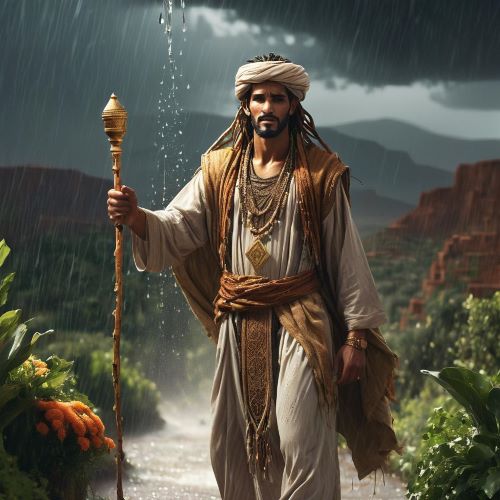
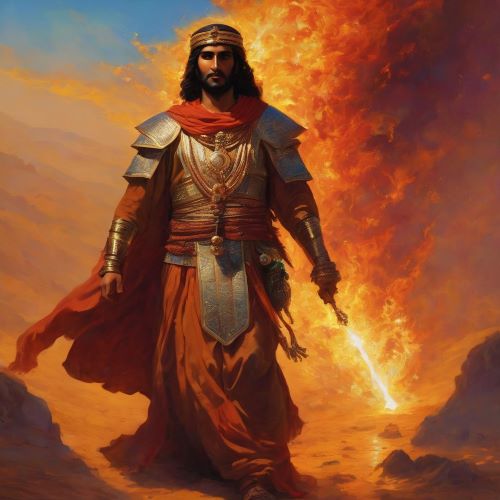
Modern artistic interpretations sometimes depict Ayyur as a youthful, radiant male figure associated with silver light and desert night skies. However, these portrayals are contemporary reconstructions rather than historically documented images. What remains consistent in traditional belief is the idea that Ayyur is fluid rather than fixed, reflecting the shifting phases of the moon.
Family
Amazigh mythology does not preserve an extensive genealogical structure comparable to Indo-European pantheons. Instead of rigid divine hierarchies, Amazigh belief systems focus on interconnected natural forces. Within certain oral traditions, Ayyur is paired symbolically with Tafukt, the sun goddess, representing the balance between day and night.
Some folktales describe both celestial beings emerging from a primordial maternal force known as Settut, sometimes referred to as a First Mother figure. In these narratives, light is born into darkness through the creation of the sun and moon. While these accounts vary regionally and lack standardized textual documentation, they emphasize cosmic duality rather than biological parentage.
Beyond this symbolic pairing, Ayyur does not possess clearly defined offspring or lineage. Other deities in Amazigh spirituality, such as Anzar, the rain god, and Gurzil, a war deity known from Roman-era sources, occupy related spheres of influence. However, their relationships are thematic rather than genealogical. The emphasis remains on harmony between natural elements.
Other names
Due to linguistic diversity among Amazigh communities across Morocco, Algeria, Tunisia, Libya, and parts of the Sahara, the name Ayyur appears in several variations. Common spellings include Ayour, Ayyour, Yur, and Ayar. These variations arise from regional dialects and transliteration into Latin script.
In Roman inscriptions, the name Ieru appears as a lunar deity worshiped in North Africa. Linguists connect this term to the Amazigh root for moon, supporting continuity between Indigenous belief and classical-era references.
In everyday Tamazight usage, “ayyur” also simply means “month,” reinforcing how inseparable the deity was from the measurement of time. The divine and the astronomical were conceptually unified rather than distinct.
Powers and Abilities
Ayyur’s influence centers on cycles. His waxing phase symbolizes growth, fertility, and renewal, while his waning phase represents rest, decline, and transformation. For agricultural societies across North Africa, these phases determined planting schedules and seasonal rhythms.
The moon also guided navigation in desert regions. Nomadic Amazigh communities relied on lunar light to travel across vast landscapes at night. In this sense, Ayyur functioned as a celestial guide, illuminating pathways when the sun disappeared.
Cultural symbolism associates the moon with moisture, fertility, and subtle transformation. While the sun brings visible heat and intensity, the moon governs quieter processes. Ayyur therefore embodies reflection, balance, and continuity. There are no preserved myths of combat or miraculous feats attributed to him. His power lies in steady influence rather than dramatic intervention.
The lunar calendar remains deeply embedded in North African religious life today, particularly in Islamic observances. While this practice is rooted in Islamic tradition, it also reflects the longstanding cultural importance of lunar timekeeping that predates the arrival of Islam in the region.
Modern Day Influence
Direct worship of Ayyur faded with the spread of Christianity and later Islam across North Africa. However, his symbolic presence continues through cultural memory. Amazigh revival movements in Morocco and Algeria often reference pre-Islamic heritage as part of identity reclamation, and lunar symbolism remains a powerful emblem.
The Tifinagh script, officially recognized in Morocco, preserves the written form of “ⴰⵢⵢⵓⵔ.” Traditional jewelry frequently incorporates crescent motifs. Folklore and poetry continue to reference the moon as a guiding presence in love, longing, and seasonal change.
Even in contemporary music and artistic expression, the name Ayyur appears as a symbolic invocation of ancestral spirituality. While no organized cult survives, the lunar archetype endures within Amazigh cultural consciousness.
Related Images




Source
Lebarty. (2024). Ayyur: The Berber God of the Moon. https://lebarty.bongchong.com/ayyur-the-berber-god-of-the-moon/
Sun Moon Studio. (2025). Ayyur: Lunar Reflections. https://sunmoon.studio/journal/ayyurlunarreflections
Encyclopedia.com. (2026). Berber Religion. https://www.encyclopedia.com/environment/encyclopedias-almanacs-transcripts-and-maps/berber-religion
Wikipedia. (2006). Traditional Berber religion. https://en.wikipedia.org/wiki/Berber_mythology
Amazigh Wiki. (2022). Amazigh religion. https://www.wiki.amazigh.com/index.php/Amazigh_religion
General Books LLC. (2010). Berber mythology: Antaeus, Berber pantheon, Tinjis, Achaman. Books LLC.
Apocalyptic Rites. (2022). AYYUR – Hidden Rooms Sessions I.
https://arrundergroundmetal.blogspot.com/2022/11/ayyur-hidden-rooms-sessions-i.html
Camps, G. (1980). Berber Mythology and Religion. Paris: Éditions du CNRS.
Chaker, S. (1995). Berber Culture: Identity and Mythology. Algiers: INALCO Press
Frequently Asked Questions
Who is Ayyur in Amazigh belief?
Ayyur is the ancient moon deity of the Amazigh people of North Africa, representing lunar cycles, timekeeping, and fertility.
What does the name Ayyur mean?
In Tamazight, Ayyur directly translates to “moon” and also refers to a lunar month.
Is Ayyur still worshiped today?
Direct worship has largely disappeared, but lunar symbolism connected to Ayyur survives in Amazigh cultural identity and folklore.
Was Ayyur connected to other gods?
He is often symbolically paired with Tafukt, the sun goddess, representing cosmic balance between day and night.
Did ancient sources mention Ayyur?
Classical references such as those by Herodotus describe North African tribes venerating the sun and moon, and Roman inscriptions mention a lunar deity called Ieru linked linguistically to Ayyur.