
Avatea : The Cook Islands Deity of Light and Creation
Listen
At a glance
| Description | |
|---|---|
| Origin | Cook Islands Mythology |
| Classification | Gods |
| Family Members | Vari-Ma-Te-Takere (Mother), Papa (Consort), Tangaroa, Rongo (Sons) |
| Region | Cook Islands |
| Associated With | Light, Creation, Balance, Celestial cycles, Land and sea harmony |
The Mythlok Perspective
Avatea reflects a distinctly Pacific understanding of divinity, where power is measured through balance rather than domination. Unlike warrior gods who impose order through force, Avatea sustains the world by embodying its opposites within a single form. His presence reminds us that creation is not an act of conquest but of alignment. Across cultures, similar ideas appear in figures like Wakea in Hawaii and even the yin-yang principle in Chinese philosophy. In each case, the universe remains stable not because one force wins, but because opposing elements learn to coexist. Avatea stands firmly within this global pattern of sacred balance.
Avatea
Introduction
Avatea is one of the most foundational figures in Cook Islands sacred tradition, especially within the cosmology of Mangaia. His name is commonly translated as “noon” or “full light,” reflecting his association with illumination, order, and the emergence of life from primordial darkness. In Cook Islands belief, Avatea is not simply a god among many but the first fully formed being to bridge divine and human existence, standing at the threshold between creation and continuity.
Born from the primordial mother Vari-Ma-Te-Takere, Avatea emerges from Avaiki, the ancestral and underworld realm, into a structured cosmos. He is remembered as both the first man and a creator deity, a dual identity that anchors genealogies, kingship, and social order. His story explains not only how gods and humans came into being, but why balance between land and sea, light and shadow, remains central to Cook Islands worldview.
Physical Traits
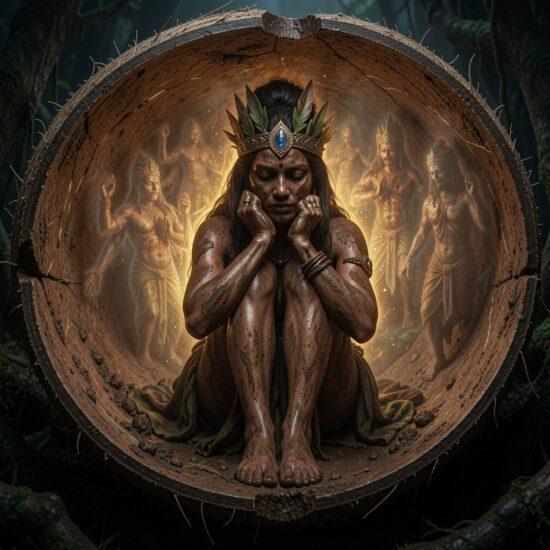
Avatea’s physical form is one of the most striking expressions of Polynesian cosmological symbolism. He is described as vertically divided, embodying two complementary realms within a single body. One half is fully human, representing the terrestrial world and social life. The other half takes the form of a fish, signifying the oceanic domain that sustains island societies.
His eyes are identified with the Sun and the Moon, granting him dominion over time, rhythm, and visibility. Through this imagery, Avatea becomes a living axis of the cosmos, watching over both day and night. His form is not monstrous or chaotic but purposeful, expressing harmony rather than conflict. This visual language reinforces his role as a mediator between environments rather than a ruler who dominates them.
Family
Avatea’s lineage begins with Vari-Ma-Te-Takere, the primordial source from whom existence itself unfolds. From her body emerged six beings, with Avatea the first male figure to attain full agency. His union with Papa, the earth goddess, establishes one of the most important creative pairings in Cook Islands belief.
Through this union, Avatea becomes the father of major deities who shape the natural and social world. Tangaroa governs the sea and marine abundance, while Rongo presides over cultivated food and peace. Through later descendants, Avatea’s line extends into chiefly families and early kingship traditions, linking political authority directly to sacred ancestry. In this way, Avatea’s family is not merely divine but deeply human in its social consequences.
Other names
Across the Cook Islands and the wider Polynesian world, Avatea appears under related names that reflect regional pronunciation and theological emphasis. The shortened form Vatea is commonly used in chants and genealogies, especially in Mangaia and Rarotonga. These variations do not alter his core identity but highlight different aspects of his nature.
Beyond the Cook Islands, Avatea is closely related to Atea in the Marquesas and Wakea in Hawaiian tradition. Each version preserves the central themes of light, sky, and generative power. These linguistic parallels reveal a shared ancestral framework across Polynesia, suggesting that Avatea represents a localized expression of a much older cosmological idea carried across the ocean by early navigators.
Powers and Abilities
Avatea’s powers are structural rather than dramatic. As a deity of light, his influence governs visibility, growth, and orientation, all of which are essential in island cultures dependent on agriculture and navigation. His solar and lunar eyes regulate the cycles that determine planting, fishing, and ritual timing.
His hybrid form grants him authority over both land and sea, reinforcing balance rather than supremacy. Avatea does not wage wars or punish humanity; instead, he sustains order by existing as the living alignment of opposites. Through his descendants, creation unfolds in stages, allowing the world to become inhabitable rather than overwhelming. His power lies in continuity, ensuring that life remains intelligible and interconnected.
Modern Day Influence
Avatea remains a living presence within Cook Islands cultural memory. His name and lineage continue to surface in oral chants, ceremonial contexts, and traditional education. Genealogies tracing descent from Avatea reinforce identity and belonging, particularly within chiefly families.
In contemporary art and literature, Avatea’s symbolism is reinterpreted to explore themes of duality, environment, and heritage. Cultural tourism often introduces visitors to his story as a way of explaining indigenous cosmology beyond surface-level folklore. Even within a society shaped by Christianity, Avatea persists as a reminder that identity, land, and ancestry are inseparable from sacred origins.
Related Images

Source
Craig, R. D. (1989). Dictionary of Polynesian mythology. Greenwood Press.
Gill, W. W. (1876). Myths and songs from the South Pacific. Henry S. King & Co.
Henry, T. (1928). Ancient Tahiti. Bernice P. Bishop Museum.
Poerava, T. (n.d.). Cook Islands mythology. Cook Islands Government. Retrieved January 15, 2026, from
https://en.wikipedia.org/wiki/Cook_Islands_mythology
Buck, P. H. (1938). Ethnology of Manihiki and Rakahanga. Bernice P. Bishop Museum.
Dixon, R. B. (1916). Oceanic mythology. George G. Harrap & Co.
Hopkins, S. (2012). Legends of the Cook Islands. Puffin Books.
Cook Islands Culture. (n.d.). Cook Islands Tourism Corporation. Retrieved from https://www.cookislands.travel/culture
Mythology of the Cook Islands. (n.d.). Living Heritage. Retrieved from http://www.livingheritage.org.nz/schools/secondary-schools/aroa-college/exploring-cook-islands-mythology/mythology-of-the-cook-islands/
Te Papa Tongarewa, Museum of New Zealand. (n.d.). Creation Stories of the Pacific. Retrieved from https://www.tepapa.govt.nz/discover-collections/read-watch-play/maori/maori-creation-stories
Frequently Asked Questions
Who is Avatea in Cook Islands belief?
Avatea is a primordial god and the first man, central to creation stories in Mangaia and the wider Cook Islands.
What does Avatea represent?
He represents light, balance, and the connection between land, sea, and celestial cycles.
Why is Avatea half human and half fish?
This form symbolises harmony between terrestrial life and the ocean, both essential to island survival.
Is Avatea connected to other Polynesian gods?
Yes. Avatea is related to Atea in the Marquesas and Wakea in Hawaiian tradition, reflecting shared ancestral beliefs.
Is Avatea still important today?
Yes. His story continues through oral tradition, cultural identity, education, and contemporary art in the Cook Islands.