


Aroni : The One Legged Forest Spirit of Yoruba Tradition
At a glance
| Description | |
|---|---|
| Origin | Yoruba Mythology |
| Classification | Spirits |
| Family Members | N/A |
| Region | Nigeria |
| Associated With | Forests, Medicinal plants, Herbal knowledge, Hunting |
The Mythlok Perspective
In Mythlok’s Perspective, Aroni represents an interesting contrast between fear and knowledge. While many supernatural forest beings across world traditions guard forbidden territories, Aroni offers something unusual: wisdom to those courageous enough to confront him. Unlike the Brazilian Saci-Pererê, whose one-legged identity is associated with mischief, Aroni’s defining characteristic is his connection to medicinal knowledge. His stories remind humanity that nature can be both intimidating and profoundly instructive.
Aroni
Introduction
Aroni (Àrọ̀nì) is a mysterious forest spirit in Yoruba tradition, associated with medicinal plants, hidden knowledge and the supernatural world of the African forest. Unlike the better-known Yoruba deities who govern thunder, rivers or fertility, Aroni occupies a more unusual position within the spiritual landscape. He is a keeper of botanical knowledge whose encounters with humans can lead to either extraordinary wisdom or terrifying consequences.
Historical accounts describe Aroni as a supernatural being who inhabits the depths of the forest. His reputation rests particularly on his knowledge of medicinal plants and his ability to teach selected individuals the secrets of herbal medicine. However, gaining access to this knowledge is not straightforward. Traditional narratives describe encounters in which courage determines whether a traveller becomes a victim or receives an opportunity to learn.
Aroni is also closely associated with Osanyin (Ọ̀sányìn), the Yoruba Orisha connected with medicinal leaves, herbal healing and traditional medicine. Although some traditions connect their identities, early accounts distinguish the two figures. This makes Aroni an especially interesting character in Yoruba spiritual traditions, where the boundaries between nature spirits, divine beings and supernatural teachers are not always clearly defined.
Physical Traits
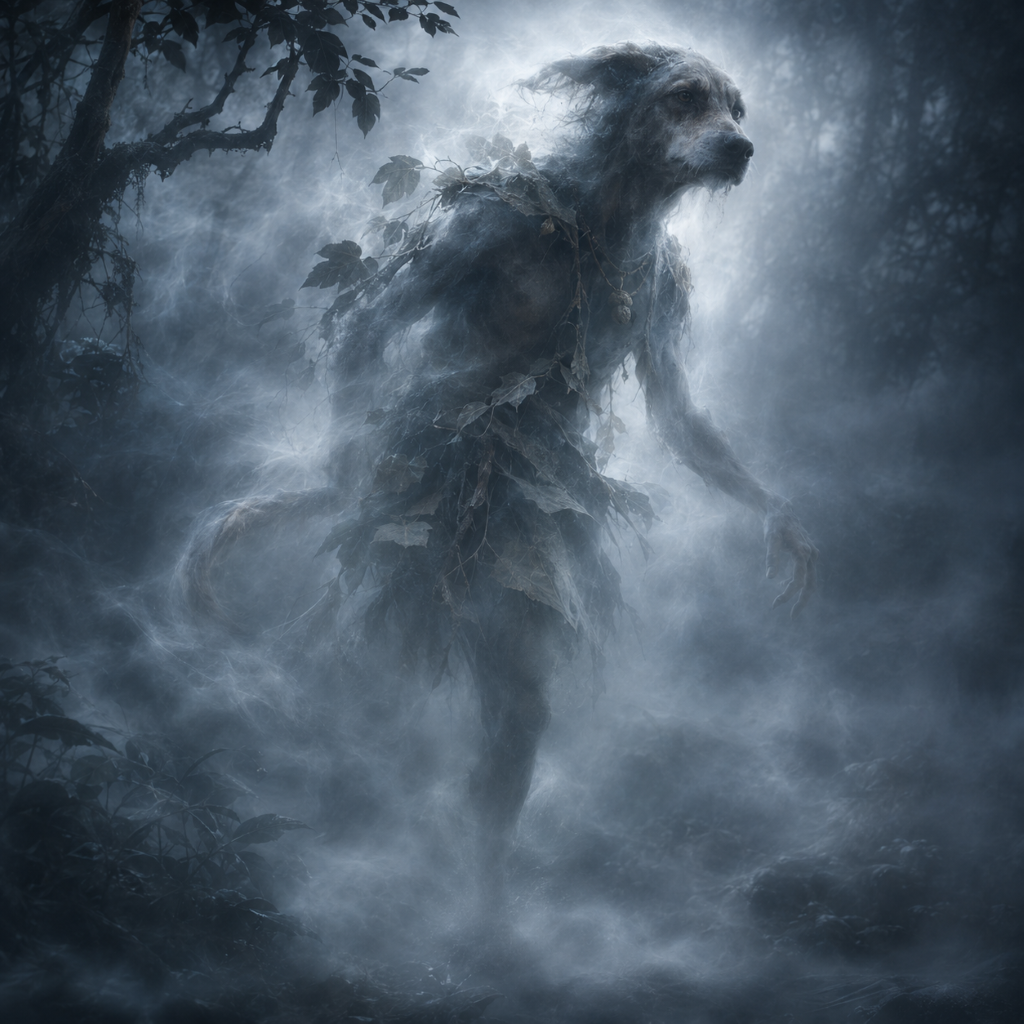
Aroni is best known for his unusual physical appearance, particularly his single leg. In his 1894 work, The Yoruba-Speaking Peoples of the Slave Coast of West Africa, British ethnographer A. B. Ellis describes him as having a human-shaped body, one leg, a dog’s head and a dog’s tail. Ellis also explains the name through the idea of a withered or impaired limb, connecting it with Aroni’s distinctive physical form.
Other descriptions present Aroni as a small, unusual forest being whose movements are characterised by hopping rather than ordinary walking. Some traditions and artistic interpretations also give him a single arm, reinforcing his supernatural appearance. These physical characteristics are not completely consistent across historical accounts, however, and should not be treated as a universal representation.
Aroni’s appearance is particularly interesting in Yoruba masquerade traditions. A documented Egúngún performance from the Yoruba region of Nigeria represents him through a dramatic mask, an elaborate costume and exaggerated physical movements. The performer may conceal one arm, hop with both legs together or lean on a staff to communicate his unusual anatomy.
Natural materials, including leaves, roots and vines, are incorporated into some representations. These elements establish a visual connection between Aroni and the forest environment he inhabits. Rather than presenting him as a conventional monster, Yoruba artistic traditions communicate his identity through movement, costume and symbolism.
Family
There is no established genealogical account identifying Aroni’s parents, spouse, children or siblings. Unlike major Yoruba Orishas, whose relationships and divine lineages feature prominently in religious narratives, Aroni is primarily understood through his associations with the natural and spiritual worlds. His most important connection is with Osanyin, the Orisha associated with medicinal plants and traditional healing. Some accounts portray Aroni as a companion, assistant or guardian of Osanyin’s botanical knowledge. Others describe him as a separate forest spirit who possesses an independent understanding of medicinal plants.
A particularly interesting connection appears in accounts describing Aroni as a custodian of medicinal secrets. His relationship with Osanyin reflects the importance of specialised knowledge within Yoruba religious traditions, where different spiritual beings may possess distinct responsibilities and forms of wisdom.
Aroni is also associated with Aja, another forest-dwelling supernatural figure connected with medicinal knowledge. In Ellis’s account, Aja independently guides selected people into the forest and teaches them about plants. Unlike Aroni, however, she is described as a figure who does not harm those she encounters. These relationships place Aroni within a wider network of Yoruba forest spirits and medicinal traditions rather than a clearly established divine family.
Other names
Aroni appears in different written forms, including Arọ̀ni and Àrọ̀nì. Variations in spelling largely reflect differences in Yoruba orthography, transcription and the use of tonal and under-dotted characters. He is frequently described as the one-legged forest spirit or the forest god, particularly in older English-language ethnographic accounts. The expression The Lame One also appears in discussions of Wole Soyinka’s dramatic work A Dance of the Forests, where Aroni is presented as a supernatural character.
His association with Osanyin has also resulted in some sources treating the two figures as alternative identities. This interpretation is particularly relevant in discussions of Yoruba-derived religious traditions outside Africa, where the names and responsibilities of spiritual beings may develop differently. However, Aroni, Aja and Osanyin should not automatically be treated as interchangeable names. Historical accounts provide evidence of distinct identities, even though later religious interpretations sometimes bring them closer together.
Powers and Abilities
Aroni’s most distinctive ability is his extraordinary knowledge of medicinal plants. Yoruba accounts associate him with the hidden properties of leaves, roots and other botanical materials found deep within the forest. His knowledge is not simply theoretical. He is portrayed as possessing information that can transform an ordinary person into someone capable of practising traditional herbal medicine.
One of the most memorable accounts appears in Ellis’s 1894 ethnographic description. According to the narrative, Aroni encounters travellers in the forest and reacts violently when they attempt to escape. Those who run away risk being seized and devoured. However, individuals who face him without fear may receive a very different experience.
Aroni takes such individuals to his dwelling within the forest, where they remain for approximately two or three months. During this period, he teaches them the medicinal properties of plants and the secrets associated with their use. Once the instruction is complete, he releases the student with a hair from his tail as evidence of having received this unusual knowledge. This story establishes courage as an important condition for acquiring supernatural wisdom. The forest is simultaneously a place of danger and a source of knowledge, and Aroni represents both possibilities.
He is also associated with hunting and the unpredictable nature of forest encounters. Some accounts connect him with the success or failure of hunters who enter his territory. His supernatural presence is particularly associated with sudden movements of wind that disturb fallen leaves. Ellis records that a swirling eddy passing through the forest could be interpreted as a manifestation of Aroni. His ability to disappear and his association with mysterious atmospheric movements further reinforce his position as a supernatural inhabitant of the wilderness.
Modern Day Influence
Aroni continues to appear in discussions of Yoruba cultural heritage, traditional religion and African literature. One of the most important artistic representations comes from Yoruba Egúngún masquerade traditions, where performers embody the forest spirit through elaborate masks, costumes and distinctive movements.
The Baltimore Museum of Art documents Aroni through its African art educational resources, describing the unusual physical characteristics communicated through his masquerade performance. The Smithsonian Institution also preserves photographic documentation of an Aroni masquerader from Ilaro, Nigeria, showing the character with one arm, one leg and medicinal packets attached to his costume. These records demonstrate that Aroni is more than a figure preserved in written folklore; he also belongs to a living history of Yoruba performance and artistic expression.
Literature has provided another important avenue for his continued presence. In Wole Soyinka’s A Dance of the Forests, Aroni appears as a supernatural forest character associated with the Forest Head. He participates in the unfolding events involving the living and the dead, helping establish the play’s connection with Yoruba cosmology and spiritual beliefs.
Aroni’s association with Osanyin has also made him relevant to conversations about traditional African medicine and the cultural importance of medicinal plants. In Yoruba-derived religious traditions in the Americas, particularly those influenced by the worship of Osanyin, his identity and responsibilities may be interpreted differently.
Today, Aroni remains an intriguing representation of the relationship between humanity, botanical knowledge and the supernatural forest. His stories suggest that nature is not simply a physical environment to be explored but a place containing knowledge, mysteries and powers that demand respect. Through oral tradition, masquerade and literature, Aroni continues to represent the mysterious relationship between human curiosity and the hidden world of the forest.
Related Images


Source
Baltimore Museum of Art. (2016). Style and meaning: Teacher’s guide—African collection.
https://artbma.org/wp-content/uploads/2026/02/BMA_african_styleandmeaning.pdf
Drewal, H. J. (2004). A spectacle of miracles: The Yoruba forest spirit mask (Aroni). In F. J. Lamp (Ed.), See the music, hear the dance: Rethinking African art at the Baltimore Museum of Art (p. 145). Prestel.
Houlberg, M. H. (1978). Notes on Egungun masquerades among the Oyo Yoruba. African Arts, 11(3), 61.
Mythologies Wiki. (2026, January 22). Aroni—One-legged spirit of the forest—Yoruba.
https://mythologies.wiki/mythology/yoruba/entry/aroni/
Oriire. (2025, October 24). Arọ̀ni the forest spirit and mythical guardian of the environment.
https://oriire.com/article/aroni-the-forest-spirit-and-mythical-guardian-of-the-environment
Santería Religion. (2026, August 10). Aroní—Public Orisha guide. https://santeriareligion.com/orishas/aroni
The Sacred Text Archive. (n.d.). Chapter III: Minor gods. In A. B. Ellis, The Yoruba-speaking peoples of the Slave Coast of West Africa. https://sacred-texts.com/afr/yor/yor04.htm
Wikiwand. (2014). Aroni. https://www.wikiwand.com/es/articles/Aroni
Frequently Asked Questions
Who is Aroni in Yoruba mythology?
Aroni is a mysterious Yoruba forest spirit associated with medicinal plants, herbal knowledge and supernatural encounters. He is particularly known for his unusual one-legged appearance.
Is Aroni a God or a spirit?
Aroni is generally described as a forest spirit in Yoruba tradition. Some historical accounts call him a forest god, but he is not universally classified as an Orisha.
What is Aroni's relationship with Osanyin?
Aroni is closely associated with Osanyin, the Yoruba Orisha of medicinal leaves and herbal healing. Some traditions describe them as companions or spiritual associates.
Why does Aroni have only one leg?
Aroni’s single leg is his defining physical characteristic. Early ethnographic accounts also describe him with a dog’s head and tail, although descriptions vary.
What powers does Aroni possess in Yoruba mythology?
Aroni possesses extraordinary knowledge of medicinal plants and can teach selected humans their properties. He is also associated with hunting, disappearance and forest whirlwinds.


