

Apaliunas : The Hittite Guardian God of Wilusa
At a glance
| Description | |
|---|---|
| Origin | Hittite Mythology |
| Classification | Gods |
| Family Members | N/A |
| Region | Turkey |
| Associated With | Protection, Treaties, Hunting, Divine justice, City guardianship |
The Mythlok Perspective
In Mythlok’s Perspective, Apaliunas is less a forgotten god and more a bridge between civilizations. He represents the quiet transmission of belief, where a local Anatolian protector becomes one of the most iconic deities of the classical world. His identity is not defined by mythic drama but by continuity. When compared to figures like the Mesopotamian Shamash or the Celtic Lugh, Apaliunas shares the archetype of the watchful guardian who enforces order while maintaining a connection to skill and precision. Unlike these more fully developed deities, however, Apaliunas exists in a transitional state, revealing how myth evolves before it crystallizes into narrative.
Apaliunas
Introduction
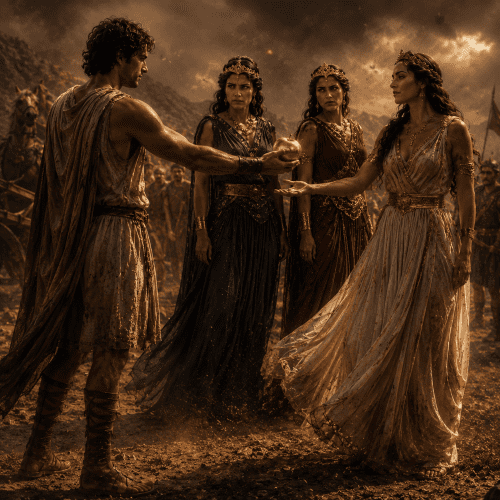
Apaliunas stands as one of the most intriguing figures in Late Bronze Age Anatolian religion, primarily because he exists at the crossroads of two great cultural worlds. Known from a Hittite treaty dated to around 1280 BCE, Apaliunas is listed among the divine witnesses invoked to guarantee an agreement between Muwatalli II and the ruler of Wilusa, a city widely identified with Troy.
In this context, Apaliunas is not a distant or abstract deity but a living political force. His role as a divine guarantor highlights how deeply religion was woven into diplomacy in the ancient Near East. The presence of Apaliunas in this treaty confirms his importance as a protector god of Wilusa, ensuring justice, order, and divine oversight.
Modern scholarship has elevated Apaliunas far beyond a local deity. Linguistic and cultural analysis strongly suggests that he represents an early Anatolian form of Apollo. This connection is not merely speculative but supported by phonetic similarities and shared mythological functions. As a result, Apaliunas is often seen as a missing link that connects Anatolian religious traditions with later Greek belief systems.
His story is therefore not just about a single god but about the movement of ideas across civilizations. Through Apaliunas, we glimpse how ancient cultures influenced one another long before the classical age, shaping the gods that would later dominate Mediterranean mythology.
Physical Traits
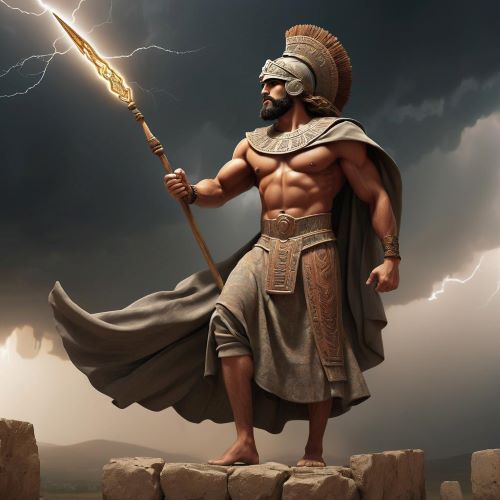
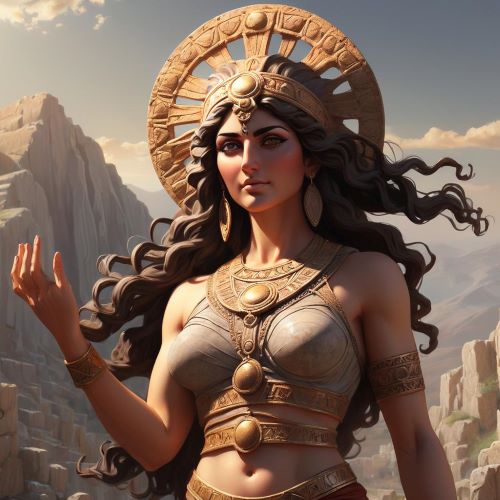
There is no confirmed visual representation of Apaliunas in surviving Hittite or Luwian art. Unlike major storm gods or solar deities, who appear frequently in reliefs and carvings, Apaliunas is known almost entirely through textual references. This absence does not diminish his importance but instead reflects the fragmentary nature of the archaeological record.
Some scholars have proposed possible identifications in Anatolian iconography. A recurring motif in the region shows a male figure standing atop a stag or holding weapons such as an axe. These images may represent a deity associated with hunting or mastery over nature, and in some interpretations, they are tentatively linked to Apaliunas. However, none of these identifications are universally accepted.
What can be said with more confidence is that Apaliunas likely embodied symbolic rather than individualized physical traits. In Anatolian religion, gods were often represented through shared visual conventions such as horned helmets, upright posture, and weapons indicating power.
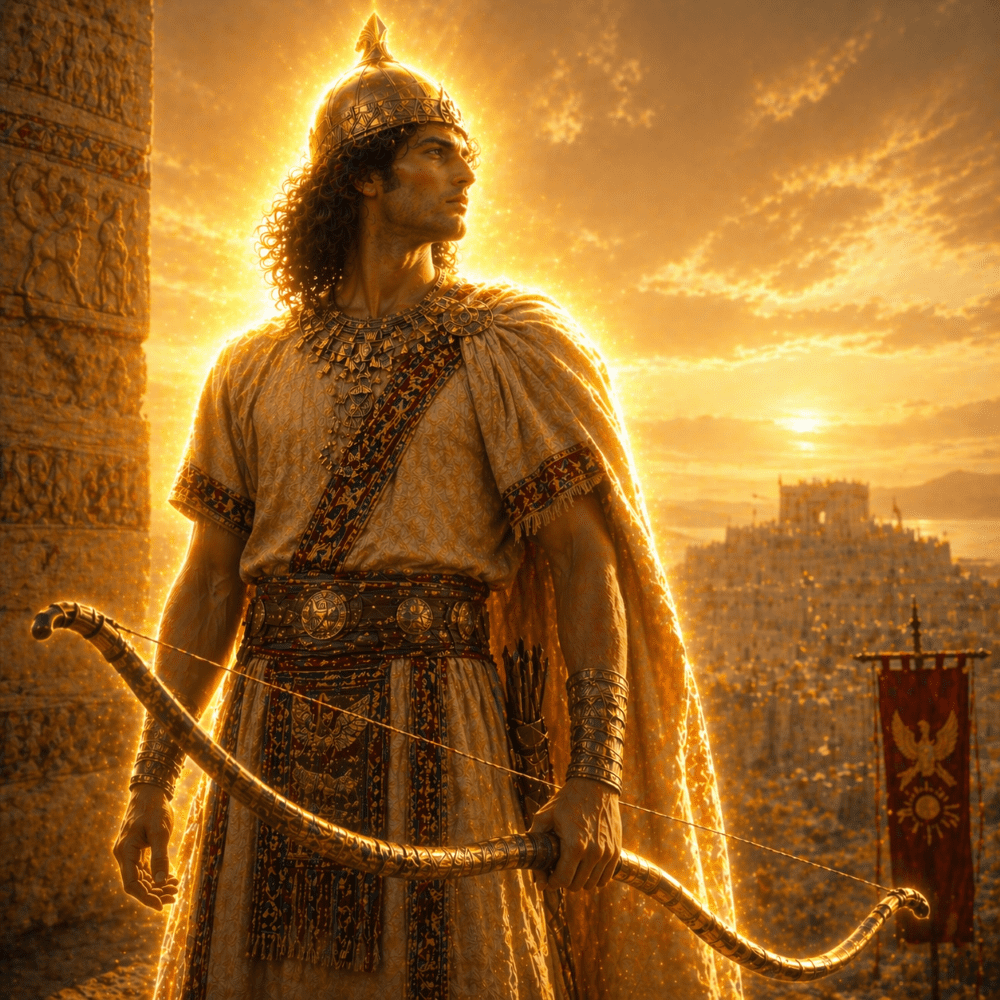
When compared to Apollo, a later cultural counterpart, we see a clearer image emerge. Apollo is typically portrayed as youthful, radiant, and armed with a bow. While this Greek depiction cannot be directly projected back onto Apaliunas, it offers a useful interpretive lens. The shared themes of youth, control, and precision suggest that Apaliunas may have been understood in similarly idealized terms, even if not visually depicted in the same way.
Family
There is no direct evidence in Hittite texts that identifies the family or lineage of Apaliunas. He appears in records as a functional deity rather than a mythological personality embedded in elaborate genealogies. This is consistent with many Anatolian gods, whose roles were often defined by their function rather than their relationships.
However, when viewed through the lens of comparative mythology, Apaliunas becomes indirectly connected to a wider divine family. His association with Apollo links him to figures such as Leto and Artemis, both of whom have strong Anatolian connections. Leto’s cult was centered in Lycia, while Artemis was worshipped prominently at Ephesus, one of the most significant religious sites in the ancient world.
These connections suggest that what later became the Greek divine family may have evolved from earlier Anatolian traditions. Rather than Apaliunas inheriting a Greek lineage, it is more accurate to say that Greek mythology absorbed and restructured older Anatolian beliefs. Thus, Apaliunas represents an earlier stage in a mythological evolution, where divine roles existed without the complex family narratives that would later define Greek religion.
Other names
Apaliunas is preserved in Hittite cuneiform as Āppaliunāš, a form that reflects its pronunciation in diplomatic and ritual contexts. Linguistically, the name is considered a precursor to the Greek “Apollo,” derived from an earlier proto-form often reconstructed as *Apeljōn.
The transformation of this name across cultures reveals a fascinating pattern of continuity and adaptation. Variants such as the Cypriot Apeílōn and Doric Apéllōn show how the name evolved as it spread through the Aegean world. The Etruscan Apulu and the Roman Apollo further demonstrate how this deity’s identity was transmitted and reshaped across different civilizations.
Another layer of evidence comes from epithets used in Greek literature. In Homeric texts, Apollo is called Lykegenes, meaning “born in Lycia,” and Smintheus, an epithet tied to Anatolian cult practices. These titles reinforce the idea that the god’s roots lie outside mainland Greece. Apaliunas, therefore, is not just an isolated name but part of a linguistic and cultural chain that connects multiple ancient societies.
Powers and Abilities
Apaliunas’s primary function was that of a protector deity, specifically tied to the city of Wilusa. His role in the treaty between Muwatalli II and Alaksandu demonstrates his authority as a divine witness who enforces oaths and ensures compliance.
This role places him within a broader tradition of gods associated with justice, order, and political stability. In the ancient world, treaties were not merely legal agreements but sacred contracts, and invoking a deity like Apaliunas meant placing the agreement under divine protection.
There is also strong evidence suggesting that Apaliunas had associations with hunting. A proposed Luwian interpretation of his name translates to “the one of entrapment,” indicating a connection to the capture of prey. This aligns closely with the later image of Apollo as an archer god.
In Greek tradition, Apollo’s arrows could bring both healing and destruction, including plagues. This dual nature may have its roots in earlier Anatolian concepts, where divine power was not strictly benevolent or harmful but balanced between protection and punishment.
Additionally, Apollo’s role as a defender of Troy in the Iliad strongly echoes Apaliunas’s function as the city’s protector. The continuity of this role across centuries suggests that the core identity of the deity remained remarkably stable, even as its cultural context changed.
Modern Day Influence
Apaliunas continues to play a significant role in modern scholarship, particularly in the study of cultural exchange between Anatolia and Greece. His identification with Apollo has reshaped how historians understand the origins of one of the most important deities in classical mythology.
Rather than viewing Apollo as a purely Greek invention, many scholars now see him as a product of cross-cultural interaction. Apaliunas provides concrete evidence that Greek religion was influenced by earlier Anatolian traditions, especially during the Late Bronze Age.
This insight has broader implications for the study of mythology. It highlights the fluid nature of religious ideas and shows how gods evolve as they move between cultures. Apaliunas, though sparsely attested, becomes a key figure in understanding this process.
Beyond academia, this connection enriches interpretations of ancient texts such as the Iliad. Knowing that Apollo’s loyalty to Troy may reflect an older Anatolian deity adds depth to the narrative and reveals hidden layers of historical memory within the epic.
Related Images



Source
Beckman, G. (1999). Hittite diplomatic texts (2nd ed.). Society of Biblical Literature.
Bryce, T. (2005). The kingdom of the Hittites (New ed.). Oxford University Press.
Korfmann, M. (1998). Stelen auf den Toren Toias: Apaliunas – Apollon in Truisa – Wilusa? In G. Arsebük et al. (Eds.), Light on top of the Black Hill (pp. 471-478). Istanbul.
Latacz, J. (2001). Troia und Homer: Der Weg zur Lösung eines alten Rätsels. C.H. Beck.
Rutherford, I. (n.d.). Hittite-Greek religious convergence on the Black Sea. University of Reading. https://centaur.reading.ac.uk/87552/1/SAMR2-Rutherford.pdf
The Archaeologist. (2023, August 24). Apaliunas to Apollo: Anatolian roots of a Greek god? https://www.thearchaeologist.org/blog/appaliunas-to-apollo-the-anatolian-roots-of-a-greek-god
Wikipedia. (2024). Apaliunas. https://en.wikipedia.org/wiki/Apaliunas
Yakubovich, I. (2021). The origin of Apollo – Again. Academia.edu. https://www.academia.edu/164896765/The_Origin_of_Apollo_Again
Frequently Asked Questions
Who was Apaliunas?
Apaliunas was a Hittite-era deity linked to Wilusa, believed to be an early form of the Greek god Apollo.
Is Apaliunas the same as Apollo?
Not exactly, but scholars strongly connect Apaliunas as a precursor or Anatolian form of Apollo.
What was Apaliunas known for?
He was known as a protector of Wilusa and a divine witness in treaties.
Where is Wilusa located?
Wilusa is widely identified with ancient Troy in modern-day Turkey.
Did Apaliunas have a family?
No family is recorded in Hittite texts, though later links connect him to Apollo’s lineage.