


Acala : The Immovable Wisdom Tibetan King Who Protects the Dharma
At a glance
| Description | |
|---|---|
| Origin | Tibetan Mythology |
| Classification | Gods |
| Family Members | N/A |
| Region | India, Tibet |
| Associated With | Immovability, Wisdom, Protection of the Dharma, Removal of obstacles |
The Mythlok Perspective
In Mythlok’s Perspective, Acala is most distinctive because his terrifying appearance serves a fundamentally protective purpose: his wrath represents wisdom acting without hesitation against obstacles to awakening. Unlike Vajrabhairava, whose mythology centres more strongly on the destruction of death and demonic forces, Acala is defined by immovability and restraint. His Tibetan identity as Miyowa also demonstrates how Buddhist tantric figures could develop different theological roles as they moved between India, Tibet, Nepal, China and Japan.
Acala
Introduction
Acala, whose Sanskrit name means “the Immovable One,” is a wrathful Buddhist deity associated with the protection of the Dharma and the removal of obstacles on the path to awakening. In Tibetan Buddhism, he is known as Miyowa (Mi g.yo ba) and appears within tantric traditions as a powerful protector whose fierce appearance represents unwavering wisdom rather than ordinary aggression. Tibetan sources and artworks preserve Acala as a distinct wrathful deity, while related traditions in China and Japan developed their own interpretations of him.
Acala’s presence in Tibet is connected with tantric Buddhist practice, particularly rituals intended to overcome obstacles that interfere with meditation, religious activity, or the development of the awakened mind. His practice was notably transmitted and popularized in Tibet through teachers such as Atisha (982–1054) and later Sakya masters. Himalayan Art identifies Tibetan Acala as a wrathful blue deity called Miyowa and records his association with Kriya Tantra practice.
Acala should not, however, be confused with Vajrabhairava, who is commonly known in Tibetan as Dorje Jigje. Likewise, the claim that Acala is simply the chief of the Five Wisdom Kings belongs more strongly to East Asian esoteric Buddhist traditions, where he became known as Fudō Myōō in Japan. The Tibetan and Japanese traditions share the same broad Buddhist figure but developed distinctive theological and ritual interpretations.
Physical Traits
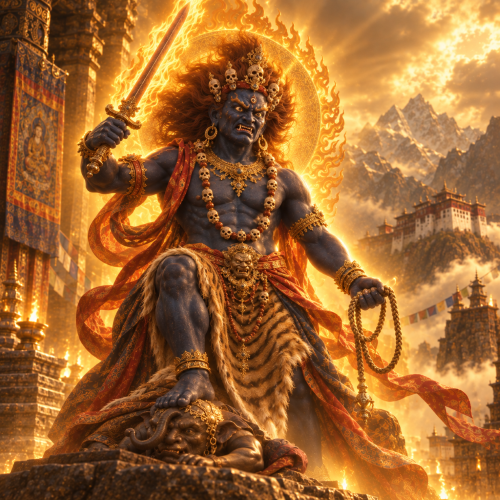
Acala is usually portrayed as a compact, intensely wrathful figure with a dark blue or blue-black body, three eyes, bared fangs, upward-flowing hair, and a powerful expression. Tibetan representations emphasize his fierce nature through exaggerated eyes, flames, weapons, and dynamic posture. One well-documented Tibetan image shows him with one face and two arms, holding a flaming wisdom sword in his raised right hand and a vajra lasso in his left.
The sword is his most recognizable attribute. It represents wisdom capable of cutting through ignorance, confusion, and the obstacles that prevent spiritual progress. His vajra lasso expresses another aspect of his protective function: forces that obstruct Buddhist practice are symbolically restrained rather than simply destroyed.
Flames surrounding Acala represent the force of awakened wisdom. They are not merely an indication of anger but a visual expression of the transformation of destructive passions and hindrances. In Tibetan iconography, Acala may stand or kneel, and some forms show him subduing Vighnaraja, the elephant-headed personification of obstacles. Other images show him kneeling on a lotus and sun seat, surrounded by blazing flames of pristine awareness.
His immovability is equally important. Whether seated, kneeling, or standing with extraordinary stability, Acala’s physical form communicates an unwavering mind that cannot be shaken by fear, distraction, or obstruction.
Family
Acala does not have a universally established family genealogy comparable to the gods and heroes of many mythological traditions. His identity is primarily defined through Buddhist tantric theology, ritual lineage, and relationships with other enlightened figures rather than through parents, spouses, or children.
Some Tibetan and Nepalese traditions do associate Acala with a consort, Viśvavajrī, and certain tantric representations show the pair in union. This association belongs to particular esoteric traditions and should not be treated as a universal feature of Acala’s mythology.
Acala’s relationship with other Buddhist figures also varies between traditions. In Tibetan Buddhism, he is represented as Miyowa, a wrathful protective deity with his own tantric practices. In Japanese Shingon Buddhism, however, Fudō Myōō is understood as a wrathful manifestation of Dainichi Nyorai, or Vairocana, and occupies a central position among the Five Wisdom Kings.
These differences demonstrate that Acala’s religious identity evolved as Buddhist tantric traditions moved across Asia. Rather than possessing one fixed genealogy, he exists within several interconnected systems of Buddhist sacred symbolism.
Other names
Acala is known by different names according to language, region, and ritual tradition. His Sanskrit name is Acala, meaning “Immovable” or “Unmoving,” while Acalanātha can be understood as “Lord of the Immovable.” He is also associated in tantric literature with names such as Caṇḍaroṣaṇa and Caṇḍamahāroṣaṇa, emphasizing his intensely wrathful nature.
In Tibetan, Acala is known as Miyowa (Mi g.yo ba). Tibetan artworks identify him explicitly by this name and portray him as a blue, wrathful deity holding the wisdom sword and vajra lasso.
In Chinese Buddhism he is known as Bùdòng Míngwáng, while in Japanese esoteric Buddhism he became Fudō Myōō, meaning the “Immovable Wisdom King.” The Japanese form became particularly prominent in Shingon and related esoteric traditions. The Metropolitan Museum of Art identifies Fudō Myōō directly with Sanskrit Acala Vidyārāja and describes him as the fierce protector of Buddhist teachings.
Powers and Abilities
Acala’s central power is the removal and subjugation of obstacles that interfere with Buddhist practice. His wrath is understood as compassionate and purposeful: it is directed toward forces, conditions, and defilements that obstruct awakening.
His flaming sword symbolizes wisdom cutting through ignorance and delusion, while his lasso represents the ability to restrain harmful or obstructive forces. His surrounding flames express the transformative power of awakened wisdom, consuming obstacles rather than representing uncontrolled destruction. Tibetan representations reinforce this symbolism by placing Acala amid fire and sometimes showing him overcoming Vighnaraja, the Lord of Hindrances.
Acala’s protective role is also connected with the preservation of the conditions necessary for spiritual practice. Tibetan tantric traditions contain specific practices devoted to him, and historical evidence shows that Acala-related ritual systems were transmitted through important Tibetan Buddhist teachers. His practice was particularly associated with Kriya Tantra, with Atisha playing an important role in its transmission in Tibet.
His fierce appearance should therefore not be interpreted as a symbol of evil. Within Buddhist iconography, wrathful deities frequently represent the forceful aspect of compassion: when peaceful methods are insufficient, wisdom takes a more uncompromising form. Acala embodies the capacity to remain completely unmoved while confronting whatever obstructs the path toward awakening.
Modern Day Influence
Acala remains an important figure in Buddhist art and religious practice, particularly through the closely related Tibetan form of Miyowa and the Japanese Fudō Myōō tradition. Tibetan paintings and sculptures continue to depict him with his characteristic blue body, flaming sword, lasso, fierce expression, and surrounding flames. These visual elements have remained remarkably recognizable across centuries of Buddhist artistic production.
His Japanese manifestation became especially influential. Fudō Myōō is one of the most widely represented figures among the Japanese Myōō, or Wisdom Kings. Japanese Buddhist art commonly portrays him standing or seated upon a rock and surrounded by flames, with a sword and lasso expressing his role as a protector of Buddhist teachings. The Metropolitan Museum describes him as a fierce protector who uses his sword to cut through ignorance and his lasso to restrain those who obstruct the path to enlightenment.
Fudō Myōō also became important in Shingon, Tendai, and Shugendō traditions, and his image remains visible at Japanese temples and in devotional art. His popularity demonstrates how the figure of Acala was adapted to different Buddhist environments while retaining the central idea of immovability.
Today, Acala’s imagery continues to appear in Tibetan and Himalayan Buddhist art, Japanese temple sculpture, religious paintings, contemporary Buddhist artwork, and popular representations of Buddhist iconography. His enduring appeal lies in a distinctive combination of frightening appearance and protective purpose: Acala looks like a force of destruction, yet his symbolism is ultimately directed toward overcoming ignorance, obstruction, and spiritual instability.
Related Images





Source
Byodoji. (n.d.). What is Acala (Fudō Myōō). https://byodoji.online/en/articles/acala
Drakorix. (2026, July 15). Acala — Buddhist deity of South/Southeast Asia mythology. https://drakorix.com/chronicles/acala
Obsidian Dragons. (2023, May 7). Acala, leader of the Vidyaraja, the 5 kings of Buddhist magical knowledge. https://obsidian-dragons.com/en/blogs/culture-bouddhiste/acala-chef-des-vidyaraja-les-5-rois-de-la-connaissance-et-des-sciences-magiques-bouddhistes
Tibetan Buddhist Encyclopedia. (n.d.). Acala. https://tibetanbuddhistencyclopedia.com/en/index.php/Acala
Tibetan Buddhist Encyclopedia. (n.d.). Arya Acalanatha Vidyaraja Sutra. https://tibetanbuddhistencyclopedia.com/en/index.php/Arya_Acalanatha_Vidyaraja_Sutra
Wisdom Compassion. (2019, September 19). Acala. https://wisdomcompassion.org/eng/mantrayana/acala/
Wisdomlib. (n.d.). Acala (अचल). https://www.wisdomlib.org/definition/acala
Wikipedia contributors. (2004, March 15). Acala. In Wikipedia. https://en.wikipedia.org/wiki/Acala
Frequently Asked Questions
Who is Acala in Tibetan mythology?
Acala is a wrathful Buddhist protector known in Tibetan as Miyowa. He represents immovable wisdom and is invoked in tantric traditions to overcome obstacles to Buddhist practice and awakening.
What does Acala symbolize in Buddhism?
Acala symbolizes unwavering wisdom, protection of the Dharma and the forceful removal of obstacles. His sword represents wisdom cutting through ignorance, while his flames represent purification.
Is Acala the same as Fudō Myōō?
Yes. Fudō Myōō is the Japanese esoteric Buddhist form of Acala. Japanese tradition developed distinctive teachings and iconography around him, especially within Shingon Buddhism.
Why does Acala hold a sword and lasso?
Acala’s sword represents wisdom cutting through ignorance and delusion, while his lasso symbolizes restraining harmful forces and obstacles that interfere with spiritual practice.
Is Acala the same as Dorje Jigje?
No. Dorje Jigje generally refers to Vajrabhairava, while Acala is known in Tibetan as Miyowa. They are distinct wrathful Buddhist deities with different tantric traditions.


