Classical Tibetan : The Sacred Literature of the Himalayas
| Description | |
|---|---|
| Culture | Tibetan |
| Writing System | Tibetan script |
| Key Epics | Buddhist Canon, Geser Khan |
| Symbolism | Sacred syllables, Dharma language |
| Age | ~900 CE onwards |
Mythlok Perspective
In Mythlok’s Perspective, Classical Tibetan was never just a literary language. It became a sacred bridge between mythology, philosophy, and spiritual practice across the Himalayas. Through epics, mantras, and monastic texts, it preserved a worldview where mountains, gods, and hidden realms were deeply interconnected. Its role can be compared to Sanskrit in India or Classical Greek in the ancient Mediterranean, yet Classical Tibetan remained uniquely tied to living ritual traditions and isolated mountain monasteries. Even today, the language carries a sense of sacred authority that extends far beyond ordinary communication.
Classical Tibetan
Introduction
Classical Tibetan is one of the most important literary languages in Asian history. Emerging from Old Tibetan during the era of the Tibetan Empire, it became the formal written language used for religion, philosophy, law, mythology, and historical records across the Himalayan world. Known as Chöke in Bhutan, the language remains deeply connected to Buddhist learning and ritual traditions even today.
Unlike many ancient literary languages that gradually disappeared from daily use, Classical Tibetan continued to survive through monasteries, scriptural study, and oral storytelling traditions. It became the primary medium for preserving Tibetan cosmology, sacred legends, and philosophical thought. Thousands of manuscripts written in Classical Tibetan still exist in monasteries and libraries throughout Tibet, Bhutan, Nepal, India, and Mongolia.
The language also holds immense historical value. Among Asian literary traditions, only Chinese possesses a comparably extensive written record spanning such a long period. Because of this continuity, Classical Tibetan provides scholars with a rare window into the political, religious, and mythological development of the Himalayan world over more than a thousand years.
Today, Classical Tibetan remains essential for anyone studying Tibetan Buddhism, Bon traditions, Himalayan mythology, or medieval Asian history. It continues to influence religious practice, scholarship, and modern cultural identity across Tibetan communities worldwide.
Geographic Context
The influence of Classical Tibetan extends across one of the largest high-altitude cultural regions on Earth. The language developed on the Tibetan Plateau but gradually spread throughout the Himalayan and Central Asian world through religion, trade, and scholarship.
Historically, Classical Tibetan became the literary language of Tibet, Bhutan, Ladakh, Sikkim, parts of Nepal, and several Himalayan kingdoms. It also reached Mongolia and sections of western China through Buddhist monastic networks. In many of these regions, local spoken dialects differed significantly, yet Classical Tibetan served as a shared written and religious language.
The expansion of Tibetan Buddhism played a major role in this spread. Monasteries translated Sanskrit Buddhist texts into Tibetan and distributed them throughout the Himalayas. As a result, Classical Tibetan became closely associated with sacred learning and spiritual authority. Monks, scholars, and pilgrims from distant regions often communicated through this literary language even when they spoke different native dialects.
Remote monasteries helped preserve the language for centuries. Ancient manuscripts survived in mountain temples, cliffside libraries, and isolated valleys where climate and geography protected fragile texts from destruction. These locations became cultural archives that safeguarded mythological narratives, ritual manuals, and historical chronicles through periods of political change and conflict.
Today, Classical Tibetan continues to be studied globally. Universities, Buddhist institutes, and research centers in Europe, North America, and Asia teach the language to scholars interested in religion, mythology, linguistics, and Himalayan history.
Script/Writing System
The Tibetan script was traditionally attributed to the 7th-century minister Thonmi Sambhota during the reign of King Songtsen Gampo. Historical evidence suggests that the script was influenced by northern Indian writing systems derived from Brahmi and Gupta scripts.
Classical Tibetan uses an alphabetic writing system consisting of thirty consonants and four primary vowel symbols. The inherent vowel “a” is built into consonant letters unless modified by vowel marks. One of the most distinctive features of the script is its stacked consonant structure, where letters combine vertically to create complex syllables.
The orthography of Classical Tibetan is highly conservative. Although spoken Tibetan dialects evolved dramatically over the centuries, the written language preserved older pronunciations from the early medieval period. Because of this, many written consonants became silent in modern speech while remaining visible in the script.
This conservative spelling system became valuable for preserving ancient religious terminology and mythological vocabulary. Sacred texts written centuries ago can still be read by trained scholars today, even if pronunciation has changed considerably.
Classical Tibetan grammar is also highly structured. Traditional grammar identifies multiple grammatical cases that clarify relationships between words within a sentence. These grammatical markers help create precision in philosophical and religious writing, especially in complex Buddhist commentaries and ritual texts.
Beyond communication, the script itself gained sacred importance. Tibetan letters appear on prayer flags, temple murals, ritual objects, and carved stones throughout the Himalayas. Written mantras are often believed to carry spiritual power, turning the visual form of the language into a religious symbol in its own right.
Mythological Texts Written
Classical Tibetan became the foundation for one of the richest mythological and religious literary traditions in Asia. The language preserved Buddhist scriptures, epic narratives, cosmological accounts, and indigenous Tibetan myths that shaped Himalayan spiritual culture.
The most significant collection is the Kangyur, which contains translated teachings attributed to the Buddha. Closely connected to it is the Tengyur, a vast body of commentaries and scholarly works. Together, these collections preserve religious stories involving celestial beings, sacred realms, karmic cycles, and cosmic battles between enlightened and destructive forces.
Another major literary tradition is the Epic of King Gesar, one of the world’s longest surviving epic narratives. The story blends mythology, heroism, folklore, and spiritual symbolism. Gesar appears as both a warrior king and a protector figure whose adventures reflect Tibetan ideals of courage, morality, and cosmic order.
Classical Tibetan also preserved texts connected to the Bon tradition, the indigenous spiritual system of Tibet. Bon mythological literature includes stories of creation, divine beings, sacred mountains, and supernatural journeys through hidden realms. These narratives reveal how local beliefs merged with Buddhist cosmology over time.
Treasure texts known as terma became another defining feature of Tibetan mythology. According to tradition, spiritual masters concealed sacred teachings to be rediscovered in later centuries by destined revealers called tertöns. These revelations added new layers of myth, prophecy, and sacred history to Tibetan religious literature.
Transmission & Preservation
The survival of Classical Tibetan literature depended on both written preservation and oral transmission. Monasteries played a central role in copying manuscripts, teaching pronunciation, and maintaining ritual recitation traditions.
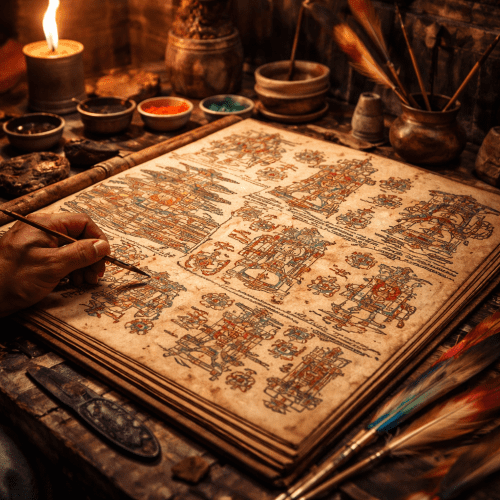
Before printing technology became widespread, scribes carefully reproduced texts by hand using ink on paper prepared from Himalayan plants. Producing sacred manuscripts was considered a religious act that generated spiritual merit.
Woodblock printing later transformed preservation efforts. Monastic printing centers created thousands of copies of important scriptures and distributed them across the Himalayan region. Some of the most famous printing houses emerged in Derge and other Tibetan cultural centers.
Oral tradition remained equally important. Epic stories such as the Epic of King Gesar survived through generations of performers who memorized vast portions of the narrative. This combination of oral and written transmission helped protect the literature even during times of political upheaval.
Modern preservation efforts now include digital archives, linguistic databases, and computational research projects. Institutions worldwide are scanning manuscripts and building searchable collections to ensure that Classical Tibetan texts remain accessible for future generations.
Symbolism & Cultural Role
Classical Tibetan carries deep symbolic importance within Himalayan culture. For many communities, the language represents spiritual continuity, cultural memory, and religious identity.
Its association with sacred teachings gave the language enormous prestige. Reading and reciting Classical Tibetan texts became closely linked to religious education and moral authority. Even individuals who could not fully understand the language often viewed it with reverence because of its spiritual significance.
The language also shaped cultural unity across geographically isolated Himalayan regions. Different communities maintained unique spoken dialects and local customs, yet Classical Tibetan provided a shared literary and religious foundation.
Many Tibetan myths describe the landscape itself as sacred. Mountains, lakes, caves, and valleys appear throughout Classical Tibetan literature as homes of deities, spirits, and enlightened beings. In this way, the language helped connect mythology directly to physical geography.
Comparative Analysis
Classical Tibetan differs from other Asian literary traditions in several important ways. Unlike Sanskrit, which originated in ancient India, Classical Tibetan emerged later and developed alongside a living monastic culture that remained active for centuries. Compared to Classical Chinese, Tibetan literary texts are generally more descriptive and narrative-driven. Tibetan mythological works frequently combine philosophy with vivid depictions of celestial realms, divine beings, and ritual journeys.
The language also preserved a stronger connection between oral storytelling and written literature than many other classical traditions. This helped maintain the emotional and performative aspects of mythological narratives. Modern spoken Tibetan dialects evolved significantly from the classical form, developing tonal systems and simpler grammatical structures. Despite these changes, Classical Tibetan remains remarkably stable as a literary language.
Modern Influence
The influence of Classical Tibetan continues in the modern world through religion, scholarship, literature, and popular culture. Monasteries across India, Nepal, Bhutan, and Tibet still teach the language to monks and students studying Buddhist philosophy and ritual traditions. International scholars rely on Classical Tibetan to access primary sources related to Buddhism, mythology, medicine, astronomy, and Himalayan history. New translations continue to introduce Tibetan literature to global audiences.
Modern writers have also developed “neo-classical” literary styles that blend traditional Tibetan grammar with contemporary themes. This allows the language to remain culturally relevant while preserving its historical roots. In global popular culture, Tibetan scripts and mythological motifs appear in films, fantasy literature, graphic novels, and spiritual movements. Yet beneath these modern adaptations lies a literary tradition that has preserved Himalayan sacred knowledge for over a thousand years.

Sources
Britannica. (2023). Tibetan language. In Encyclopædia Britannica. https://www.britannica.com/topic/Tibetan-language
Thonmi Sambhota and the origins of Tibetan script. (n.d.). In Wisdomlib – Tibet: Myth, Religion and History. https://www.wisdomlib.org/history/essay/tibet-myth-religion-and-history/d/doc1146109.html
Wikipedia. (2023). Classical Tibetan. In Wikipedia. https://en.wikipedia.org/wiki/Classical_Tibetan
Wikipedia. (2023). Tibetan script. In Wikipedia. https://en.wikipedia.org/wiki/Tibetan_script
Tibetan Buddhist canon. (2023). In Wikipedia. https://en.wikipedia.org/wiki/Tibetan_Buddhist_canon
Tibetan literature. (2023). In Wikipedia. https://en.wikipedia.org/wiki/Tibetan_literature
Tonpa Shenrab Miwoche. (2023). In Wikipedia. https://en.wikipedia.org/wiki/Tonpa_Shenrab_Miwoche
Namkhai, N. (2022). Tibet: Myth, religion and history (Chapters on language and Tonpa Shenrab). Wisdomlib. https://www.wisdomlib.org/history/essay/tibet-myth-religion-and-history
Library of Tibetan Classics. (2021). Library of Tibetan Classics project. Wisdom Publications. https://wisdomexperience.org/library-of-tibetan-classics/
Transmission of the Tibetan Kanjur. (2023). Academia.edu research collection. https://www.academia.edu/Documents/in/Transmission_of_the_Tibetan_Kanjur
Classical Tibetan, texts, and translation. (2024). Maitripa College guide. https://maitripa.org/library/subject-guides/classical-tibetan-texts-and-translation/
Visualising the tradition, preserving history: Material practices in Tibetan Buddhism. (n.d.). Humboldt University research project. https://inherit.hu-berlin.de/projects/visualising-the-tradition-preserving-history-material-practices-in-tibetan-buddhism
Frequently Asked Questions
What is Sanskrit and why is it important?
Sanskrit is a classical Indo-Aryan language that preserved India’s sacred texts, myths, and philosophies with exceptional accuracy.
Is Sanskrit still used today?
Yes, it is actively used in rituals, academic study, and cultural practices, and its texts continue to influence modern thought.
Why is Sanskrit called the language of the gods?
Because it was believed to carry divine sound vibrations and was used for sacred hymns, mantras, and ritual communication with the cosmos.
Which scripts are used to write Sanskrit?
Sanskrit has been written in many Brahmic scripts, with Devanāgarī being the most widely used today.
How did Sanskrit influence other cultures?
Through trade, religion, and scholarship, it shaped mythologies, royal ideology, and philosophy across South and Southeast Asia.