
Classical Egyptian : The Language of Ancient Egyptian Religion and Myth
Mythlok Perspective
In Mythlok’s Perspective, Classical Egyptian demonstrates how a language can become far more than a means of communication. Ancient Egyptians believed that words possessed the power to create, protect, and sustain reality itself. This transformed writing into a sacred act and elevated language to a cosmic force. A useful comparison can be made with Sanskrit in India and Classical Chinese in East Asia. Like Classical Egyptian, both became prestigious literary languages that preserved religious and philosophical traditions long after spoken forms evolved. Yet Classical Egyptian stands apart because its writing system was itself considered divine.
Classical Egyptian
Introduction
Classical Egyptian, commonly known as Middle Egyptian, was the literary and religious form of the Egyptian language that flourished during the Middle Kingdom, roughly between 2055 and 1650 BCE. Although everyday speech continued to evolve over the centuries, Classical Egyptian retained its status as the preferred language for religious inscriptions, royal monuments, funerary literature, and sacred texts for more than a thousand years.
In ancient Egypt, language was far more than a tool for communication. Egyptians believed that words possessed creative and divine power. Speaking, writing, or reciting sacred texts was thought to influence reality itself. This belief made Classical Egyptian central to mythology, religion, kingship, and funerary practices. Through this language, priests recorded creation stories, hymns to the gods, magical spells, and guidance for the dead entering the afterlife.
Because many of Egypt’s most important religious texts were preserved in Classical Egyptian, it remains one of the most valuable sources for understanding ancient Egyptian beliefs and mythology today.
Geographic Context
The development of Classical Egyptian was closely tied to the Nile Valley, the lifeline of ancient Egyptian civilization. Stretching from the Mediterranean Delta in the north to the regions bordering Nubia in the south, the Nile provided fertile farmland surrounded by vast deserts. This unique landscape deeply influenced Egyptian religious thought.
Egyptians viewed the fertile lands along the river as symbols of order, prosperity, and life. In contrast, the surrounding deserts represented uncertainty, danger, and chaos. These opposing forces became reflected in the concepts of maat and isfet. Maat represented cosmic balance, justice, and harmony, while isfet embodied disorder and destruction.
Several major religious centers played key roles in preserving and transmitting sacred traditions through Classical Egyptian. Heliopolis was associated with solar creation myths, Memphis with the creator god Ptah, Thebes with Amun, and Abydos with Osiris and the cult of the dead. The language helped unify these diverse traditions across Egypt, allowing myths and religious teachings to be shared throughout the kingdom.
Script/Writing System
Classical Egyptian was recorded using multiple writing systems, each designed for specific purposes. The most recognizable script was hieroglyphic writing. These detailed pictorial signs adorned temple walls, tombs, monuments, and royal inscriptions. Egyptians referred to hieroglyphs as mdw-nṯr, meaning “words of the gods,” emphasizing their sacred significance.
Alongside hieroglyphs, scribes used Hieratic, a faster cursive script written with ink on papyrus. Hieratic became the primary medium for literary works, administrative documents, religious manuscripts, and educational texts.
In later periods, Demotic emerged as a simplified script used for legal records, administration, and magical writings. Eventually, the Egyptian language evolved into Coptic, which employed the Greek alphabet supplemented by several Demotic characters. Coptic remains in use today within the Coptic Orthodox Church. The Egyptian writing system combined phonetic signs, determinatives, and symbolic imagery, allowing texts to communicate both literal and spiritual meanings simultaneously.
Mythological Texts Written
Some of the most influential religious and mythological works in human history were preserved in Classical Egyptian. The earliest major collection was the Pyramid Texts, inscribed inside royal pyramids during the Old Kingdom. These texts contained spells and prayers intended to help deceased pharaohs ascend to the heavens and join the gods.
During the Middle Kingdom, the Coffin Texts expanded access to afterlife knowledge beyond royalty. Nobles and officials could now include sacred spells within their coffins, reflecting changing beliefs about the afterlife.
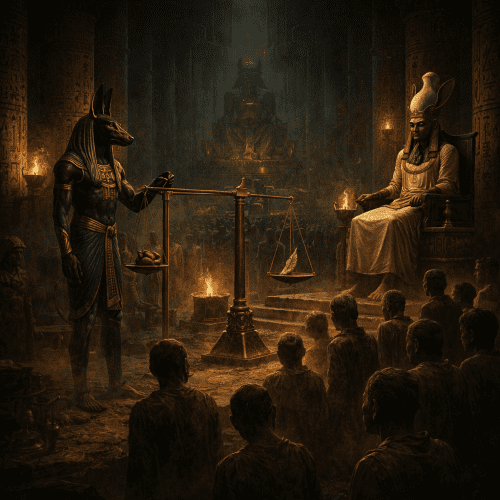
The most famous funerary work, the Book of the Dead, emerged during the New Kingdom. Rather than being a single book, it consisted of collections of spells, illustrations, and rituals designed to guide souls through the dangers of the underworld and the judgment before Osiris.
Other important compositions included the Book of Gates, the Amduat, creation hymns, temple liturgies, and theological texts such as the Memphite Theology. Together, these works preserved stories about the gods, creation of the cosmos, divine kingship, and the journey beyond death.
Transmission & Preservation
The survival of Classical Egyptian literature depended largely on Egypt’s highly trained scribal class. Scribes underwent years of education to master reading and writing, making them among the most respected members of society.
Religious and literary texts were copied onto papyrus scrolls, wooden tablets, ostraca, and stone monuments. Temple libraries served as centers of learning where priests preserved sacred manuscripts and maintained religious traditions.
One remarkable feature of Classical Egyptian was its longevity. Even after Late Egyptian became the spoken language, priests continued to write religious works in the older Classical form. This practice resembled the continued use of Latin in medieval Europe long after it ceased being a common spoken language.
Oral recitation also played a crucial role in preservation. Hymns, rituals, and funerary texts were regularly spoken during ceremonies, helping maintain their authority and continuity across generations.
Symbolism & Cultural Role
Classical Egyptian occupied a unique position within Egyptian culture because language itself was viewed as sacred. The god Thoth, patron of wisdom, writing, and knowledge, was credited with giving writing to humanity. Words carried spiritual power and could influence both earthly and divine realms. Correctly spoken prayers and rituals were believed to sustain maat, the cosmic order that maintained balance throughout the universe.
Writing also reinforced royal authority. Pharaohs used inscriptions to proclaim their divine status, commemorate victories, and establish connections with the gods. The cartouche, an oval enclosing a royal name, became a powerful symbol of sacred kingship and protection.
Many symbols found in Classical Egyptian texts continue to be recognized worldwide today. The ankh represented life, the Eye of Horus symbolized healing and protection, and the scarab beetle embodied renewal and rebirth. Through language and imagery, these symbols became enduring expressions of Egyptian spirituality.
Comparative Analysis
Classical Egyptian shares certain characteristics with other ancient writing traditions while maintaining several unique features. Mesopotamian cuneiform was similarly used to record myths, religious narratives, and administrative records. However, Egyptian writing integrated visual symbolism more deeply into its religious worldview, giving individual signs theological significance beyond their phonetic value.
Ancient Greek literature focused increasingly on philosophy, drama, and historical narrative. Egyptian religious texts, by contrast, maintained a strong ritual function and remained closely connected to temple worship throughout their history.
As a member of the Afro-Asiatic language family, Egyptian shared distant linguistic relationships with languages such as Hebrew, Arabic, and Akkadian. Despite these connections, Egyptian developed a distinctive grammatical structure and symbolic writing tradition that set it apart from its linguistic relatives.
Modern Influence
The legacy of Classical Egyptian continues to influence scholarship, religion, and popular culture. The decipherment of hieroglyphs by Jean-François Champollion in 1822, aided by the Rosetta Stone, transformed the study of ancient Egypt. Scholars could finally read texts that had remained silent for centuries.
Today, Classical Egyptian forms the foundation of Egyptological research. Students and researchers learn Middle Egyptian to access temple inscriptions, funerary literature, historical records, and mythological narratives in their original form.
The language also survives indirectly through Coptic liturgy, preserving echoes of ancient Egyptian speech within modern religious practice. Beyond academia, Egyptian symbols, gods, and myths remain popular in films, novels, video games, museums, and visual art. Their enduring appeal reflects humanity’s fascination with ancient wisdom, immortality, and the mysteries of the afterlife.


Sources
Bibliotheca Alexandrina. (n.d.). Scripts of the ancient Egyptian language. https://www.bibalex.org/learnhieroglyphs/lesson/LessonDetails_En.aspx?l=20
Britannica. (2026, March 5). Ancient Egyptian religion: History, rituals, gods, beliefs, & facts. https://www.britannica.com/topic/ancient-Egyptian-religion
David, R. (2021). Religion and gods in ancient Egypt. The Australian Museum. https://australian.museum/learn/cultures/international-collection/ancient-egyptian/religion-and-gods-in-ancient-egypt/
Fitzwilliam Museum. (2025, August 14). The Book of the Dead. https://book-of-the-dead.fitzmuseum.cam.ac.ac/explore/book-of-the-dead/funerary-literature
Omniglot. (n.d.). Ancient Egyptian scripts (hieroglyphs, hieratic and demotic). https://www.omniglot.com/writing/egyptian.htm
Simpson, W. K. (1996). Ancient Egyptian literature. World History Encyclopedia. https://www.worldhistory.org/Egyptian_Literature/
Wikipedia. (2002, March 30). Egyptian language. https://en.wikipedia.org/wiki/Egyptian_language
Wikipedia. (2005, October 23). Ancient Egyptian funerary texts. https://en.wikipedia.org/wiki/Ancient_Egyptian_funerary_texts
Breasted, J. H. (1912). Development of Religion and Thought in Ancient Egypt. New York: Scribner.
Budge, E. A. W. (1895). The Egyptian Book of the Dead. London: British Museum.
Mark, J. J. (2016). Ancient Egyptian Literature. World History Encyclopedia.
Mercer, S. A. B. (1952). The Pyramid Texts. New York: Longmans.
Frequently Asked Questions
What is Classical Egyptian?
Classical Egyptian, or Middle Egyptian, was the literary and religious form of the Egyptian language used from the Middle Kingdom onward.
Was Classical Egyptian a spoken language?
Originally yes, but it later survived mainly as a sacred and literary language after spoken Egyptian evolved.
What texts were written in Classical Egyptian?
Major works include the Coffin Texts, Book of the Dead, religious hymns, wisdom literature, and temple inscriptions.
Why were hieroglyphs considered sacred?
Egyptians called hieroglyphs “words of the gods” and believed writing possessed divine and magical power.
How was Classical Egyptian deciphered?
The language was deciphered in 1822 by Jean-François Champollion using the Rosetta Stone as a key to understanding hieroglyphs.