

Isis and Osiris : The Love Story That Conquered Death
| Description | |
|---|---|
| Origin | Egyptian Mythology |
| Story Title | The Resurrection of the Divine King |
| Main Characters | Isis, Osiris, Set, Horus, Nephthys, Anubis, Thoth |
| Type of Ending | Bittersweet |
| Symbolism | Death and rebirth, Eternal love |
Mythlok Perspective
In Mythlok’s View, Isis and Osiris represent transformation rather than simple resurrection. Their story reflects a deeper truth that endings reshape existence instead of reversing it. Similar to Persephone and Inanna, the descent and return motif reveals how life emerges from cycles of loss. Across cultures, this myth echoes a universal idea: death is not the opposite of life, but part of its continuity.
Isis and Osiris
Introduction
The story of Isis and Osiris stands among the most powerful narratives of ancient Egypt, blending love, loss, kingship, and cosmic balance. More than a divine romance, it is a foundational myth that explains death, resurrection, and the eternal cycle of life. Osiris, remembered as a just ruler, brought order, agriculture, and law to Egypt. His tragic death at the hands of his brother Set shattered this harmony, but Isis’s relentless devotion restored it in a new form.
This myth is not just about resurrection; it is about transformation. Osiris does not return to the world of the living as before but becomes ruler of the afterlife, while Isis ensures continuity through their son Horus. Preserved across sources like the Pyramid Texts, Coffin Texts, and later accounts such as Plutarch’s On Isis and Osiris, the story reflects the Egyptian belief that life persists through change, not despite it.
Characters Involved
At the center of this myth are deeply symbolic figures whose roles extend beyond narrative into cosmic principles.
Osiris embodies kingship, fertility, and rebirth. Often depicted with green skin, he represents vegetation and renewal, linking his fate to the cycles of the Nile. As one of the earliest deities associated with mummification, his transformation into the lord of the underworld defines Egyptian views of death.
Isis, his sister and wife, represents magic, motherhood, and protection. She is not a passive consort but an active force who restores order through knowledge and determination. Her throne-shaped headdress symbolizes her role as the foundation of kingship itself.
Set, the antagonist, represents chaos, storms, and the desert. His actions are not random but embody the ever-present threat of disorder against cosmic balance. His murder of Osiris is both a personal betrayal and a cosmic disruption.
Horus, the son of Isis and Osiris, symbolizes rightful kingship and restoration. His eventual victory over Set is not just revenge but the re-establishment of order. Supporting figures such as Nephthys, Anubis, and Thoth each contribute to the restoration process, especially in the development of funerary traditions and sacred rituals.
Story Summary
The myth begins with Osiris ruling Egypt as a wise and benevolent king. His reign brings prosperity, teaching humanity agriculture and moral order. However, Set, driven by jealousy and ambition, plots his downfall. He crafts a beautifully decorated chest and presents it at a feast, promising it to whoever fits perfectly inside. When Osiris lies in it, Set seals the chest and casts it into the Nile.
Isis, devastated but determined, begins her search. Her journey takes her beyond Egypt to Byblos, where the chest has become embedded in a tree. She retrieves Osiris’s body and returns, only for Set to discover it. In a final act of violence, Set dismembers Osiris and scatters the pieces across Egypt.
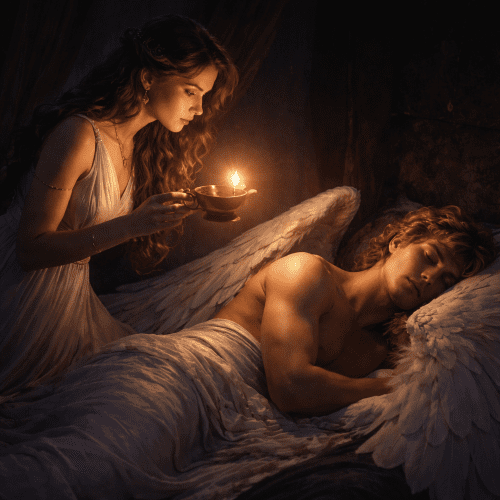
Refusing defeat, Isis, aided by Nephthys, searches tirelessly for the fragments. She recovers almost all of them, reconstructing Osiris’s body. With the help of sacred magic and divine assistance, she revives him briefly. During this moment, she conceives Horus.
Osiris, however, cannot remain among the living. Instead, he becomes the ruler of the underworld, presiding over the dead. Horus grows under Isis’s protection and eventually confronts Set. Their conflict ends with Horus reclaiming the throne, restoring balance to the world.
Epics & Poems
Unlike epics such as those of Mesopotamia or Greece, the story of Isis and Osiris survives through a collection of religious texts rather than a single narrative work. The earliest references appear in the Pyramid Texts of the Old Kingdom, where Osiris’s death and resurrection are already central themes.
The Coffin Texts expand these ideas, making them accessible beyond royalty and emphasizing the possibility of resurrection for all. The Book of the Dead further develops Osiris’s role as judge of the dead, guiding souls through the afterlife.
The most detailed continuous narrative comes from Plutarch, whose account synthesizes Egyptian traditions with Greek interpretation. While not entirely faithful to original Egyptian beliefs, his version preserves key elements such as the chest, dismemberment, and Isis’s quest.
Symbolism
The myth operates on multiple symbolic levels, making it one of the richest narratives in ancient belief systems. Osiris’s death and rebirth mirror the annual flooding of the Nile, where apparent destruction leads to renewal. His green skin represents vegetation, reinforcing this agricultural connection. Isis symbolizes protective magic, known as heka, which sustains life and restores order. Her actions demonstrate that knowledge and devotion can overcome even death.
The dismemberment of Osiris is often interpreted as reflecting fragmentation in nature or society, while his reassembly represents restoration. The missing phallus, replaced symbolically, emphasizes creation through transformation rather than completeness. At a philosophical level, the myth expresses the tension between ma’at (order) and isfet (chaos). Osiris and Horus uphold balance, while Set represents the forces that threaten it.
Cultural Variations
The story of Isis and Osiris evolved across regions and time periods within Egypt. Different traditions vary in the number of pieces Osiris was cut into, ranging from fourteen to forty-two, possibly reflecting lunar cycles or administrative divisions of Egypt.
In Abydos, Osiris was primarily worshipped as the ruler of the dead, with elaborate tomb rituals reenacting his story. In Philae, Isis’s magical role was emphasized, especially in relation to protection and healing.
During the Ptolemaic period, Greek influence reshaped the myth. Osiris was associated with Dionysus, while Isis was linked to Demeter. The creation of Serapis further blended Egyptian and Greek religious ideas, expanding the myth’s reach across the Mediterranean.
Associated Practices
The myth deeply influenced Egyptian religious practices, particularly funerary rituals. Mummification itself is rooted in the reassembly of Osiris, symbolizing the preservation of the body for eternal life.
Festivals such as Khoiak reenacted Osiris’s death and rebirth through ritual drama. “Osiris beds,” made of soil and seeds, symbolized regeneration as plants grew from them. Priests followed strict purity rules, wearing linen and avoiding certain foods. Rituals involving water, incense, and offerings reflected the belief that Osiris’s life force was tied to the Nile.
The widespread worship of Isis extended beyond Egypt, with temples dedicated to her across the Roman world, highlighting her universal appeal as a protective and maternal figure.
Modern Influence
The story of Isis and Osiris continues to shape modern culture, appearing in films, literature, and games that explore themes of resurrection and eternal love. Its influence can be seen in narratives that deal with death and rebirth, often echoing Osiris’s transformation.
Isis, in particular, has been reinterpreted as a symbol of feminine strength and resilience. Her role as a restorer of life and protector of her child resonates strongly in contemporary discussions of leadership and empowerment. Scholars and psychologists have also drawn on this myth, especially in Jungian interpretations of death and renewal as essential processes of transformation.


Sources
Egypt Tours Portal. (2018). The Egyptian mythology story of Osiris. https://www.egypttoursportal.com/en-us/the-egyptian-mythology-story-of-osiris/
Study.com. (2024). Osiris, Egyptian god of the underworld | Symbol, story & powers. https://study.com/academy/lesson/the-egyptian-god-osiris-facts-symbol.html
Anubis Aeon. (2024). Exploring the myth of Osiris and Isis in ancient Egyptian beliefs. https://anubisaeon.com/myth-of-osiris-and-isis-3/
University of Chicago. (n.d.). Plutarch: Isis and Osiris (Part 1 of 5). https://penelope.uchicago.edu/Thayer/E/Roman/Texts/Plutarch/Moralia/Isis_and_Osiris*/A.html
Plutarch. (1936). Isis and Osiris (B. P. Grenfell, Trans.). In J. G. Frazer (Ed.), Loeb classical library (Vol. 5). Harvard University Press. (Original work published ca. 100 CE)
Budge, E. A. W. (1912). Legends of the gods: The Egyptian texts. British Museum.
Witt, R. E. (1997). Isis in the ancient world. Johns Hopkins University Press. (Original work published 1971)
Macksey Journal. (n.d.). The transnational reach of the Osiris myth in the Hellenistic world. https://mackseyjournal.scholasticahq.com/article/91228.pdf
Frequently Asked Questions
Who were Isis and Osiris?
Isis and Osiris were central Egyptian deities symbolizing magic, kingship, death, and rebirth, forming one of the most important divine pairs.
Why did Set kill Osiris?
Set killed Osiris out of jealousy and a desire for power, representing chaos opposing divine order.
How did Isis revive Osiris?
Isis used powerful magic to reassemble and briefly resurrect Osiris, enabling the birth of Horus.
What does the myth symbolize?
It represents death and rebirth, the Nile’s cycles, and the eternal struggle between order and chaos.
Why is Osiris important in the afterlife?
Osiris became the ruler and judge of the dead, guiding souls and ensuring justice in the afterlife.